At Google I/O 2026, Google made it official: Search is receiving its biggest upgrade in over 25 years. And it’s a fundamental reimagining of what search is, what it does, and who (or what) it serves.
Generative AI is shifting how people create and find content. And Google just made that shift impossible to ignore.
We're watching Search evolve from a list of blue links into an AI-powered answer and action engine. One that openly interacts with the information it receives. Understanding it, reasoning with it, and acting on it.
For marketers, content creators, and B2B business owners, this is a shift worth paying attention to. Because deciding to ignore it could have you playing catch-up six months from now.
So, consider this your guide to understanding what changed about Google Search, why it matters, and what you should do about it.
The Big Picture: Search Is Becoming an AI Operating System
Google's vision for search has always been ambitious. But what was announced at I/O 2026 goes beyond search as we've known it.
Search is graduating from being a “retrieval tool" and becoming an AI workspace instead. It’s capable of understanding context, reasoning through complexity, and completing tasks on behalf of users. Google calls this "agentic search," and it represents a shift in how information is discovered, processed, and acted upon.
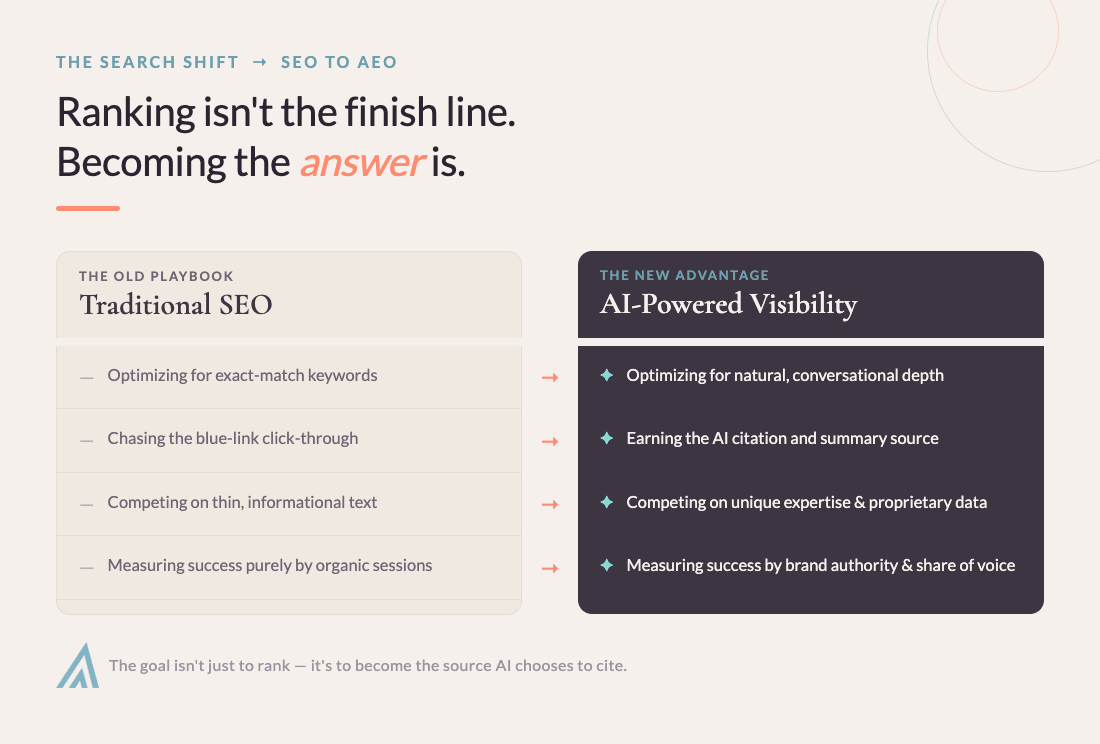
For marketers, this changes a core question. Instead of asking, “Do we rank?” we should be asking, “Are we a source that AI trusts?”
So, traditional SEO metrics (rankings, click-through rates, organic sessions) will become harder to rely on as the primary measure of visibility. Still important, but not as the main focus.
Update #1: The Search Box Just Got Its Biggest Redesign Ever
A Shift From Keywords to Conversations
Your thinking pathways don’t always fit within black and white. And human thought has always existed in shades of grey. That’s why Google's new intelligent search box is built to align with how you think. Users can now submit longer, more natural prompts. You can ask complex, multi-layered questions that would have broken traditional search queries.
And this is important because it changes what "good content" looks like. Comprehensive topical coverage now outweighs exact-match keyword targeting. If your content only answers one narrow question, it may not be enough.
Multimodal Search Becomes Standard
Text is no longer the only way to search. Users can now search with images, documents, videos, and even open Chrome tabs. Search behavior is expanding, and so is the surface area your content needs to cover.
Formerly considered secondary to written content, visual and multimedia assets are now first-class SEO considerations.
What This Means for SEO
Now, your focus should be on content depth over keyword density.
Here’s the kind of content that will win: content answering the full scope of a topic, not just the head term.
Also, start thinking about how your visual assets, videos, and documents align with your written content (and how they show up in searches). Because now, your audience has more ways to find you than ever before.
Update #2: AI Mode Is Becoming the Default Search Experience
What Is AI Mode?
AI Overviews were only the warm-up. Now, AI Mode is the main event. It creates a specific, tailored-to-you conversational search experience.
You can type in your question exactly how you think, and AI Mode thinks through it with you. Now, users can keep the conversation going without starting over — creating a search dialogue conversation that’s interconnected.
Gemini 3.5 Flash Powers Search
AI Mode runs on Gemini 2.5 Flash, Google's new default AI model built for speed and sophistication. It handles complex, multi-layered queries with faster reasoning and sharper contextual understanding. Meaning, the answers Search generates are more specific, accurate, and create less space for thin content.
What This Means for Website Traffic
Zero-click searches will increase. When AI Mode surfaces a direct, conversational answer, fewer users click through to source websites. Informational content (built to answer a quick question and earn a visit) faces its stiffest competition yet.
The focus shifts from earning the click to earning the citation. Brands getting referenced by AI Mode will have a meaningful advantage over those optimizing only for traditional rankings.
Update #3: Search Agents Can Now Do Work for Users
What Are Search Agents?
Search agents are AI systems that perform tasks on behalf of users. They conduct persistent, ongoing research and monitoring, checking in on topics, tracking changes, and surfacing relevant updates without being asked twice.
Examples Announced at I/O
Google demonstrated search agents handling real workflows: tracking topics and events as they develop, monitoring products for price changes or availability, gathering updates automatically over time, and completing multi-step research that would otherwise take hours of manual effort.
Why This Changes Digital Marketing
Your future online audience may be an AI agent before it's a human. These agents are evaluating your content, your credibility, and your authority on behalf of the people you're trying to reach.
This means businesses need machine-readable content that AI can parse and trust. Meaning, clear structure, strong entity signals, and demonstrated expertise aren't just SEO best practices. In fact, this proves that authority and trust signals have never mattered more.
Update #4: Search Can Now Generate Interactive Experiences
Search Is Becoming Dynamic
Search results no longer feel one-dimensional and static.
Google is now generating AI-powered visualizations, interactive layouts, and dynamic interfaces built directly from search queries. This means it’s assembling experiences on the fly rather than returning a list of links to existing pages.
The Rise of Search-Powered Mini Apps
At I/O, Google demonstrated how Search can now create mini-apps within itself, without users ever visiting a third-party website.
A few examples include:
- Travel planners
- Budget calculators
- Fitness trackers
- Project dashboards
Implications for Content Marketers
Static articles are now competing with dynamic AI-generated experiences for the same search real estate.
Interactive tools (calculators, assessments, configurators) become significantly more valuable as a result. And content strategy needs to shift toward supporting task completion, not just delivering information. If your content doesn't help a user accomplish something, it's easier than ever for AI to replace it with something that does.
Update #5: Shopping Is Moving Closer to Google’s Ecosystem
Introducing Universal Cart
Google introduced Universal Cart, which is a unified shopping experience that connects Search, Gemini, YouTube, and Gmail under one checkout flow. Users can browse, compare, and purchase across Google's properties without ever leaving the ecosystem. Whether you sell physical products or not, Google is making its intent clear: keep users inside Google longer.
What This Means for Ecommerce Brands
Structured product data is now a front-line visibility asset. Product feeds become critical for appearing where buyers are making decisions, and visibility inside Google's ecosystem may matter more than traffic to your own website.
Implications for SEO and Paid Media
Product schema, Merchant Center optimization, and local inventory data are now most important. Brands that haven't treated these as priorities will find themselves invisible in the spaces where Google is consolidating commerce.
What Google I/O 2026 Means for SEO
SEO Isn’t Dead, But It Is Changing
After reading to this point, you might think SEO is no longer relevant. But it is. In fact, Google's AI-powered search experiences make it more demanding. The fundamentals of SEO still hold, but what's shifting is what those fundamentals reward.
What Matters More:
- Demonstrated expertise
- Original insights
- Author credibility
- Brand authority
- Structured data
- Entity optimization
What Matters Less:
- Exact-match keyword targeting
- Thin informational content
- Producing content solely for rankings
The New Goal: Become a Source AI Trusts
The new benchmark for ranking success is this: search experiences built on authoritative, trustworthy content — sources that can be surfaced, summarized, and cited with confidence.
Here are a few ways to create sources that AI trusts:
- Use E-E-A-T (Experience, Expertise, Authoritativeness, and Trustworthiness) - has always been Google's quality framework. In an AI-first search environment, it becomes the deciding factor.
- Prioritize Digital PR and earned brand mentions - these both signal to AI systems that your brand is referenced and respected beyond your own domain.
- Thought leadership content (original perspectives, proprietary research, expert commentary) - gives AI something worth citing.
- Multi-platform visibility - being visible across LinkedIn, YouTube, industry publications, and podcasts expands the footprint AI can draw from when building answers.
The brands that invest in all of the above will be the sources AI reaches for first.
How Businesses Should Respond Right Now
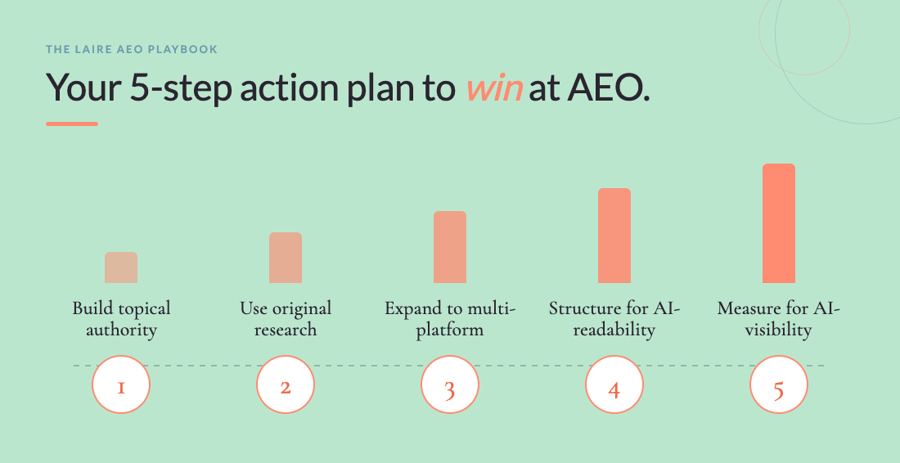
1. Build Topical Authority, Not Just Rankings
Having content clusters and pillar pages that comprehensively cover a topic signal authority to both human readers and AI systems. Go deep, not just broad.
2. Invest in Original Research and Perspectives
Proprietary data, case studies, and expert commentary are the content AI is most likely to surface and cite. Generic content will blend in, and original insight will stand out.
3. Expand Beyond Your Website
LinkedIn, YouTube, industry publications, podcasts, and PR opportunities all contribute to your brand's presence in AI-powered search. If you only exist on your own domain, you’ll likely struggle with visibility.
4. Structure Content for AI Consumption
Clear headings, FAQ sections, schema markup, and entity-based SEO make your content easier for AI systems to parse, reference, and recommend. If AI can't easily read your content, it won't cite it.
5. Measure Visibility Beyond Organic Traffic
AI citations, brand mentions, share of voice, and referral sources matter most in this new environment. Organic traffic alone won't tell the full story.
The Future of Search Is About Visibility, Not Just Rankings
Google's direction is clear: AI is becoming the primary interface for information discovery. And Search is evolving from information retrieval to reasoning and action.
Rankings still hold their weight. But being referenced, cited, and trusted by AI systems is becoming equally important. The companies that build genuine expertise, invest in brand authority, and structure their content for the AI era will be the ones that stay visible.
So, don’t let the Google I/O 2026 search updates give you a reason to panic. Let them fuel a fire to sharpen your strategy.
Ready to find out where your brand stands in AI-powered search? Book a 20-minute AI Readiness Assessment with the LAIRE team.