TABLE OF CONTENTS
What Is “Slow Marketing”? | Why “Slower” Is Faster for Growth | “Smarter” Measurement | Human-in-the-Loop | 3 Pillars for Financial Marketing Success
The average consumer is now hit with hundreds, if not thousands, of AI-powered messages every single day. And financial services buyers, especially high-net-worth (HNW) individuals, sophisticated investors, and institutional buyers, have developed a finely tuned filter for all of it.
They’re not impressed by rapid-fire campaigns or algorithmically personalized pitches. They’re looking for something harder to manufacture: credibility.
That’s exactly why the most effective financial marketers in 2026 aren’t racing to keep up with automation. They’re doing the opposite. They’re slowing down, being more deliberate, and using strategy, not just speed, to build the kind of trust that converts HNW prospects into long-term clients.
We call this approach slow marketing. And in a world flooded with cheap AI content, it’s one of the biggest competitive advantages a financial firm can have.
What Is “Slow Marketing” for Financial Services?
Slow marketing isn’t about doing less. It’s about doing things that actually matter, with intention.
- Instead of chasing impressions and volume, you focus on precision: the right message, in the right channel, in front of the right audience, at the right time.
- You build brand equity through consistency and authority rather than noise.
- And you measure success by outcomes that matter, like sustainable assets under management (AUM) growth, portfolio retention, and long-term client value, not vanity metrics.
High-stakes financial decisions don’t happen overnight, and aggressive, rapid-fire outreach can actually create friction with the very prospects you’re trying to win.
Slowing down creates room for trust, and trust is the only thing that closes deals at this level.
Why “Slower” Is Actually Faster for Growth
Here’s the counterintuitive truth: deliberate marketing compounds over time in ways that aggressive, high-volume campaigns simply can’t.
When you place your messaging in premium environments, such as respected industry journals, curated newsletters, and high-quality podcasts, you signal stability and credibility. These are repeated trust deposits in front of the exact audience you’re trying to reach.
When you invest in white papers and in-depth case studies over quick social posts, you give HNW prospects what they actually want: substantive proof that you understand their world.
A case study detailing how you helped a client navigate market volatility or capitalize on alternative investment trends, for example, will do more work than a hundred digital ads.
And when you engage at a steady, predictable cadence rather than bombarding your list, you stay top of mind without becoming a source of noise.
The result? You attract the right clients, and those clients stay.
What a slow, deliberate approach looks like in practice:
- Thoughtful channel selection: Premium placements that match your audience’s habits and trust signals
- Steady communication cadence: Regular, reliable outreach — not bursts followed by silence
- Trust-building content: Case studies, white papers, and market analysis that demonstrate real expertise
- High-touch interactions: Personalized outreach that respects the client’s timeline and decision-making process
Moving deliberately doesn’t mean moving slowly toward growth. It means building a foundation that accelerates sustainable AUM growth over the long term.
“Smarter” Measurement: Stop Counting Clicks, Start Tracking Outcomes
Metrics in financial services marketing have evolved. Impressions, clicks, and social shares aren’t meaningless, but in 2026, they’re not the point. They’re noise without context.
The firms winning the AUM race are turning to Marketing Mix Modeling (MMM) — connecting every marketing dollar to tangible business outcomes like portfolio growth, loan-to-value ratios, and client retention. Every spend decision is justified by what it contributed to revenue, not how many people scrolled past it.
The other major shift? First-party data.
Instead of casting a wide net to capture thousands of unqualified leads, the smartest financial marketers are building deep profiles of a small number of ideal prospects and nurturing those relationships with precision.

In practice, this means treating every engagement signal as meaningful data. A prospect who attends your webinar and downloads your white paper is showing real readiness. Multi-touch analysis lets you connect those dots and time your outreach accordingly.
Key shifts in financial marketing measurement:
- First-party data over third-party reach: Build your own intelligence on ideal clients instead of renting someone else’s audience
- Long-term outcomes over short-term leads: Track margin, retention, and portfolio growth — not just form fills
- Meaningful signals over vanity metrics: Prioritize engagement quality over engagement volume
- Iterative targeting: Learn from client responses, refine your approach, and adjust campaigns based on what’s actually working
Smarter measurement is not only more efficient, but it also gives your team the clarity to cut what isn’t working and double down on what is.
Human-in-the-Loop: The Smart Way to Use AI in Financial Marketing
AI is a powerful operating system for your marketing team, but it’s not a replacement for human judgment, especially in financial services.
AI excels at data analysis, segmentation, predictive modeling, content drafting, and campaign logistics. What it can’t do is interpret nuance, catch compliance-sensitive errors, or make the judgment calls that protect your brand reputation.
Industry estimates suggest AI-generated content carries a 5–20% error or hallucination rate as of February 2026. In financial marketing, those errors can damage your firm’s credibility and, in some cases, create regulatory exposure.
The human-in-the-loop model solves this. AI handles the heavy lifting, freeing up your team to focus on the high-touch, high-value work that actually requires human expertise:
- Reviewing AI-generated drafts for accuracy, tone, and compliance
- Building relationships through personalized outreach and calls
- Curating thought leadership content for webinars and white papers
- Testing messaging in controlled segments before scaling
A slower review process isn’t a bottleneck. In a world dominated by instant, unchecked AI output, it’s your competitive differentiator.
The 3 Pillars of Slow Marketing for Financial Firms
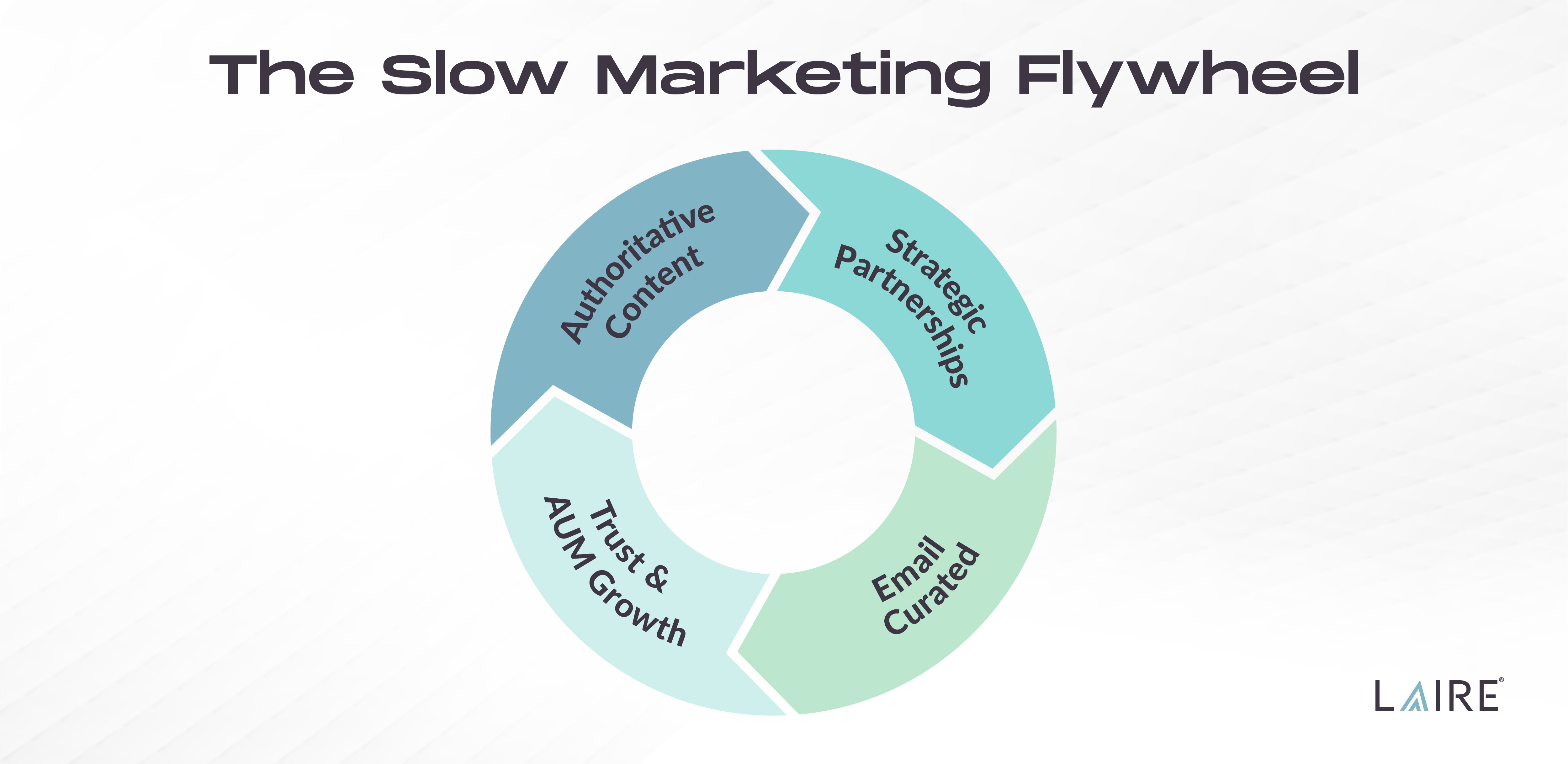
Ready to build a slow marketing strategy? Start here. These three pillars are the foundation of what effective financial marketing looks like in 2026.
Pillar 1. Long-Form, Authoritative Content
Forget the 500-word listicle. HNW clients and institutional buyers respond to substance. That means 2,000-word white papers, expert-led webinars, and in-depth research reports on the trends and dynamics that matter to your specific audience.
This type of content does two things at once: it demonstrates genuine expertise, and it creates durable marketing assets that continue working long after they’re published. A well-crafted white paper can fuel your email strategy, your sales team’s outreach, and your organic search rankings for months.
The key is genuine insight. Generic thought leadership won’t cut it. Dig into the specifics (market volatility, alternative investment trends, estate planning complexity, etc.), and speak to the real questions your prospects are wrestling with.
Pillar 2. Strategic Partnerships
You don’t have to build all your credibility from scratch. Strategic partnerships with respected analysts, industry voices, and even satisfied clients extend your reach and add authenticity.
Co-created content, like a co-authored article, a joint webinar, or a client success story told in the client’s own words, carries a weight that solo content simply can’t match. It demonstrates that real people in your industry trust and value your perspective.
Think of these partnerships as brand moats. They differentiate your firm from competitors in ways that are difficult to replicate and build the kind of authority that search engines and potential clients both reward.
This is E-E-A-T (Expertise, Experience, Authority, Trustworthiness) in action, and it’s increasingly important for both SEO and AEO as AI overviews pull from credible, authoritative sources.
Pillar 3. Curated, High-Value Email Communications
Email shouldn’t be a volume play. At this level, it’s a relationship tool.
The most effective financial firms are moving away from generic blast campaigns and toward segmented, educational newsletters that deliver real value with every send. That means market insights, trend analysis, and actionable takeaways, all tailored to where each client or prospect is in their journey.
This isn’t just more respectful of your audience’s time. It’s more effective. Relevant, well-timed content builds the kind of ongoing relationship that makes your firm the obvious choice when a prospect is finally ready to move.
How to Put These Pillars into Practice
Strategy without execution is just a plan. Here’s how to operationalize this approach:
- Audit your current content: Identify what’s genuinely building authority vs what’s just generating clicks. Cut ruthlessly.
- Map high-value partnerships: Who are the analysts, advisors, and clients whose names would add credibility to your content? Start there.
- Segment your email list with precision: Different messages for prospects at different stages. One-size-fits-all email is leaving revenue on the table.
- Track the right outcomes: Are your content investments leading to more meetings booked, more portfolio conversations, better retention? If you can’t answer that, start building the measurement infrastructure now.
The Tortoise Still Wins the AUM Race
The firms that win in 2026 aren’t necessarily the fastest. They’re the most deliberate, the most precise, and the most consistent.
In a financial marketing landscape flooded with AI-generated noise, slowing down to verify your data, polish your messaging, and invest in real human relationships is how you build the kind of brand that attracts high-value clients and keeps them.
Slow marketing is less a campaign strategy and more a philosophy for sustainable growth. It’s how you ensure that the right clients find you — and that when they do, they trust what they see.
Is your financial firm’s marketing moving too fast to be effective? Start with a Marketing Action Plan (MAP) by LAIRE® to build a smarter, more sustainable growth engine.