TABLE OF CONTENTS
Why Clicks Don’t Become Consultations | Follow-Up Best Practices | HubSpot for Financial Services | Lead Gen Strategies to Try Now
You can feel it when the numbers don’t add up. Traffic is steady. Cost per click is reasonable. Your SEO team is hitting targets. Yet consultations aren’t increasing at the same pace.
Inside the CRM, the story looks different. Dozens (sometimes hundreds) of contacts sit in limbo. You reached out once: no reply, no meeting booked, no movement.
For many firms, this stall happens in the window between form submission and meaningful engagement. And that’s when ROI either increases or falls apart.
Marketing experts emphasize that the quality and speed of follow-up often determine whether marketing dollars produce revenue. The financial services industry is no exception.
When a prospect downloads a guide or requests information, they’re signaling interest, not just browsing. If your firm’s response is slow, generic, or unclear, that interest fades quickly.
This is why marketing automation for financial advisors has become central to modern growth strategies. It ensures that curiosity leads to clarity and that no inquiry depends solely on someone remembering to check their inbox between client meetings.
Why Clicks Aren’t Turning Into Consultations
More traffic rarely fixes a follow-up problem. In fact, it often magnifies it.
Many firms invest heavily in visibility, but underestimate how fragile intent really is. A prospect who fills out a form is actively evaluating options. If the post-conversion experience feels slow or impersonal and confusing, that momentum fades fast.
Even optimized landing pages can end up creating friction due to slow load times, too many required fields, unclear next steps, or similar issues. Financial decisions carry a lot of weight, and prospects are subconsciously assessing professionalism at every step.
Speed also matters more than most advisory teams think.
When someone requests information about retirement planning or tax strategy, they’re often comparing firms in parallel. A delayed response pauses the process and indicates a lack of urgency. In a competitive market, that perception alone can redirect the opportunity elsewhere.
Another issue is tone: Financial prospects don’t want to feel like a name in a newsletter list. They want to feel understood. A generic confirmation email rarely builds confidence that your firm grasps the nuance of their situation.
There are also quieter conversion killers that rarely get discussed:
- Forms that ask for too much sensitive information up front
- No clarity on what happens after submission
- Inconsistent branding between ads, landing pages, and follow-up emails
- No visible proof points (credentials, case studies, media mentions) near the call to action
Without automated financial services workflows, inconsistency exacerbates the issue. Advisors respond only when time allows. Some leads receive thoughtful outreach, while others receive minimal attention. High-intent prospects may never be prioritized properly when there’s no behavioral framework guiding the response.
When clicks don’t convert into consultations, the root problem is rarely traffic quality alone. It’s the experience that prospects encounter the moment they decide to engage.
Marketing Automation Best Practices for Wealth Managers
Effective automated marketing for financial advisors involves reinforcing the human element with structure, timing, and intelligence, not removing it.
The most successful firms design email nurture campaigns that react to behavior in real time.
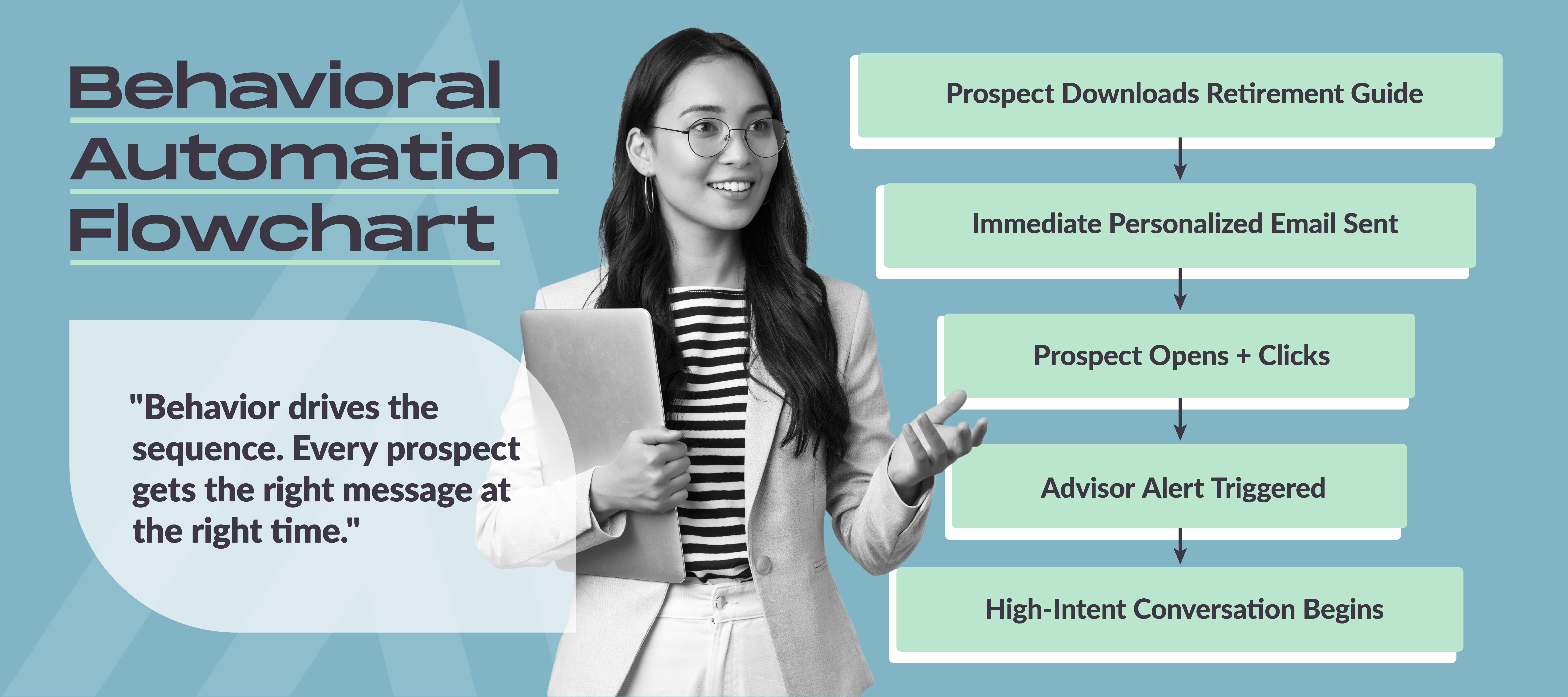
For example, when a prospect downloads a retirement planning resource, the follow-up references retirement concerns. When someone engages with tax strategy content, subsequent communication reflects that interest. Context replaces guesswork.
Strong automation frameworks typically include:
- Immediate, personalized outreach that specific actions trigger
- Behavioral segmentation that distinguishes research from buying intent
- Logic-driven workflows that adapt based on engagement
- Internal alerts when a lead demonstrates high-value activity
- Seamless transitions from automated touchpoints to advisor conversations
The difference between rigid email sequences and adaptive logic is substantial. Modern systems can evaluate key details:
- Which pages a prospect visited
- How long they stayed
- Whether they opened previous emails
Based on that engagement, the platform determines the most appropriate next step rather than forcing every lead down the same path.
This approach respects the complexity of financial decision-making. A business owner exploring succession planning requires different messaging than a couple nearing retirement, for instance.
Automation ensures relevance at scale while freeing advisors to focus on substantive conversations instead of administrative follow-up.
Why HubSpot for Financial Services Is the Gold Standard
Technology choice matters, especially in a regulated, relationship-driven industry. While many CRMs store contact information and track tasks, fewer connect marketing activity directly to pipeline performance in a way that leadership can analyze.
HubSpot for financial services stands out because it integrates website engagement, email interactions, campaign attribution, and sales stages within one ecosystem. Rather than separating marketing metrics from revenue outcomes, firms gain a unified view of how prospects move from first click to signed client.
For organizations investing heavily in fintech inbound marketing, this kind of alignment eliminates blind spots. Leaders can see which content attracts the right prospects, how quickly advisors respond, and exactly where opportunities stall, then make operational improvements based on data, not assumptions.
That does require investment in terms of HubSpot costs. But measured against the lifetime value of even a single ideal client, the math shifts quickly. When your marketing automation and sales pipeline share the same data, follow-up stops being a hopeful process and starts being a measurable one.
In an industry where trust and responsiveness influence decision-making, that level of coordination gives you a competitive advantage.
Strategies to Bridge the Gap Today
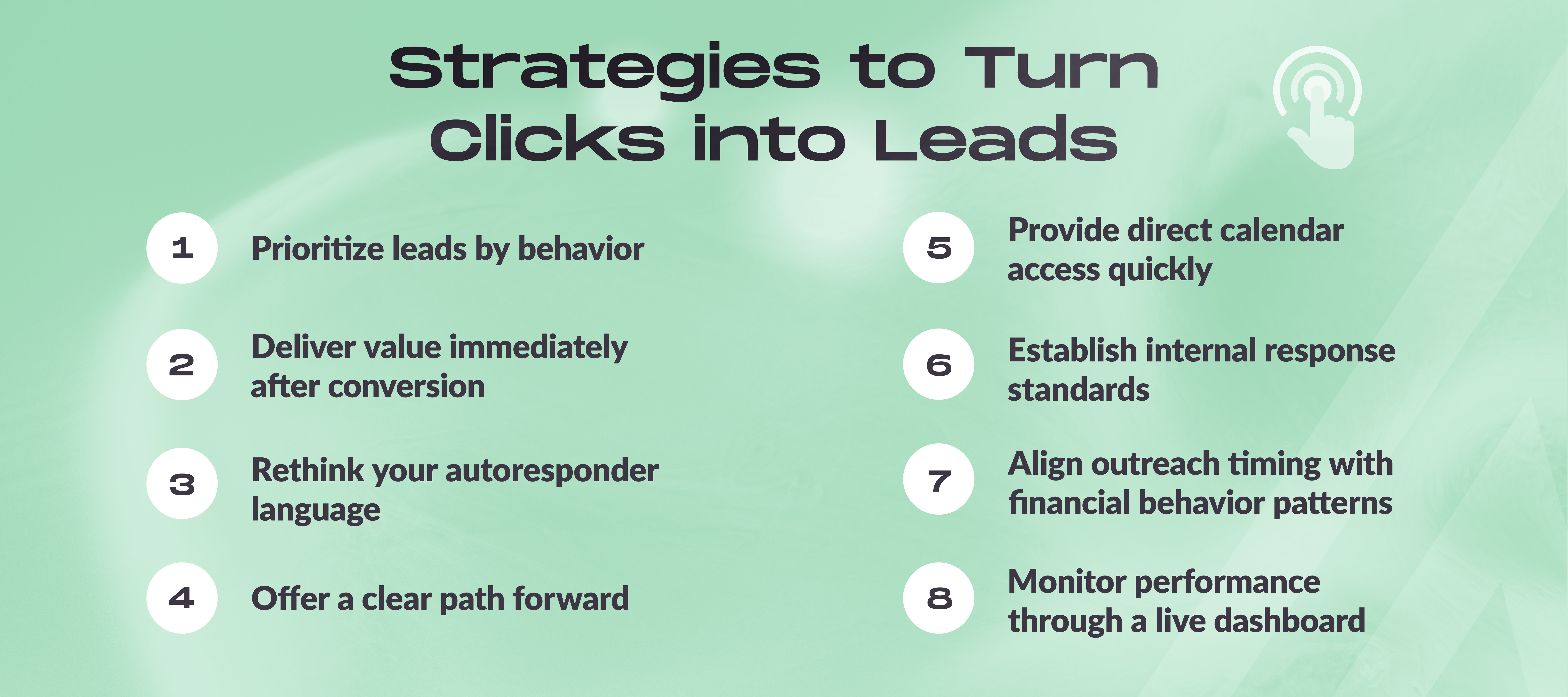
Closing the follow-up gap doesn’t require a complete technology overhaul overnight. Many improvements begin with disciplined execution:
- Prioritize leads by behavior: A prospect reviewing service pages or pricing details signals stronger intent than someone casually reading an educational article. Your response strategy should reflect that difference.
- Deliver value immediately after conversion: Reinforce their interest with a “Lead Magnet” — relevant insights, a short explainer video, or a practical checklist that deepens the conversation.
- Rethink your autoresponder language: Instead of a bland confirmation, acknowledge the specific topic they engaged with and outline what they can expect next.
- Offer a clear path forward: Ambiguous invitations to “reach out anytime” create hesitation, but a defined next step removes uncertainty.
- Provide direct calendar access quickly: When prospects can secure time on your team’s schedule within moments of converting, you preserve momentum.
- Establish internal response standards: Define who owns incoming inquiries and the maximum acceptable response window. Consistency builds reliability.
- Align outreach timing with financial behavior patterns: Test communication windows and track results. Certain times of day consistently outperform others.
- Monitor performance through a live dashboard: Visibility into certain factors, such as response times, engagement levels, and stalled opportunities, ensures you address issues before leads go cold.
Turning Interest Into Engagement
A click represents possibility, not progress. It signals that someone is open to a conversation about their financial future. What happens next determines whether that possibility turns into a client relationship.
Many firms assume lost opportunities stem from weak messaging or insufficient traffic. But in reality, most deals fade before the first call, when the digital experience fails to build early rapport. Slow replies, generic emails, and unclear next steps all erode trust before an advisor ever picks up the phone.
That dynamic shifts when structured follow-up, intelligent automation, and clear accountability work together. Prospects feel understood. Advisors respond with confidence. And leadership can draw a direct line between marketing investment and revenue growth.
Knowing where to start is the hardest part. Our Guide to Lead Generation with AI walks through exactly how financial services firms are turning clicks into conversations — and conversations into clients.
When you respond with speed and relevance, every click becomes an opportunity worth capturing.