TABLE OF CONTENTS
What Is AI Marketing? | 8 Ways to Use AI in Marketing | Ethical Considerations | Frequently Asked Questions
Quick Answer: What Is AI Marketing?
AI marketing uses artificial intelligence tools like ChatGPT, Claude, and Gemini to automate campaigns, analyze customer data, personalize content, and predict behavior. Modern marketers use AI to reduce content creation time while improving targeting accuracy and conversion rates through machine learning and predictive analytics.

What Is AI Marketing in 2026?
Artificial intelligence marketing involves using machine learning systems, large language models, and predictive analytics to understand customer behavior, automate repetitive tasks, and create personalized experiences at scale.
Since 2023, AI marketing has evolved from basic chatbots to sophisticated AI agents that can manage entire campaign workflows. Today's AI tools analyze millions of data points in seconds to predict what your customers want before they know it themselves.
The marketing landscape has fundamentally shifted. According to a 2025 survey from McKinsey, 88% of responding businesses use AI regularly in at least one business function, up from 78% in 2024 and around 55% in 2023.
How AI Transforms Modern Marketing Operations
AI marketing technology helps your team work smarter by:
- Predicting customer behavior using historical data patterns
- Identifying key business insights from customer interactions across all channels
- Personalizing content for individual users based on browsing history and preferences
- Increasing engagement rates through optimized send times and messaging
- Automating repetitive tasks like data entry, reporting, and basic content creation
By understanding these behavioral patterns, you can create campaigns that feel personally crafted for each customer. This results in better targeting, higher engagement, and conversion rates that often double compared to traditional approaches.
8 Top Ways to Use AI in Marketing
Modern AI marketing spans from streamlining routine tasks to creating data-driven strategies that were impossible just three years ago. AI has become essential to competitive marketing operations. Here's how to leverage it effectively in 2026.
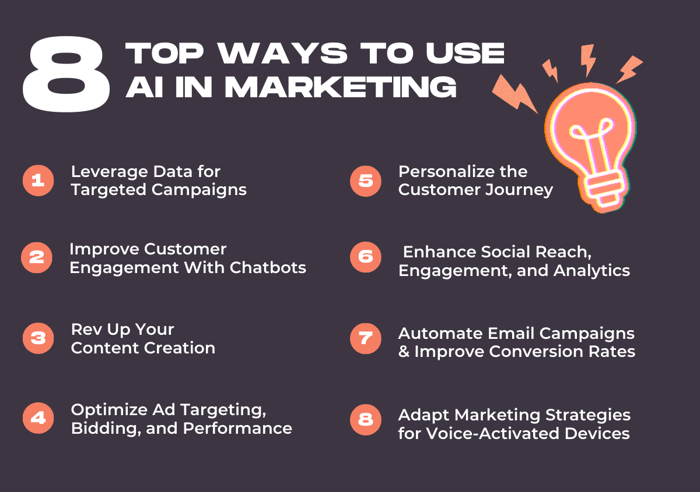
1. Leverage Data for Targeted Campaigns
One of the main benefits of using AI marketing solutions is to utilize data to create more targeted and strategic campaigns.
The best AI marketing tools have the ability to analyze large aggregate customer data sets to extract valuable insights. AI can dissect and identify your target audience’s social media engagement, purchase history, online activity, and more to develop a well-rounded understanding of customer preferences and behaviors.
Using an AI marketing tool to understand the behaviors of your target audience can help you create more thoughtful customer segmentation and understand their predicted behaviors when developing your campaigns. This can make your marketing campaigns more accurate and compelling for the right audience at the right time.
2. Improve Customer Engagement With Chatbots
Marketers are constantly looking for ways to get their customers to engage. In recent years, the industry has seen an uptick in AI-powered chatbots and virtual assistants that are transforming the customer experience.
Like all AI software, chatbots have the ability to analyze and process a massive amount of data very quickly to identify patterns in customer inquiries and provide relevant responses. Chatbots powered by AI for digital marketing have many benefits, including:
- Answering frequently asked questions
- Offering assistance in real-time
- Assisting in customer support processes
- Asking qualifying questions to route customers to the appropriate department
- Providing quick and accurate responses to inquiries
The byproduct of each of the above benefits of AI marketing bots is improved customer satisfaction due to reduced response times. But there’s a small catch...
Chatbots can provide great value to the customer experience. Still, it’s essential to balance AI marketing automation with human interaction when communicating with customers. Bots play a critical role in providing quick and accurate service, but there are instances where human intervention is needed to solve problems or provide personalized support to your customers.
Ultimately, to enhance engagement and increase client retention, make sure to strike a balance between leveraging AI chatbots and human interactions with customers.
3. Rev Up Your Content Creation
AI is starting a revolution in how we’re creating and generating content. AI tools for content marketing have the ability to create clear blog posts, social media updates, product descriptions, and much more.
Through machine learning and natural language processing, content marketing AI systems can assist in writing and proofreading your content to ensure it’s coherent, engaging, and accurate. AI can even help optimize content for search engine optimization (SEO), improving its performance in search engine results and fostering better visibility for your business.
With the assistance of AI marketing copy, marketers like you can save time and resources while improving the quality of the content you are delivering to your audiences. Overall, by leveraging AI in content marketing, your company can:
- Streamline content creation
- Increase content output
- Rank higher in search engine results
- Improve audience engagement
- Save time and resources
Keep in mind, however, that it’s critical to use a plagiarism-checking tool whenever you leverage AI to help write content.
4. Optimize Ad Targeting, Bidding, and Performance
AI marketing solutions have the ability to enhance paid advertising campaigns by analyzing audience data and making adjustments to targeting parameters in real-time.
AI’s advanced machine learning can constantly analyze and interpret data to help you gain a deeper understanding of your target audience. With this knowledge, AI-powered tools can automatically improve various aspects of advertising campaigns, such as automated bidding, ad placement, and performance tracking.
AI optimizes ads by adjusting targeting parameters based on real-time insights, ensuring relevance and engagement. In turn, using this AI marketing strategy can maximize return on ad spend by allocating your budget to high-performing campaigns and adjusting efforts based on performance metrics.
5. Personalize the Customer Journey
In today’s oversaturated market, customers are consuming large amounts of content that may or may not be the best fit for their specific needs. It’s your job to personalize the customer journey so your business remains relevant to your target audience.
AI marketing solutions can play a pivotal role in facilitating personalized recommendations. AI algorithms can help you identify user behavior, preferences, and historical data to deliver tailored product recommendations to each individual customer. This precise personalization not only enhances the customer experience but can also increase cross-selling opportunities.
You can leverage AI to find trends in customer data to offer relevant and timely recommendations that best align with the unique preferences of prospects and customers for your specific product or service. Personalizing the customer journey with AI in this way drives higher conversion rates, improves customer satisfaction, and fosters brand loyalty.
6. Enhance Social Reach, Engagement, and Analytics
AI marketing software can greatly enhance social media marketing strategies by analyzing trends, optimizing content, and automating posting schedules.
With AI tools for digital marketing, you can gain valuable insights into social media trends and understand what type of content best resonates with your target audience and the exact right time for optimal visibility.
Social listening tools powered by AI also enable sentiment analysis, allowing you to gain a better understanding of what customers are saying about your brand and products. Competitive analysis is also made easy with generative AI for marketing by analyzing competitor metrics and making improvements based on data.
From there, you can use future data to measure the effectiveness of your campaigns and identify areas of improvement with the help of AI for digital marketing.
7. Automate Email Campaigns and Improve Conversion Rates
AI-driven marketing efforts can also be leveraged when creating an effective email campaign strategy, from personalized email sequencing to dynamic content generation.
AI for email marketing can handle delivering personalized content to customers, optimizing calls-to-action, and segmenting audiences to improve conversion. AI predictive analytics can find customer preferences, purchase history, and consumer behavior to create relevant and eye-catching content in email campaigns.
Further, AI-powered email subject line optimization can help increase the chances of your emails being opened and read — and, in turn, improve conversion rates and bolster sales.
By leveraging strategic AI marketing campaigns, you can increase efficiency to see higher email engagement and increased business growth.
8. Adapt Marketing Strategies for Voice-Activated Devices
The growing popularity of voice search has presented new opportunities for marketers to optimize their strategies for voice-activated devices with AI.
To ensure your strategy is optimized for voice search results on smart speakers and voice assistants, make sure your brand is discoverable by using conversation keywords and phrases to align with how users speak when making a voice search.
AI analyzes user data and behavior to understand user intent and deliver relevant results. With AI-powered voice analytics, marketers like you can understand the preferences and behaviors of voice search users to tailor your strategies effectively.
Ethical AI Considerations & Compliance in 2026
Balancing innovation with consumer privacy and ethical responsibility has become critical as AI marketing tools grow more powerful. Marketers must adopt responsible AI practices to address data privacy, algorithmic bias, transparency, and regulatory compliance.
Your business should implement these ethical AI practices:
- Obtain explicit user consent before using personal data for AI training or personalization. Make opt-out options clear and accessible.
- Provide transparency about AI-driven marketing strategies. Disclose when customers interact with chatbots, receive AI-generated content, or are subject to AI-powered personalization.
- Fact-check AI outputs before publishing. AI can generate plausible-sounding but incorrect information. Human review remains mandatory for accuracy and brand safety.
- Test for bias in AI recommendations and targeting. AI systems can perpetuate or amplify existing biases in training data, potentially excluding certain demographics from opportunities.
- Maintain human oversight for significant marketing decisions. AI should augment human judgment, not replace it entirely, especially for strategic decisions affecting brand reputation.
These practices maintain credibility and build trust with consumers. Implementing responsible AI isn't just about compliance; it's a competitive advantage that differentiates your brand in a market where consumers increasingly scrutinize how companies use their data.
Frequently Asked Questions About AI in Marketing
Will marketing be replaced by AI?
With the rise of artificial intelligence, many people are wondering if AI can replace marketers.
We don’t think this will be the case — and neither does HubSpot. The role of a marketer requires data interpretation, trend monitoring, campaign oversight, content creation, and more. These functions are not achievable with AI marketing automation alone.
Again, your AI-generated content must have a personalized, human touch.
How is AI changing the future of digital marketing?
As AI technology continues to improve and become more popular, digital marketing professionals should expect their businesses to leverage AI algorithms to improve their processes.
More businesses are starting to use AI technology to streamline operations and create more targeted digital marketing campaigns. In the modern marketing world, we can expect AI to continue to play a huge part in our roles.
What are some of the best AI marketing tools?
The best AI tools for digital marketing often have different benefits, so it’s important to identify which platforms best fit your business’s specific needs. There are a few free AI tools for marketing available as well.
Here are some of the best AI tools for marketing:
- HubSpot
- ChatGPT
- Jasper.ai
- Adverity
- Zapier
- Semrush
- Crayon
How do I get started with AI marketing?
Start with these practical steps:
- Identify your biggest time drain: Find repetitive tasks AI could handle (content creation, data analysis, reporting)
- Choose one AI tool: Don't try everything at once; master one tool first
- Run a small test: Use AI for one campaign or content piece and measure results
- Establish guidelines: Create processes for fact-checking and quality control
- Train your team: Invest in learning how to write effective AI prompts
- Measure and iterate: Track time savings and quality improvements
- Scale gradually: Add more AI tools as you prove ROI
The marketers seeing the best results from AI are those who start small, learn systematically, and expand based on measurable success.
Supercharge Your Marketing Efforts With AI
AI is a powerful tool for marketers to improve their marketing strategy and target their ideal customer base.
By leveraging the capabilities of AI, you can predict customer behavior, identify key business insights, personalize content, and increase engagement. But you must also prioritize ethical AI practices to build trust with customers and protect user privacy.
As AI continues to evolve in the industry, it’s increasingly important for marketers like you to stay up-to-date and adapt accordingly to the new landscape. Want more tips and strategies to help you use AI in your marketing role? Download our free AI marketing prompts now!