TABLE OF CONTENTS
Considerations When Choosing an AI Marketing Tool | Overview of Major AI Tools | ChatGPT Pros & Cons | Claude Pros & Cons | Gemini Pros & Cons | Tips for Creative Teams | Which Is Best?
Your marketing team is stretched thin: more content, more personalization, faster deadlines, and bigger results demanded yesterday.
AI tools promise a solution, but not all are created equal. The right tool can supercharge your campaigns, save hours of work, and make your team look unstoppable. The wrong one? A flashy distraction that wastes time and budget.
With so many options — ChatGPT, Claude, Gemini, Perplexity, and more — how do you know which AI will actually move the needle for your team?
In this article, we’ll help you cut through the noise and answer the questions that matter:
- Which AI tools are the best fit for your marketing goals?
- What are their real strengths and limitations?
- How can you use AI to amplify your team’s skills, not replace them?
Let’s find the tools that work and start marketing smarter, faster, and better.
What to Consider When Selecting an AI Tool for a Marketing Team
Brand Voice Consistency
You may generate lots of content, but if it drifts in tone, your brand suffers. Ensure your AI tool supports templates, memory, or context that maintain brand voice over many assets.
Brand voice is more than the words you use or whether a 6th grader could understand it. Your brand voice subtly demonstrates an understanding of your client’s pain points and how your services answer their specific problems.
Integration With Your Stack
Does the tool integrate with your content management system (CMS), design tools, asset repositories, and workflow automation? If it’s siloed, you’ll lose momentum.
Even if it takes some time to set up properly within your ecosystem, this is time well spent. It will save you in the long run while reducing team frustration, double work, and undesirable AI output. It can enhance your online visibility where it matters most.
Workflow & Training
A powerful tool isn’t enough without the right workflow. Your team will need prompt engineering training to quickly get the desired result.
To navigate the B2B landscape effectively with generative AI, you’ll need best practices, versioning, a review process, and guardrails for branding and compliance.
Scalability & Cost
As your content volume grows, you’ll add more channels or more clients. Those tokens/time/costs add up fast. Inability to scale quickly can lead to lost momentum and missed opportunities.
Some tools scale better for speed and volume, others for depth and brand-fidelity. There’s no one-size-fits-all answer to which you need more.
Multimodal vs Text Only
If your marketing relies heavily on images, video, or slide decks, choose a tool with robust multimodal capabilities, like Gemini. For primarily text-based content, such as social posts or articles, a text-focused AI like ChatGPT or Claude will likely meet your needs.
Risk and Brand Safety
These tools differ in safety, hallucination risk, and tone drift. If you’re working in regulated industries (such as finance, healthcare, or legal) or with high-stakes brands with fewer large clients, choose a tool with stronger guardrails (e.g., Claude).
This AI for marketers was designed by former OpenAI (ChatGPT) team members to specifically address some of the risks of using ChatGPT without significant human oversight.
Tool Strategy
You don’t necessarily have to pick one tool forever. Many marketing teams adopt a toolkit approach, for example, ChatGPT for quick social or ad copy, Gemini for asset-rich campaigns, and Claude for strategic long-form.
In most cases, the cost-benefit of these tools makes having more than one tool with a clearly defined role within your marketing team an effective strategy.
Keep Monitoring
The AI landscape changes fast: new features, integrations, and models are popping up all the time. What works for your team today might feel outdated in 6 to 12 months. That’s why it’s crucial to keep evaluating your tools.
Experiment with new options and listen to your team’s feedback. Even the best AI tools have their quirks, and your team will figure out ways to work around them. The key? Make sure your AI stack is always the right fit for your marketing goals. Stay flexible, stay informed, and keep iterating.
Now, let’s dive into some of the top AI tools built for marketing teams and explore how they can help you work smarter, not harder.
Overview of Major AI Tools & Their Strengths/Weaknesses for Creative Marketing
At a Glance
|
TOOL |
STRENGTHS |
WEAKNESSES |
|
ChatGPT |
Fast, good for short-form high volume, many use cases |
Tone drift, hallucination risk, less multimodal integration |
|
Claude |
Premium brand voice, long-form, safe & aligned |
Slower, less optimized for super high-volume short tasks |
|
Gemini |
Multimodal + built into the Google ecosystem |
Complexity may overshoot needs for simple workflows |
ChatGPT
Strengths
- Mature model, excellent for drafting social posts, brainstorming ideas, and writing copy across clients.
- Strong community, many prompt-engineering patterns.
- Good for fast turnaround and volume.
Weaknesses
- May struggle with deeply integrated workflows (asset + document + multi-channel) or long-term brand-voice consistency across many assets without guardrails. As soon as you think it’s got it, it can suddenly “forget” everything it “remembered,” and you’re back to square one.
- Can hallucinate or produce inaccurate information. It’s a people pleaser! If it can’t find what it thinks you want to see, it will make something up. And what it makes up can seem 100% plausible. You might not even question it.
- Prompt sensitivity: small changes can lead to big variance in output quality.
Fit for Creative Marketing Teams
Perfect for high-volume short-form tasks, including ads, posts, and quick drafts, that a human can quickly review and sign off on. But if your workflow demands tight brand control, many assets, or multimodal integration, you may need complementary tools.
Claude
Strengths
- Emphasis on safety, reliability, and alignment. Good for brand risk and compliance.
- Strong at long-form content and coherence across large documents.
Weaknesses
- May be less optimal for very high-volume “many clients, many posts” workflows compared to tools optimized for speed and scale.
- Pricing and access may be more restrictive; ecosystem/integrations may not be as mature in some stacks.
Fit for Creative Marketing Teams
Ideal where quality, brand voice, and strategy documents matter, for example, campaign briefs, brand books, and premium clients. If your queue is mostly fast and high volume, you might use Claude selectively.
Gemini
Strengths
- Built by Google, with multimodal capabilities (text + image + audio + video) and deep integration with Google Workspace (Drive, Docs, Sheets, Slides).
- Especially useful where you already have large asset libraries and need the AI to reference them.
Weaknesses
- Integration or “polish” may not yet match older models in every area. Some users report lag or features still rolling out.
- If your workflow is purely text/social copy, the added complexity may not pay off immediately.
Fit for Creative Marketing Teams
Ideal for teams deeply embedded in Google Workspace, especially those running asset-rich, multimodal campaigns. If your work is mostly text with minimal assets, a simpler tool may be just as effective. Sometimes less really is more.
Real-World Considerations & Workflow Tips for Creative Teams
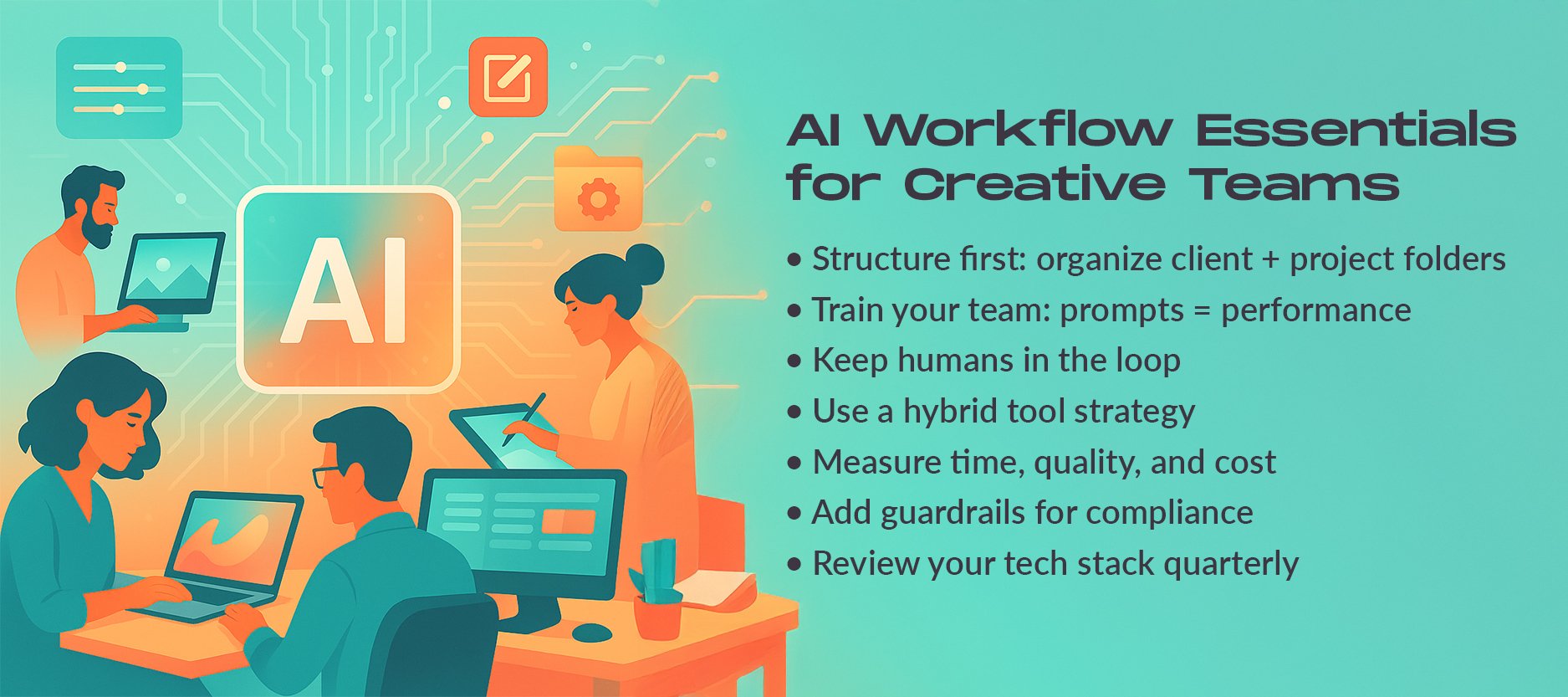
A strong AI workflow starts with structure. Set up dedicated client and project folders so your tools can reference brand history and context as they generate content. This helps maintain consistency and prevents drift across campaigns.
Your team will also need training. Prompt engineering isn’t optional anymore. As business leaders, we must think of AI prompt creation as a core skill that determines how well your AI performs. Teach your team how to give clear instructions, manage versions, and refine outputs through iteration.
To continue, human review still matters. AI is a powerful co-pilot, but it shouldn’t operate on autopilot. Build collaboration steps into your workflow so content gets polished, validated, and aligned before publishing.
A hybrid tool strategy often works best. Many creative teams draft quick ad variants in ChatGPT, refine tone and brand voice in Claude, then produce image- or video-rich assets in Gemini. Using each tool for its strengths leads to better results with less friction.
Measurement closes the loop. Track time saved, output quality, consistency, and cost. Once you know which tasks drain the most resources, you can apply AI where it delivers the highest impact.
Guardrails are also vital. If you work in regulated industries, build templates and compliance prompts to ensure each tool stays in safe territory. This protects the brand but also reduces review time. Ask your team to be on the lookout for “issues” they must repeatedly fix in review. Adding a guardrail saves that time.
Finally, revisit your stack regularly. AI tools evolve quickly, so review your setup quarterly. New features or integrations may open up better workflows or cost efficiencies.
Which Tool Should You Choose (or Should You Use Multiple?)
Making the right AI choice starts with understanding your bottlenecks. Where is your marketing team getting stuck? Which steps create delays or leave others unsure how to proceed? If your challenge is volume, your needs differ from a team focused on long-form strategy or high-end brand work.
Your tech ecosystem also matters. Teams embedded in Google Workspace often see major benefits with Gemini, while agencies using mixed tools or custom CMS platforms may prefer ChatGPT or Claude for flexibility.
Client mix plays a role, too. If you manage many clients and brand voices, speed and adaptability may outweigh deep-context fidelity. If you work with a few high-stakes brands, voice consistency and long-form clarity become top priorities.
Budget and governance should always stay front and center. Costs can rise with volume, and some tools demand more oversight or training. Risk tolerance is also critical, especially in regulated industries like healthcare, finance, or legal.
Consider these examples:
- A performance-marketing agency producing 100+ micro-campaigns per month prioritizes speed and scalability. They often rely on ChatGPT for drafting, Gemini for media-heavy projects, and Claude for premium long-form polish.
- A boutique branding firm working with five high-stakes clients prioritizes consistency across strategy decks, brand books, and messaging guides. Claude becomes their primary tool, Gemini supports visual assets, and ChatGPT is used lightly for ideation.
Here’s a Quick AI Selection Checklist to Guide You
- Define your key use-cases (social copy, long-form thought leadership, asset-rich campaigns).
- Identify volumes, channels, and asset types.
- Audit current tools/workflows.
- Pilot two tools side-by-side on similar tasks and compare output quality, brand fit, speed, and cost.
- Roll out based on results, then revisit every 6 to 12 months.
The Best AI Tool for Marketers
As you can see, there is no clear winner. It’s about fit. Identify your bottlenecks, risk tolerance, client needs, and workflow demands. The best AI tools empower your creative marketing team to scale with consistency, while matching tool strength to task.
Map your pain-points. Pilot intelligently. Then measure, iterate, and roll out. And remember: The AI tool landscape is evolving fast. What works today might change in 6 to 12 months. Stay curious, stay testing, and stay ahead.
If you’re ready to get strategic about AI tools for your marketing team, explore our AI services and let the LAIRE team help you map your toolkit and workflow.