You use AI for marketing by handing specific jobs to it, then keeping a person in charge of judgment and quality. That means drafting and refreshing content, optimizing for search and AI answers, personalizing messages, scoring leads, running automations, powering chatbots, testing ads, researching your market, sharpening email, and reading your data faster. The ten applications below are where AI earns its keep for real marketing teams. Each one includes a concrete B2B example and a note on where humans still decide.
What does "using AI for marketing" actually mean?
Using AI for marketing means applying machine learning and generative tools to defined marketing tasks. It is a set of use cases, not one product and not a magic button.
The distinction matters because hype sells AI as a strategy. It is not a strategy. It is a capable assistant that speeds up work you already understand. Point it at a clear job with clean inputs, and it saves real time. Point it at a vague goal and hope for growth, and you get generic output that a buyer can smell.
The best results share a pattern. AI handles volume, speed, and first drafts. People handle strategy, accuracy, taste, and the final call. Keep that division and most of the applications below become straightforward.
10 practical ways to use AI for marketing
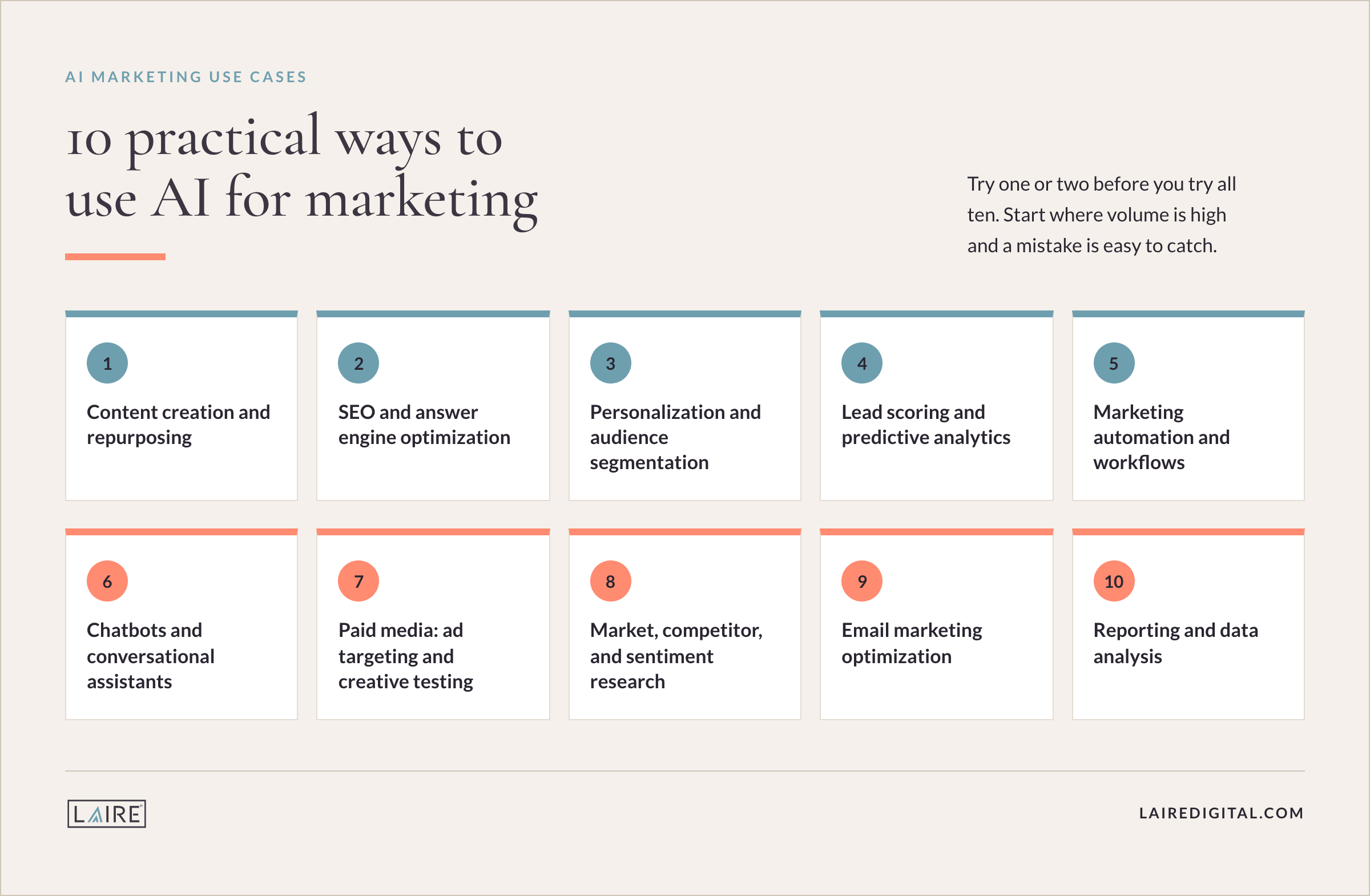
These are the AI marketing use cases we see deliver value most often for B2B teams. Try one or two before you try all ten.
1. Using AI for content creation and repurposing
AI drafts, refreshes, and adapts content much faster than a team working from a blank page. Use it for outlines, first drafts, meta descriptions, and turning one asset into several formats.
A manufacturer can turn a single product guide into a blog post, three LinkedIn posts, and a sales email in an afternoon. The catch is quality. A model cannot supply your first-hand expertise, and AI-generated content alone rarely earns SEO value. Keep a human editor on every piece to add real examples, check facts, and protect your voice. The teams that win treat AI as a fast drafter, then layer in first-hand expertise and E-E-A-T that a competitor cannot copy.
2. Using AI for SEO and AEO (Answer Engine Optimization)
AI helps you research topics, cluster keywords, and structure pages so both search engines and AI answer engines can use them. This is where AEO comes in.
Buyers now ask ChatGPT, Gemini, and Google's AI Overviews for recommendations. If your content is clear, well structured, and credible, those engines can cite you. A financial services firm might use AI to map the exact questions clients ask, then build pages that answer each one directly. Our guide to AI visibility best practices walks through the mechanics. It also helps to understand how Google AI Overviews change what buyers see. Use AI to find and organize the opportunities. Keep human judgment on which claims you are willing to stand behind.
3. Using AI for personalization and audience segmentation
AI can group contacts and tailor messages at a scale no manual process can match. It can read behavior, firmographics, and engagement, then suggest the right message for each segment.
A SaaS company can move past "email everyone the same thing" and instead send a security-focused message to IT buyers and an ROI-focused message to finance. That relevance lifts engagement. The guardrail is data quality and privacy. Segment on clean, consented data, and review the logic so you are not making assumptions a real buyer would find off.
4. Using AI for lead scoring and predictive analytics
AI predicts which leads are most likely to convert by learning from your closed-won and closed-lost history. It ranks prospects so sales spends time on the right ones.
Instead of scoring leads on a few manual rules, a predictive model weighs dozens of signals at once. A B2B team can route high-fit, high-intent leads to sales immediately and nurture the rest. This is one of the most practical forms of AI lead generation because it improves quality, not just volume. Validate the model against real outcomes, and revisit it as your market shifts.
5. Marketing automation and workflows
AI extends automation from simple "if this, then that" rules into smarter actions. It can summarize a record, draft a reply, or decide the next best step inside your existing workflows.
If you run HubSpot, agents like Breeze can qualify leads, keep data current, and surface insights from your CRM. A team can set up AI-assisted workflows in HubSpot that handle routine follow-up while people focus on real conversations. Start with one high-volume, low-risk workflow. Prove it works, then expand.
6. Chatbots and conversational assistants
AI chatbots answer common questions, qualify visitors, and book meetings around the clock. Modern assistants understand natural language, so they feel less like a decision tree.
A home builder can use a website assistant to answer questions about floor plans and availability, then capture the lead while interest is high. Done well, this shortens response time and catches prospects who would have left. Set clear limits on what the bot can promise, and route anything sensitive or high-value to a person quickly.
7. Using AI for paid media: Ad targeting and creative testing
AI improves paid campaigns by optimizing targeting, bids, and creative in real time. Platforms already use machine learning; your job is to feed them good inputs and read the output well.
A manufacturer running lead-gen ads can let AI test dozens of headline and image combinations, then shift budget toward the winners. AI can also generate creative variations to test faster than a team could produce them. Keep a human on strategy, brand safety, and the numbers behind the platform's recommendations. Automated bidding will happily spend toward the wrong goal if you set it up that way.
8. Using AI for market, competitor, and sentiment research
AI scans forums, reviews, news, and social channels to surface trends, competitor moves, and shifts in how people feel about your brand. It compresses days of reading into a usable summary.
A fintech team can track what buyers complain about across review sites, then feed those themes into messaging and content. This kind of listening used to be slow and manual. Now you can monitor it continuously. Treat AI summaries as a starting point, and have a strategist interpret what the patterns mean for your next move. Generative AI also carries risks in B2B, which we cover in our guide to generative AI in B2B marketing.
9. Using AI for email marketing optimization
AI sharpens the parts of email that drive results: subject lines, send times, segmentation, and sequencing. It suggests variations and predicts what will perform.
A professional services firm can use AI to draft five subject line options and test them. It can also pick the send time each contact is most likely to open. That compounds across a large list. Some tools also flag when a sequence is too long or a message is off-tone. Keep your brand voice and your promises under human review, since email is where an off-note travels fastest.
10. Using AI for reporting and data analysis
AI reads marketing data and explains what happened in plain language. It spots patterns across channels and drafts the first version of a report.
Rather than exporting spreadsheets and hunting for the story, a marketing leader can ask why leads dropped last month and get a starting answer in seconds. That frees the team to act instead of assemble. The judgment still belongs to people. AI can tell you what changed, but deciding what it means for the business, and what to do next, is your call. It also helps to speak the language, so a shared AI marketing terms glossary keeps the team aligned.
AI for B2B marketing: What you need to know
AI for B2B marketing follows the same applications, but the stakes and the guardrails are higher. B2B purchases are considered decisions made by a buying committee, over a long cycle. That changes how you use AI.
Accuracy matters more. A consumer brand can post a light AI-written caption with little risk. A financial or manufacturing buyer will notice a wrong spec or a vague claim immediately, and it costs you trust. Personalization is harder too, because you are speaking to several roles inside one account. AI is well suited to that complexity when your data is clean, since it can tailor by role and stage. The applications with the clearest B2B payoff are usually lead scoring, content support, and research, where speed helps and a human still owns the final judgment. AI is also reshaping the sales side of the funnel, which we cover in how AI is changing sales teams.
Where to start with AI in marketing
Start with one job that is high-volume, repetitive, and low-risk, then measure the result before you add the next. You do not need a full AI program to see value this quarter.
Use a simple test to choose. Pick a task your team does often, that follows a pattern, and where a mistake is easy to catch. First drafts, meta descriptions, list segmentation, and reporting all fit. Set up the tool inside the system you already use, keep a person reviewing the output, and track the time or performance change against how you worked before. If it earns its place, expand to the next task. A few useful questions as you go: Which task eats the most hours for the least strategic value? Where would faster output actually change a result? Who owns the final review? What does good look like, and how will we measure it? Answer those, and you avoid the most common failure, which is adopting AI everywhere and improving nothing.
Conclusion
AI is most useful in marketing when you treat it as ten practical jobs rather than one big promise. Draft faster, optimize for AI search, personalize, score leads, automate, converse, test ads, research, refine email, and read your data. Keep a person in charge of accuracy, strategy, and taste, and connect the work to your stack and your numbers. Choose one application, prove it, then build from there.
Frequently asked questions
What is AI marketing?
AI marketing is the use of artificial intelligence, including machine learning and generative tools, to perform or improve marketing tasks. Common uses include content creation, personalization, lead scoring, automation, ad optimization, and data analysis. It works best as an assistant that speeds up defined work while people keep control of strategy and quality.
Is AI good for B2B marketing?
Yes, when it is applied to the right jobs with clean data and human review. B2B buyers make considered decisions and notice errors quickly, so accuracy and brand voice matter more than in consumer marketing. AI adds the most value in B2B through lead scoring, content support, personalization by role, and market research.
What are the risks of using AI in marketing?
The main risks are inaccurate or generic output, data privacy issues, and over-reliance that erodes your brand voice. AI can state something wrong with confidence, which is costly with informed buyers. You reduce the risk by using clean, consented data, keeping a human editor on customer-facing work, and checking any claim or statistic before it ships.
Do you still need humans if you use AI for marketing?
Yes. AI handles volume, speed, and first drafts, while people handle strategy, accuracy, judgment, and final approval. The strongest results come from that partnership, not from full automation. First-hand expertise is also what makes content credible to both buyers and AI answer engines, and a model cannot supply that on its own.
How do I start using AI for marketing?
Start with one high-volume, low-risk task, such as content drafts, segmentation, or reporting. Set the tool up inside the system you already use, keep a person reviewing the output, and measure the result against how you worked before. If it earns its place, expand to the next task. Avoid adopting AI everywhere at once.
Ready to put these applications to work? The LAIRE AI Consulting Services help B2B teams find where AI can pay for itself first, then implement it inside your existing tools. Book a 20-minute AI readiness assessment and we will show you where to start.