Your organic sessions are down and nobody has given you a satisfying explanation. Meanwhile, three vendors this month have told you the answer is answer engine optimization. The pitch always arrives with the same urgency and the same vagueness.
So here's the version we'd want if we were sitting on your side of the table. We'll define AEO properly and show you what the research says has changed. We'll also quote Google's own position on whether any of this needs new techniques, because it may surprise you. Then we'll show you our own AI visibility numbers from the last 30 days, including the ones that don't flatter us. A guide written by an agency that sells AEO should probably include evidence that the agency measures it.
What is AEO, in plain terms
Answer engine optimization, or AEO, is the practice of making your content easy for AI systems to find, understand, and cite. It matters when those systems answer a question directly instead of returning a list of links. The answer engines are tools like ChatGPT, Google AI Overviews, Google AI Mode, Gemini, and Perplexity. The goal is to be the source the answer gets built from.
If that sounds close to how we define SEO in under 40 words, it should. We'll come back to why.
Key takeaways
- AEO is the work of getting your content found, understood, and cited when an AI assistant answers a question instead of listing links.
- Google's own guidance says optimizing for AI search is still SEO. The techniques have changed far less than the vendors selling them suggest.
- What has changed is the relationship between visibility and clicks. You can be the answer and get no visit.
- AI referral traffic is still very small. The traffic you're losing isn't being replaced in volume, so the honest goal is influence rather than session recovery.
- Get a baseline before you buy a tactic. Without one, you can't tell a working AEO strategy from a market that moved underneath you.
What changed in search, and what didn't
Two things are true at once. Most of the coverage you've read picks one and ignores the other.
The first is that clicks have fallen where AI answers appear. Pew Research Center tracked 900 US adults across 68,879 Google searches in March 2025. Users who saw an AI summary clicked a traditional result in 8% of visits. Users who didn't see one clicked nearly twice as often, in 15% of visits.
Ahrefs measured something different and landed in the same place. Comparing Search Console clickthrough rates across 300,000 keywords, they found that an AI Overview now correlates with a 58% lower average clickthrough rate for top-ranking pages. Their April 2025 version of that study put the figure at 34.5%. The effect is getting worse rather than settling.
The second fact is less widely reported, and it changes what you should do about the first. Semrush analyzed traffic across more than 50,000 websites in 17 industries. AI traffic grew 66% during 2025, rising from 462 million to 767 million monthly visits. That's real growth. It also still represents just 0.14% of all web visits.
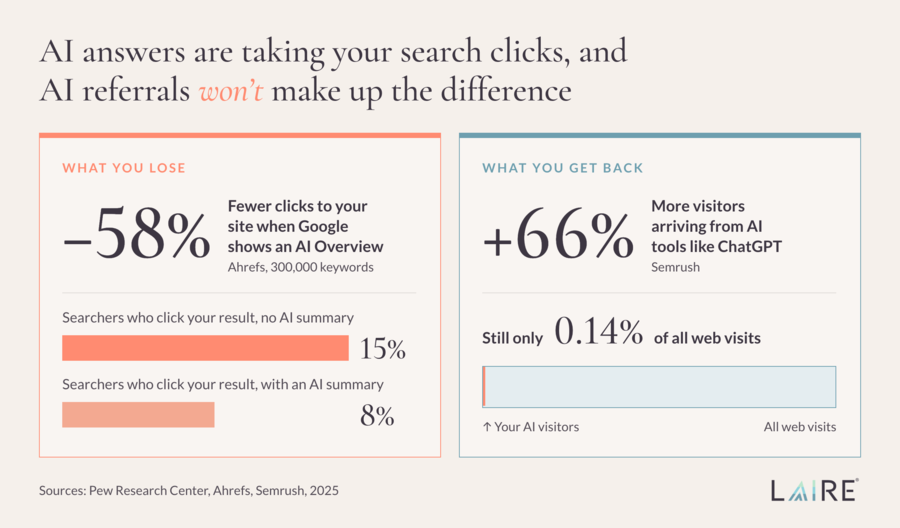
Put those together and you get the honest picture. The clicks you're losing aren't coming back as AI referral traffic, because that channel is nowhere near big enough to replace them. Anyone selling you AEO as a way to recover lost sessions is selling you the wrong outcome.
What you're protecting is influence. A buyer asks an assistant which firms do what you do, and the answer shapes their shortlist. That happens long before they visit any of your traffic sources. Being in that answer matters even when it sends you nothing you can measure.
Where your buyers are asking the questions
The surfaces worth caring about in B2B are narrower than the hype suggests. Ahrefs found that ChatGPT, Perplexity, and Gemini account for roughly 98% of measurable AI referral traffic. The split runs about 50%, 31%, and 18%.
Reaching far more people are Google's AI Overviews and AI Mode. These appear inside the search results your buyers were already using, which is part of why their effect on clicks is so pronounced. We covered the search updates from Google I/O 2026 separately if you want that detail.
AEO and SEO are not separate disciplines
Here's where we part company with most AEO guides. We'd rather point you at the primary source than ask you to take our word for it.
Google publishes an optimization guide for its generative AI features, and its position is unambiguous. "From Google Search's perspective," it says, "optimizing for generative AI search is optimizing for the search experience, and thus still SEO."
The reason is structural. Google's AI features are built on top of its core ranking systems. The systems deciding whether you're a credible source are the same ones that decided it before.
That doesn't make AEO meaningless. It means the difference lives in emphasis and measurement, not in a new toolkit.
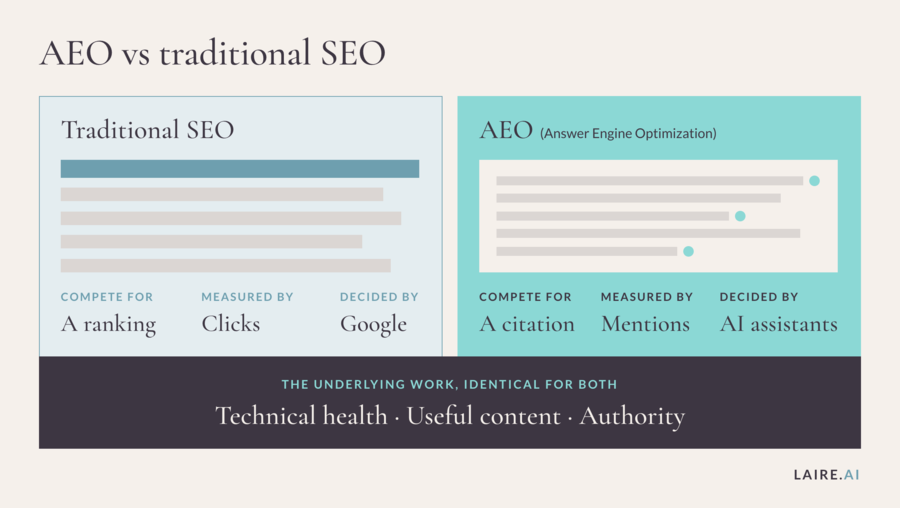
|
SEO (Search Engine Optimization) |
AEO (Answer Engine Optimization) |
|
|
What you compete for |
A position in a list of links |
Inclusion in a generated answer |
|
What success looks like |
Rankings, clicks, sessions |
Mentions, citations, share of voice |
|
Who decides |
Google's ranking systems |
The same systems, plus each assistant's own retrieval |
|
What the content must do |
Satisfy the searcher who lands on it |
Be extractable and quotable before anyone lands |
|
Where you check the result |
Search Console, rank tracking |
Prompt-level visibility tracking across assistants |
|
The underlying work |
Technical health, useful content, authority |
Technical health, useful content, authority |
That last row is the one that matters. Keyword research still sets the foundation, and the fundamentals behind our B2B SEO work haven't been replaced. What's new is that you now have to measure a surface that doesn't report back to you.
What our own AI visibility looks like right now
Every AEO guide we read while researching this one analyzed someone else's citations. None published their own. So here are ours.
We track 23 prompts in HubSpot's AI visibility tool, covering questions a B2B buyer would plausibly ask when looking for an agency like us. Between September 6 and October 6, 2026, those prompts produced 2,135 recorded AI responses.
|
Metric |
Result |
|
AI responses recorded |
2,135 |
|
Responses that mentioned LAIRE |
434 |
|
Average visibility |
20.3% |
|
Total citations recorded |
16,767 |
|
Citations pointing to lairedigital.com |
195 (1.2%) |
|
Our rank among all cited domains |
9th |
|
Most-cited domain in the set |
hubspot.com, 3,594 citations (21.4%) |
Here's the same window split by assistant, which is where it gets useful.
|
Assistant |
Responses |
Mentioned us |
Mention rate |
Citations issued |
Citations to us |
|
ChatGPT |
713 |
221 |
31.0% |
3,678 |
19 |
|
Gemini |
713 |
109 |
15.3% |
2,296 |
58 |
|
Perplexity |
709 |
104 |
14.7% |
10,793 |
118 |
Four things are worth drawing out, because raw numbers don't interpret themselves.
ChatGPT mentions us twice as often as Gemini or Perplexity, and it almost never links to us. Only 19 of the 221 responses that named us pointed a reader at our site. The brand is doing that work, not the page.
Perplexity behaves in the opposite way. It issued 10,793 citations across 709 responses, roughly 15 sources per answer. It was also the assistant least likely to mention us by name. Citation volume and mention likelihood are different things, and a tool reporting only one of them will mislead you.
A single vendor's domain took 21.4% of all citations in the set. For questions about agencies, HubSpot's own content is the most-cited source by a wide margin. That tells you something real about where authority accumulates inside a partner ecosystem.
Our share of voice across the agency set we track is 0.24%, against roughly 4.9% for the strongest performer. We're publishing that figure because a baseline you only share when it flatters you isn't a baseline. Twenty-three prompts is a small tracked set, the window is 30 days, and these are high-competition agency-selection queries. What the number gives us is a starting point and a direction. That's more than most companies have.
Get a baseline before you change anything
Almost every AEO guide skips this part. If you don't know where you stand today, you won't be able to tell whether anything you do next worked. Assistants update constantly, so a visibility number that moves after your changes may have moved anyway.
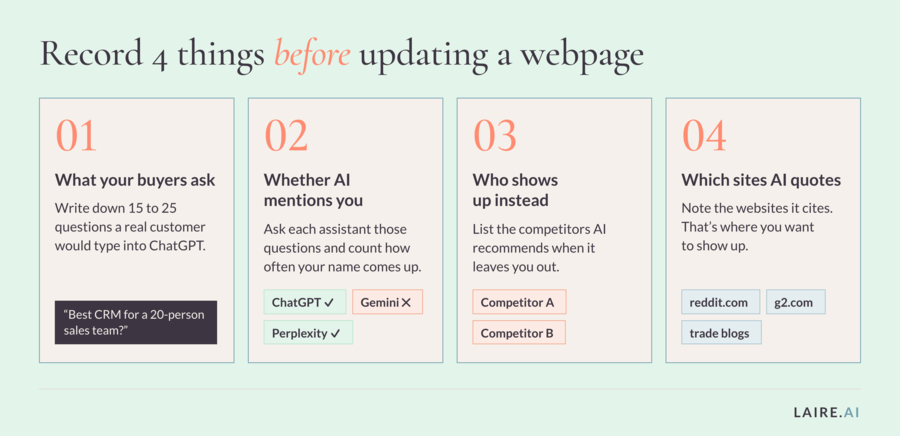
Record four things before you touch a single page:
1. What your buyers ask. Pick 15 to 25 prompts a real buyer would type. Mix category questions, comparison questions, and the problem questions that sit earlier in the journey. These become your tracked set, and you should expect to live with them for a while.
2. Your mention rate per assistant. How often does each assistant name you, out of the responses it generated for your set? The per-assistant split tells you more than the average does, as our own numbers show.
3. Who gets cited instead. The competitors appearing where you don't are more useful than any keyword gap report. They tell you which sources the model trusts on your topic.
4. Which domains the citations point to. Most teams never look at this one, and it's the one that shows you where to go next. If a review platform, a partner directory, or a vendor's blog carries the citations in your category, that's the surface to work on.
Once the baseline is down, our nine AI visibility best practices go deeper on the practices themselves.
What the evidence says is worth doing
With a baseline recorded, the work splits into three tiers by how well supported it is.
Answer the question before you do anything else
The highest-confidence move is also the least glamorous. Put a direct, self-contained answer near the top of any page meant to serve a question. Write it so it survives being lifted out of context. Keep it to 40 to 60 words, and make sure it reads as a complete thought without the heading above it.
The same logic applies to structure. Clear headings matched to real questions, comparison tables, and short definitional blocks all help a model locate the part of your page that answers the question. We've written about comparison tables that AI can lift in more detail. Structuring a site so content is findable is the same discipline applied one level up.
Build the sources that models already trust
Assistants cite what they can corroborate. That makes third-party presence more valuable than it was when a link was the only goal, whether it's review platforms, partner directories, trade publications, or genuine expert bylines. Building E-E-A-T signals into your pages matters here for the reason it always did. The new wrinkle is that a model has to be able to tell who wrote something and why they're credible.
Volume stops helping at this point. AI-generated content doesn't carry SEO value on its own. Publishing more of it into a category where models weigh source quality tends to make things worse.
Keep the technical floor intact
None of the above works if a page is slow, blocked, or duplicated. Confirm your pages are crawlable. Check that you haven't no-indexed something that should be visible, and that your best pages aren't competing with near-duplicates. If you have an existing library worth saving, re-optimizing posts with ROPS is usually faster than writing new ones.
What the AEO market sells that Google says you can skip
Several things sold as AEO essentials are, by Google's own account, unnecessary. We'd rather you spent the budget elsewhere.
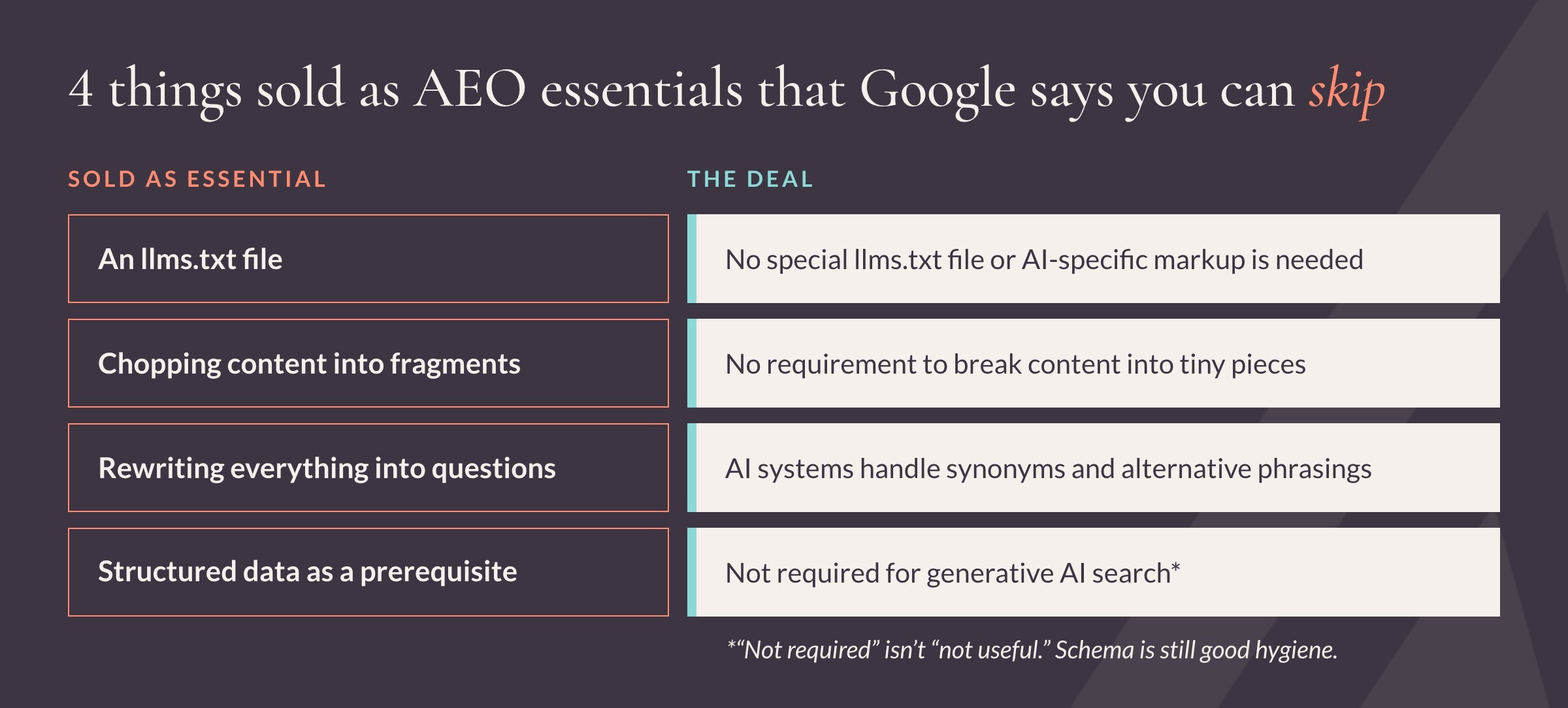
An llms.txt file. Google's guide states plainly that no special llms.txt file or AI-specific markup is needed. Adoption of the format stays voluntary and inconsistent across assistants.
Chopping your content into fragments. There's no requirement, Google says, to break content into tiny pieces for AI. Short self-contained answers help. Shredding a good page into disconnected chunks does not.
Rewriting everything into question format. AI systems handle synonyms and alternative phrasings. Rewriting a library of working pages so every heading becomes a question is a large cost for a small effect.
Structured data as a prerequisite. This one surprises people, because it contradicts a lot of AEO marketing. Google's position is that structured data isn't required for generative AI search.
That last point deserves a caveat. "Not required" and "not useful" are different claims. Schema still helps search features; it still helps Google parse your page reliably, and it costs very little. Treat it as good hygiene rather than the thing standing between you and a citation.
How to measure AEO when the click never happens
The hardest adjustment isn't tactical. It's accepting that your best outcome may generate no session at all, which breaks most marketing dashboards.
Four measures survive the shift.
Mention rate, tracked per assistant over time. This is the single number worth reporting upward. Track the trend rather than the absolute figure, since the figure depends entirely on which prompts you picked.
Citation share. Of the sources cited in answers to your questions, what proportion are yours? Ours is 1.2%, and that's the number we're working on.
Competitive share of voice. Who's being named instead of you, and is that changing? This travels well in a leadership meeting because it's comparative rather than absolute.
Referral quality, not volume. AI referral traffic will be small. Judge it on what it does, and don't hold it to the volume standard you used for organic.
For a vertical view, we've written up seven AEO plays for financial firms and a walkthrough of optimizing a wealth management site for AI search.
Frequently asked questions
What does AEO stand for?
AEO stands for answer engine optimization. It's the practice of structuring and strengthening your content so AI-powered answer engines can find it, understand it, and cite it when generating a direct answer.
What is AEO in marketing, and is it different from SEO?
Not in technique. Google's own optimization guide says optimizing for generative AI search "is still SEO," because its AI features run on the same core ranking systems. The difference sits in emphasis and measurement. AEO prioritizes extractable answers and third-party corroboration, and you measure it by mentions and citations rather than rankings and clicks.
What's the difference between AEO and GEO?
Very little in practice. GEO stands for generative engine optimization. You'll also see AI visibility optimization and AI search optimization used for the same work. The terms come from different vendors rather than different methods. Pick one internally and move on.
Do I need an llms.txt file?
Not for Google. Its guidance states that no special llms.txt file or AI-specific markup is required. Support across other assistants is voluntary and inconsistent, so treat it as a low-priority experiment rather than a foundation.
How long does AEO take to show results?
Expect to track for at least 60 to 90 days before you trust a trend. Assistant outputs vary between runs even when nothing on your site has changed. That variance is precisely why a recorded baseline matters more here than it does in traditional SEO.
How do I know whether AI is citing my site?
You need prompt-level tracking, because standard analytics won't show it. Tools inside HubSpot, Semrush, and several dedicated platforms run a fixed set of prompts across assistants on a schedule, then record mentions and citations. Our own numbers above come from running exactly that.
Start with a baseline, not a retainer
If you take one thing from this, make it the order of operations. Find out where you stand across the assistants your buyers use. See who's being cited instead of you. Only then decide what's worth changing. Most companies we talk to are being sold tactics before anyone has established what needs fixing.
That's why our AI consulting and AEO services start with an LLM Analysis & Brand Insights report rather than a content plan. It takes a 20-minute AI Readiness Assessment to get one, and you'll leave with your own version of the tables above.

If you'd rather not talk to anyone yet, our AI-Powered Storytelling handbook covers how to pair AI efficiency with the human judgment buyers still trust.
AI visibility figures in this article come from HubSpot AI Visibility tracking of 23 prompts across ChatGPT, Gemini, and Perplexity, September 6 to October 6, 2026. Structured-data figures come from a Semrush crawl of lairedigital.com completed October 6, 2026.