A financial services marketing plan is a 12-month document that settles six decisions: who you’re reaching, what you’ll say, which channels carry it, what it costs, who owns each piece, and how you’ll measure it.
The structure isn’t unusual. Financial services makes it harder in two ways. Almost every asset has to clear an approval process before anyone outside the building sees it, and trust in this category takes years to build.
Most firms write a plan their compliance process can’t absorb, then abandon it by spring. If you size yours to what you can produce and approve, it will out-publish a more ambitious plan every year it runs.
What makes a financial services marketing plan different
Three things change the shape of the document.
Compliance sits inside the production line, not at the end of it. A blog post, a webinar invitation and a one-page PDF are all regulated communications in most financial firms. The person who approves them usually has a full-time job elsewhere, and that person’s availability sets your production ceiling.
Events trigger buying; campaigns don’t. A business sells, a physician finishes residency, a treasurer gets burned by a bank. You can’t schedule those moments, so the plan has to keep your firm visible through a long quiet period and then convert fast when one arrives.
Clients buy on trust. Nobody moves a retirement account because of a clever campaign, so your plan has to keep producing evidence of competence. That work is slower and less exciting than a quarterly push.
Written plans are also rarer than you’d expect. Broadridge’s fifth annual advisor marketing survey, fielded by the independent research firm 8 Acre Perspective among 403 U.S. registered advisors in late 2023, found that only 20% had a defined marketing strategy, down from 28% in 2019. Advisors who had one were much more likely to report a rise in inbound requests, 70% against 44%.
Those are self-reported numbers from advisors, and they don’t extend to banks or lenders. They do suggest the bar for standing out is lower than most marketing leaders assume.
Still weighing plan against strategy? The distinction between the two is worth five minutes before you start writing.
Start with the arithmetic, not the channels
Before you choose a single tactic, work backward from the revenue number to the traffic number. Most plan templates skip this step, which is why so many plans commit to goals nobody ever tested.
Take an RIA that wants to add $8 million in new assets under management next year. The average new relationship is $800,000, so the plan needs ten new clients. If one in four qualified meetings becomes a client, that’s forty meetings. If one in five inbound inquiries becomes a meeting, that’s two hundred inquiries. At a 2% visitor-to-inquiry rate, the plan needs about 10,000 sessions across the year, or roughly 830 a month.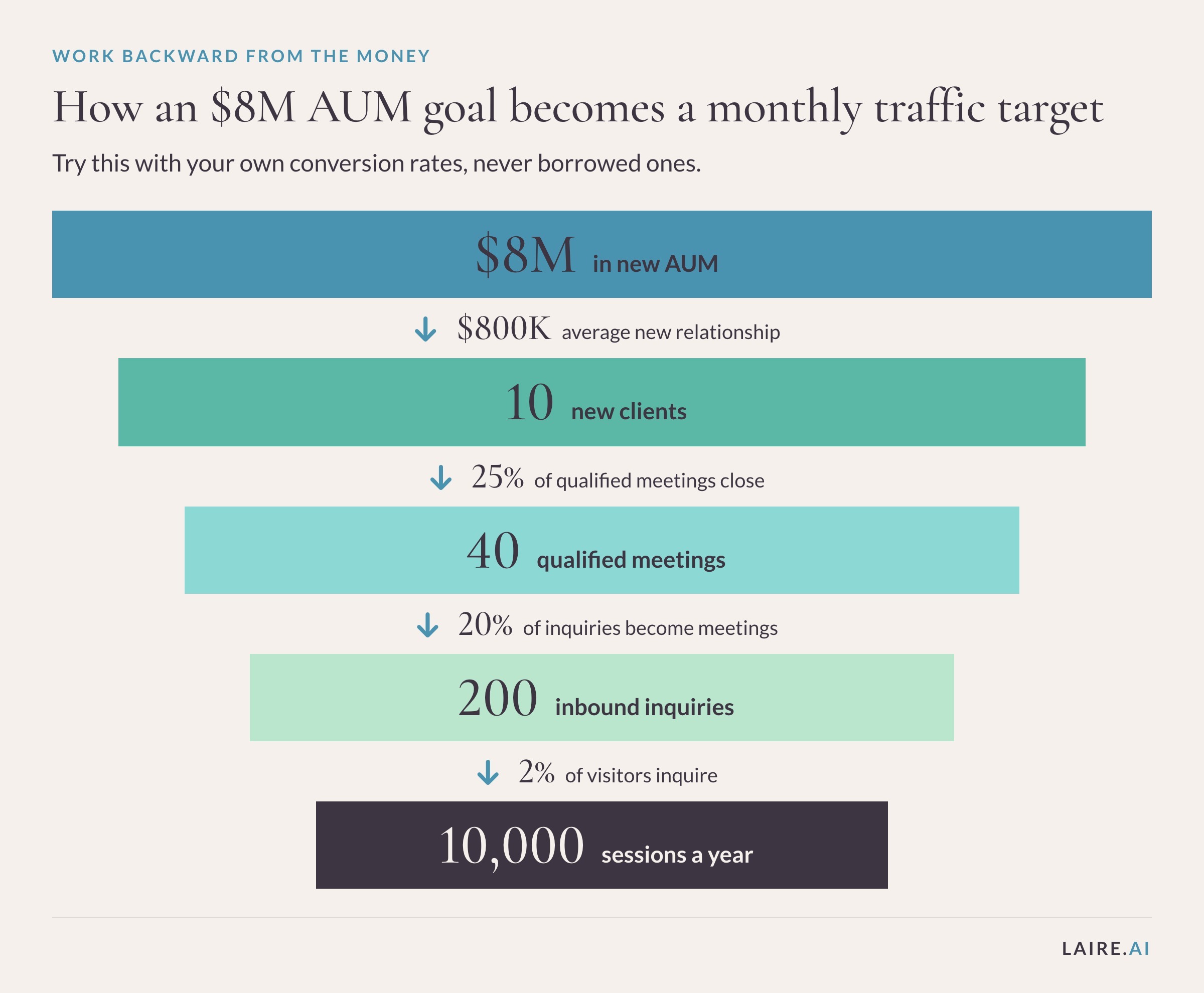
The table below shows how one revenue goal cascades into a monthly traffic requirement.
|
Step |
Conversion assumption |
Required volume |
|---|---|---|
|
New AUM goal |
$800K average relationship |
$8M |
|
New clients |
Target |
10 |
|
Qualified meetings |
25% close to client |
40 |
|
Inbound inquiries |
20% inquiry to meeting |
200 |
|
Website sessions |
2% visitor to inquiry |
10,000 |
Now compare that last number to what your firm does today. At 300 sessions a month, 830 is ambitious but reachable in a year. At 90, you need a longer horizon, paid traffic to buy the shortfall, or a referral motion carrying most of the load.
Run this with your own conversion rates, never borrowed ones. If you don’t have them yet, finding out is the first project in the plan. Firms that generate traffic but can’t say where it stops converting usually have a follow-up problem rather than a traffic problem.
The six sections your plan needs
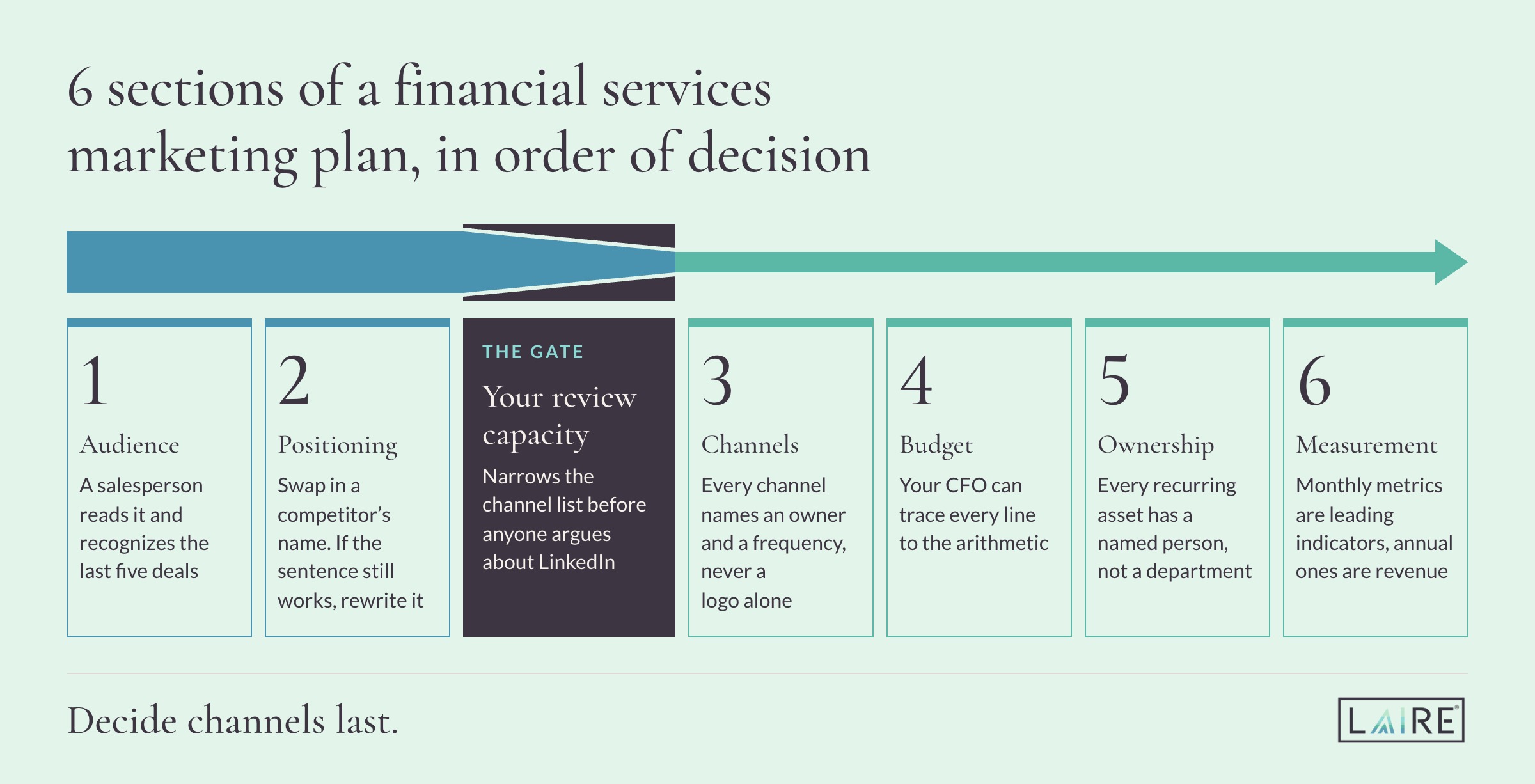
Everything in a working financial services marketing plan fits into six sections, and each one has a test it has to pass. A section that can't pass its test belongs in a wish list.
Use the table below as the structure of the document itself, one section per heading, each with its test written underneath.
|
Section |
What it must answer |
The test |
|---|---|---|
|
Audience |
Which segments are you pursuing, in priority order, and what triggers their search? |
A salesperson reads it and recognizes the last five deals |
|
Positioning |
What do you say that a competitor across town couldn't say about themselves? |
Swap in a competitor's name. If the sentence still works, rewrite it |
|
Channels |
Which channels carry which message, at what cadence? |
Each channel names an owner and a frequency, never a logo alone |
|
Budget |
What does the plan cost, split by channel and by build versus run? |
Your CFO can trace every line to an outcome in the arithmetic above |
|
Ownership |
Who produces, who reviews, who approves, who publishes? |
Every recurring asset has a named person, not a department |
|
Measurement |
What are you watching monthly, quarterly and annually? |
Monthly metrics are leading indicators, annual ones are revenue |
Two of these deserve more attention than they get. Positioning fails because firms describe themselves in terms every competitor also uses, so the sentence survives the swap test. Ownership fails because plans assign work to “marketing” instead of a named person, and recurring work is always the first to disappear.
Channels are where most of the debate happens, so decide them last. Audience, positioning and review capacity should narrow the list before anyone argues about LinkedIn.
Build the plan around your review capacity
Review capacity breaks more financial services marketing plans than budget does. Your plan publishes only as fast as your reviewer approves, and almost nobody calculates that number before committing to a calendar.
What the rules require
Under FINRA Rule 2210, a written communication made available to more than 25 retail investors in any 30 calendar-day period counts as a retail communication. A qualified registered principal has to approve it before use. The rule also requires records showing the source of any statistical table, chart, graph or illustration in it.
SEC-registered advisers work under the Marketing Rule, Rule 206(4)-1, which has applied since its November 4, 2022 compliance date. It permits testimonials and endorsements, a useful opening for advisory firms, but the conditions are strict. You need clear and prominent disclosure of whether the promoter is a client and whether they were paid, a written agreement with the promoter, and adviser oversight. Compensation of $1,000 or less over the preceding twelve months falls under a de minimis exception. Amended Rule 204-2 requires advisers to keep copies of every advertisement they disseminate.
In practice, each of these is a production cost: a sourced record for every chart, an agreement and a disclosure for every testimonial, and a named approver and date for every asset.
Calculate your monthly ceiling
Do this before you set the calendar:
Approved assets per month = (reviewer hours per month ÷ hours of review per asset) × (1 − rework rate)
Say your compliance officer gives marketing six hours a month and each asset takes forty-five minutes. That clears eight pieces. If a quarter come back for changes, you’re down to six, so the plan commits to six a month. A calendar calling for twelve will start missing in February, and marketing will take the blame for a math error made in January.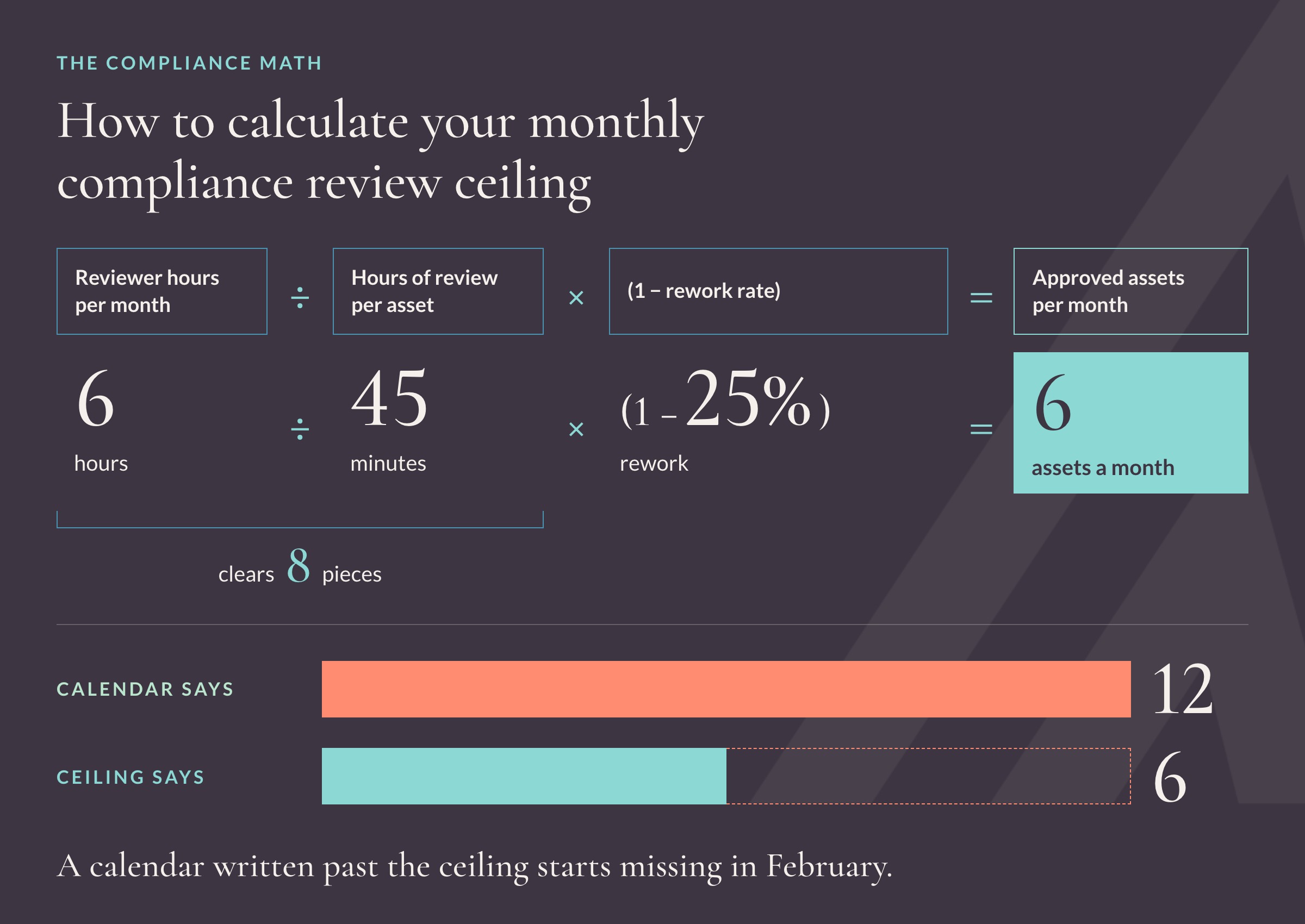
Three ways to raise the ceiling
In order of how fast they work:
- Pre-approve the repeatable parts. Get standing approval for disclosure language, bio boilerplate, performance presentation formats and a set of recurring templates. Reviews speed up when only the new material is new.
- Submit in batches with sources attached. A reviewer working through eight assets with citations already assembled moves faster than one chasing footnotes across eight emails.
- Shift the mix toward lower-review assets. A client case summary built from pre-approved language costs less review time than market commentary with fresh numbers in it.
We’ve made the fuller argument for why this pace is an advantage in why financial marketing has to run slower and smarter.
How much to budget, and how to split it
Gartner's 2026 CMO Spend Survey puts the average marketing budget at 7.8% of company revenue. Gartner describes that as 18% below the mean four years earlier. Paid media accounts for 31.4% of budgets. It’s a cross-industry average with no sector breakout published, so use it as a conversation anchor with your CFO. Advisory practices and community institutions commonly run well below it.
A more useful method is to price the plan you’ve written. Add up four things: the production the calendar requires, the systems it depends on, the paid spend that closes the traffic shortfall, and the people doing the work. If the total lands far outside what leadership will approve, cut scope. Under-funding every line instead leaves no channel with enough behind it to work.
For a mid-market financial firm starting from a thin digital presence, a reasonable first-year split looks roughly like this. Treat it as a starting point; we’d adjust for your situation.
- Around 40% to foundations. Website, tracking, CRM setup, positioning and the first pre-approved templates. Heavy in year one, much lighter afterward.
- Around 35% to content and organic visibility. The compounding asset, and the one your review capacity governs.
- Around 25% to paid acquisition. Enough to learn which messages and segments respond while organic builds.
The split shifts in year two. Foundation spending drops and the other two absorb the difference. If your growth target is aggressive, work through the relationship between marketing spend and revenue growth before the budget conversation.
What to measure in year one, and what the growth curve looks like
Separate leading indicators from lagging ones, and be clear with your board about which you can expect when.
Monthly, watch what you control: assets published against assets planned, review turnaround time, organic sessions, inquiry volume and inquiry-to-meeting conversion. Quarterly, watch pipeline: qualified meetings held, opportunities created and cost per qualified meeting. Annually, watch revenue, new clients and client acquisition cost.
Organic sessions are an input rather than a result. Report them to a board as a result and marketing loses credibility fast, especially in a firm that counts dollars for a living. The same goes for follower counts and impressions, which is the longer argument we make about vanity metrics.
The timeline is the part most articles soften. The table below tracks six years of organic performance at a Charlotte financial planning firm we've worked with since 2019. It starts from a site that had produced twelve leads in nine months.
|
Year |
Organic sessions |
New organic contacts |
|---|---|---|
|
2019 |
2,816 |
12 |
|
2020 |
6,734 |
31 |
|
2021 |
16,720 |
33 |
|
2022 |
13,607 |
30 |
|
2023 |
32,885 |
53 |
|
2024 |
68,658 |
69 |
Across that span, organic sessions grew 2,338% and new organic contacts grew 475%. The middle of the table tells you more. In 2022, traffic went backwards and contacts stayed flat. A firm reading that quarter by quarter would have had every reason to conclude the plan had failed, and plenty of firms decide exactly that in month twenty.
This is one firm, in one segment, in one market, so the numbers are neither typical nor a guarantee. They do show a shape worth planning for: slow early, uneven through the middle, then steep. Build your budget and your leadership expectations around that curve instead of a straight line.
A twelve-month sequence that holds up
Order matters as much as content, and most plans try to run everything at once in January.
The sequence below loads the heavy foundation work into Q1, so the publishing months aren’t competing with setup.
|
Quarter |
Focus |
What finishes |
|---|---|---|
|
Q1 |
Foundations |
Tracking and CRM working, positioning agreed, pre-approved template set signed off, baseline conversion rates measured |
|
Q2 |
Publish and learn |
Content running at the approved monthly ceiling, first paid tests live, review turnaround measured and improved |
|
Q3 |
Expand what works |
Double down on the two channels producing meetings, retire the rest, build the first substantial conversion offer |
|
Q4 |
Review and reset |
Full-year read against the arithmetic, revised conversion assumptions, next year's plan drafted from real numbers |
Firms skip the Q4 step, and it’s the cheapest improvement available. Rebuilding next year’s plan on measured conversion rates beats most new tactics, because it corrects the arithmetic everything else rests on. A standing review cadence for the plan itself keeps that from becoming an annual scramble.
Add one check in 2026. Ask an AI assistant a question you want to be found for and see how your firm appears. Answer engines increasingly sit between a prospective client and your website, and the work that earns a citation differs from classic SEO. We covered the specifics in getting your financial firm cited by AI.
Build it in-house or bring in help
Decide on capacity and range first, cost second. A plan like this needs strategy, writing that survives compliance review, SEO, design, marketing operations and reporting. Few financial firms under two hundred people hold all of that in one or two people, and the ones that do usually hold it in someone already fully booked.
Build in-house when you have a marketer with that range, a reviewer who responds quickly, and leadership patient enough to wait out the middle of that curve. Bring in help when the plan keeps slipping for reasons nobody can name, when two years produced activity without pipeline, or when you’re entering an unfamiliar segment.
If cost is the open question, we've published what a custom marketing plan typically costs and a comparison of hiring in-house against bringing in an agency.
Where financial services marketing plans usually break
Four failure modes account for most of it.
The plan commits to more than the reviewer can approve, so the calendar slips in month two and never recovers. The plan carries no arithmetic, so nobody can say whether the goal was reachable. Ownership goes to a department instead of a person, so recurring work stops without anyone deciding to stop it. The most expensive one is judging the plan on a quarterly timeline when the asset it builds compounds over years.
All four are planning decisions rather than execution problems, so all four are fixable in a document before anyone spends money. A broader look at why marketing plans fail covers the patterns that show up outside financial services too.
Frequently asked questions
How much should a financial services company spend on marketing?
Gartner's 2026 CMO Spend Survey puts the cross-industry average at 7.8% of company revenue. No financial services breakout is published, and many advisory firms and community institutions spend considerably less. A better method is to price the plan itself: production, systems, paid spend to close the traffic shortfall, and people. If that total exceeds what leadership will fund, reduce scope instead of under-funding every line.
How long does it take for a financial services marketing plan to produce leads?
Expect early engagement signals within one to three months, meaningful organic results in six to twelve, and reliable pipeline contribution near the end of year one. Paid channels produce inquiries faster but stop when spending stops. The compounding curve is rarely smooth, and a flat or negative quarter in year two is common. It isn’t a reason to abandon the plan.
Who should own the marketing plan at a small financial services firm?
One named person with calendar time for it, usually a marketing manager or director. They need an executive sponsor who can clear roadblocks and a compliance reviewer committed to a specific turnaround time. Plans assigned to “the marketing team” lose their recurring work first. Negotiate the reviewer’s availability when the plan is written, not in March.
Can financial advisors use client testimonials in marketing?
SEC-registered investment advisers have been able to since the Marketing Rule’s November 4, 2022 compliance date, subject to conditions. Advertisements must clearly and prominently disclose whether the promoter is a client and whether they were compensated. The adviser must also oversee compliance and hold a written agreement with the promoter. Compensation of $1,000 or less over the preceding twelve months falls under a de minimis exception. Rules differ for broker-dealers and other regulated entities, so confirm your own obligations with counsel or your compliance officer.
What is the difference between a marketing plan and a marketing strategy?
A strategy is the set of choices about which markets you compete in and how you intend to thrive in them. A plan is the 12-month execution document that turns those choices into channels, budgets, owners and dates. A firm with a plan but no strategy produces consistent activity aimed at nobody in particular. A firm with a strategy but no plan produces good intentions.
Get a second read before you commit a year to it
Most plans stall somewhere specific. Usually it's the arithmetic nobody tested, or a calendar written past the review ceiling. Both are cheaper to find now than in June.
That's the work behind the Marketing Action Plan (MAP) by LAIRE. It covers personas, positioning, competitor analysis, content and SEO recommendations, paid guidance and a prioritized twelve-month implementation plan built for your firm, not your category. Book a free 20-minute consult and we'll tell you where your plan is likely to stall and what to fix first.
Prefer to build it yourself? The Marketing Action Plan Workbook follows the same structure, and our financial services marketing page explains how we work with firms in this category.