Financial services firms are under increasing pressure to create more personalized client experiences, streamline operations, and scale growth without adding unnecessary complexity.
For many firms, the CRM becomes the foundation of that strategy.
Two of the most recognized CRM platforms on the market are HubSpot and Salesforce. Both offer powerful capabilities, but they approach customer relationship management very differently.
So, which platform is the better fit for financial advisors, RIAs, wealth management firms, insurance agencies, and financial services organizations?
The answer depends on your goals, resources, and growth strategy.
The Quick Answer
For most small to mid-sized financial services firms, HubSpot is typically the better choice.
For large enterprises with dedicated Salesforce administrators, extensive custom development requirements, and highly complex operational needs, Salesforce may be the better fit.
The reality is that many firms purchase more CRM than they actually need.
The best CRM is not the one with the longest feature list. It is the one your team will actually use.
HubSpot vs Salesforce: A High-Level Comparison
|
|
HubSpot |
Salesforce |
|
Ease of Use |
Excellent |
Moderate |
|
User Adoption |
High |
Often Requires Training |
|
Implementation Time |
Weeks |
Months |
|
Marketing Automation |
Built In |
Additional Products |
|
Reporting |
Strong |
Highly Customizable |
|
Custom Development |
Moderate |
Extensive |
|
Cost of Ownership |
Lower |
Higher |
|
Financial Services Flexibility |
Strong |
Strong |
|
AI Capabilities |
Built Into Platform |
Available Through Einstein |
Why Financial Services Firms Are Choosing HubSpot
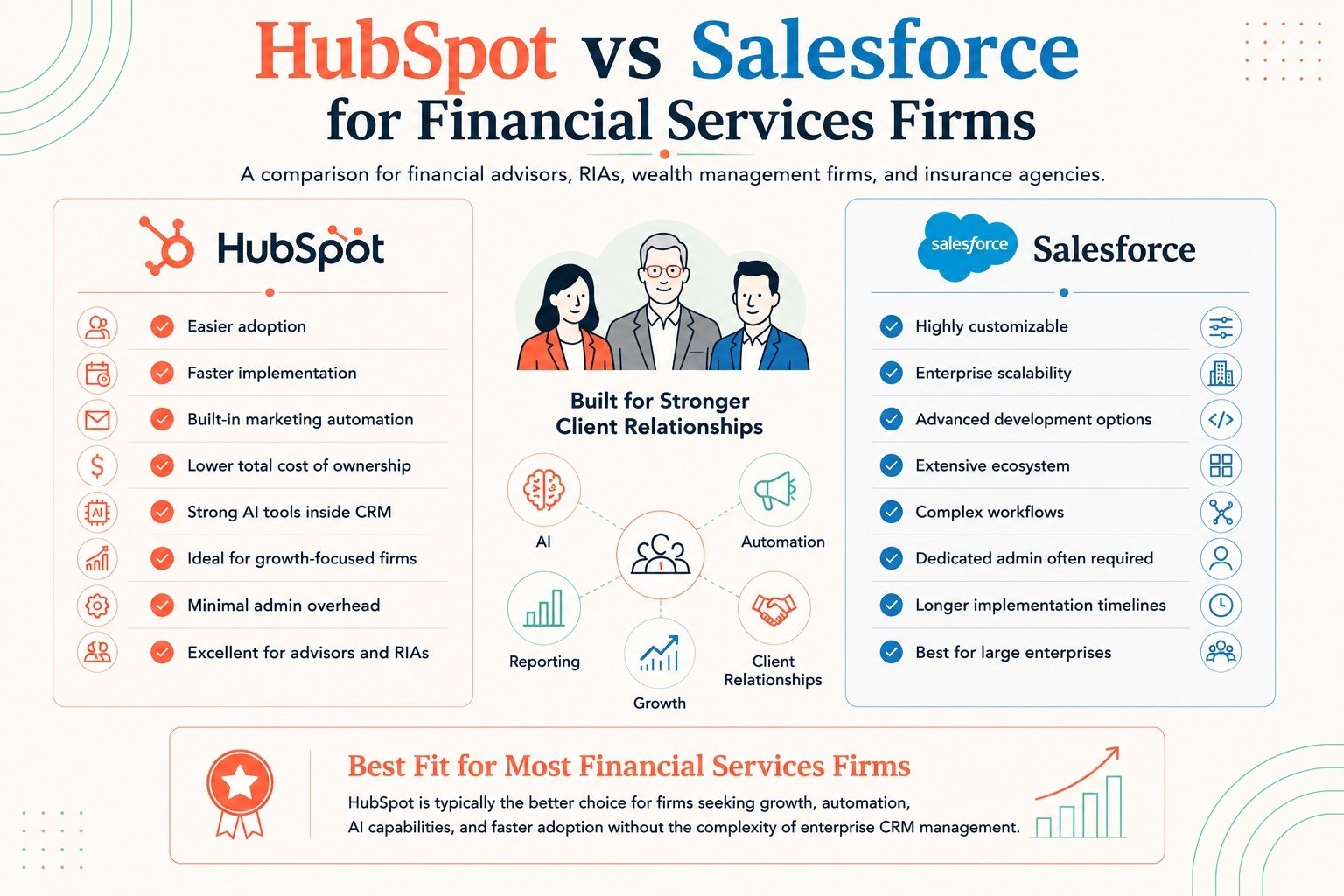
Historically, Salesforce dominated the financial services industry.
Today, many advisory firms, RIAs, insurance agencies, and wealth management companies are evaluating HubSpot for its modern experience and the fact that it doesn't require a dedicated CRM administrator.
HubSpot combines:
- CRM
- Marketing Automation
- Sales Automation
- Content Management
- Customer Service
- Reporting
- AI Tools
Within a single platform.
For growing firms, this often eliminates the need to manage multiple disconnected systems. If your firm isn't ready to fully migrate, you can learn how to bridge the gap between platforms in our HubSpot and Salesforce Integration Guide.
Advantages of HubSpot for Financial Services
1. Faster User Adoption
One of the biggest challenges in financial services technology is adoption.
Many firms invest heavily in software only to discover that advisors, producers, and relationship managers are not using it consistently. To overcome this hurdle, check out our Certified HubSpot Trainer Insights.
HubSpot’s interface is intuitive and designed for everyday users rather than technical administrators.
This often results in:
- Better data quality
- Improved visibility
- Increased team adoption
- More consistent processes
2. Better Marketing and Growth Capabilities
Many financial firms are trying to solve more than CRM challenges.
They are trying to:
- Generate leads
- Nurture prospects
- Increase referrals
- Improve client communication
- Create personalized experiences
HubSpot was built with these goals in mind.
Its marketing automation capabilities make it easier to create sophisticated client journeys without a separate marketing platform.
Its marketing automation capabilities make it easier to create sophisticated client journeys without a separate marketing platform. See how this works in practice with our guide on HubSpot for Financial Services.
3. Strong AI Integration
HubSpot’s AI tools are embedded directly into the CRM experience.
Examples include:
- Prospecting assistance
- Automated content creation
- Sales recommendations
- Workflow automation
- Conversation intelligence
The focus is less on replacing advisors and more on helping teams become more efficient.
When Salesforce Makes Sense
Salesforce remains an excellent platform for certain organizations.
In particular, firms may benefit from Salesforce when they have:
- Enterprise-level complexity
- Multiple business units
- Dedicated Salesforce administrators
- Internal development teams
- Extensive customization requirements
Large institutions often choose Salesforce because they can build highly customized ecosystems around the platform.
The tradeoff is increased complexity, implementation costs, and ongoing administration. If you choose a simpler path but still need expert guidance, find out whether hiring a full-service agency makes sense.
HubSpot vs Salesforce for RIAs
For most Registered Investment Advisors, HubSpot offers a simpler path to growth.
Many RIAs need:
- Prospect management
- Marketing automation
- Referral tracking
- Appointment scheduling
- Client communication workflows
- Reporting
HubSpot provides these capabilities in a platform that is easier to manage and scale. To maximize these tools for your pipeline, learn how to generate leads for financial advisors.
Salesforce can absolutely accomplish the same goals, but it often requires more configuration and ongoing support.
HubSpot vs Salesforce for Wealth Management Firms
Wealth management firms often prioritize:
- Relationship management
- Personalized communication
- Client retention
- Marketing automation
- Advisor productivity
Because of this, many firms find that HubSpot’s combination of CRM, automation, and marketing tools aligns well with their growth strategy. See how this framework delivers tangible growth, as in 260% growth with Inbound Marketing.
The ability to create highly personalized communication at scale is becoming increasingly important as firms adopt AI-powered engagement tools.
The Growing Role of AI in Financial Services CRM
The CRM conversation is no longer just about managing contacts.
It is about creating personalized experiences.
Modern firms are using AI to:
- Reduce no-shows
- Automate follow-up
- Personalize outreach
- Improve lead conversion
- Increase advisor productivity
The firms that succeed over the next decade will not simply collect data.
They will activate it. To prepare your digital presence for the future of AI-driven discovery, see how to optimize with Perplexity and ChatGPT.
This is where CRM selection becomes a strategic decision rather than a technology decision.
Our Recommendation
For most financial services firms, HubSpot provides the strongest balance of:
- Ease of use
- Adoption
- Marketing capabilities
- Automation
- AI readiness
- Total cost of ownership
Salesforce remains a powerful enterprise platform, but many firms discover they can achieve their growth objectives faster and with less complexity using HubSpot. If you are ready to evaluate next steps, learn whether you need simple onboarding or a custom implementation.
The right choice ultimately depends on your firm’s size, goals, and operational requirements.
Need Help Evaluating HubSpot for Financial Services?
At LAIRE, we help financial advisors, RIAs, wealth management firms, and financial services organizations evaluate, implement, and optimize HubSpot.
Whether you’re migrating from Salesforce, exploring CRM options, or looking to leverage AI-driven automation, our team can help you build a scalable growth strategy that fits your business.