An ideal customer profile describes the type of company that gets real value from what you sell and is profitable for you to serve. It's a description of an organization, and the people inside it come later.
Most companies already have one written down somewhere. The trouble is that it usually describes a company anyone would want: mid-sized, growing, well-funded, and open to new ideas. That's a wish list. A working ICP does something harder. It tells your team which companies to stop pursuing.
This article covers the definition, how an ICP differs from a buyer persona and your total addressable market, a test for choosing criteria, and a five-step method you can run on data you already have.
What is an ideal customer profile?
An ideal customer profile is a description of the companies most likely to buy from you, stay with you, and grow with you. It sits at the account level. Firmographics, operating model, technology, and buying structure are the usual inputs.
The word "ideal" carries weight in both directions. These companies get genuine value from your product or service. You also serve them profitably, renew them, and get referrals from them. A customer who's delighted but unprofitable belongs outside the profile, and so does a lucrative account that never renews.
Three things often get filed under "ICP" and belong somewhere else. A list of attractive company traits is a wish list. The universe of companies that could buy is your total addressable market. A description of a person is a buyer persona.
Here's the practical test. Read your current ICP and ask which companies in your pipeline it rules out. If the answer is none, you've written a description of your market and called it a profile.
Total addressable market vs ICP vs buyer persona
These three terms get used interchangeably more often than any other set in B2B marketing. The table below compares them on the five things that matter in practice: what each one describes, the question it answers, the attributes it holds, who owns it, and when you reach for it.
|
Total addressable market |
Ideal customer profile |
Buyer persona |
|
|---|---|---|---|
|
Unit of analysis |
A market |
A company |
A person |
|
Question it answers |
Who could buy this? |
Which companies should we pursue? |
How do we speak to the people who decide? |
|
Typical attributes |
Industry categories, geography, market size |
Revenue band, employee count, operating model, tech stack, trigger events |
Role, responsibilities, goals, objections, where they get information |
|
Who usually owns it |
Finance and leadership |
Sales, marketing, and RevOps together |
Marketing |
|
What you use it for |
Sizing the opportunity and planning investment |
Deciding which accounts to work and which to decline |
Writing the message and choosing the channel |
They stack. Your total addressable market is every company that could plausibly buy. Your ICP narrows that to the ones you win, keep, and grow. Your personas describe the people inside those companies.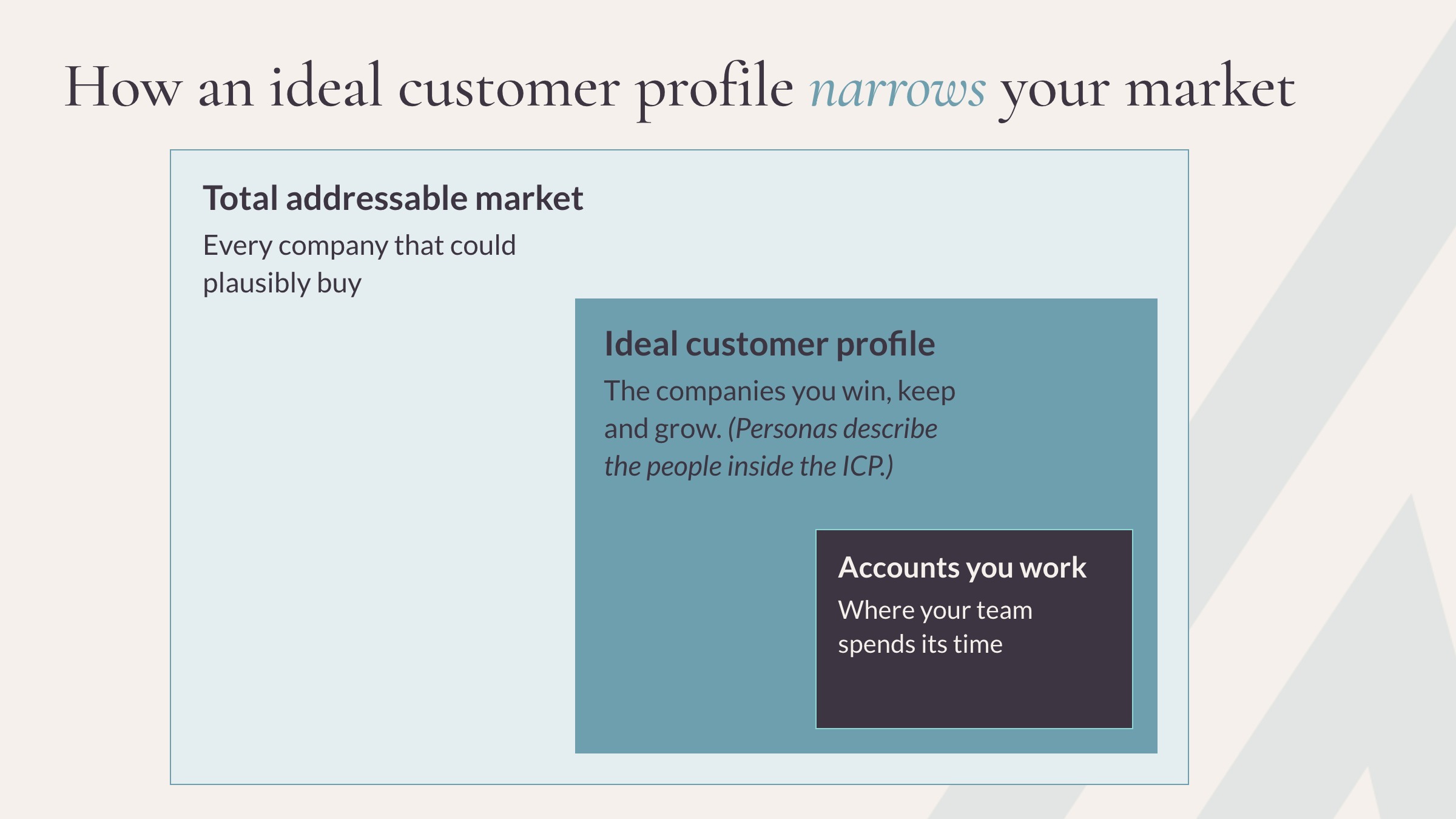
Order matters here. A persona built before an ICP tells you how to talk to someone you may have no business pursuing. Once the profile is settled, you can build the buyer personas that sit inside it.
The expensive version of this confusion is subtle. Teams build detailed personas, feel organized, and still have no agreed rule for turning down an account.
Why a vague ICP costs more than no ICP at all
A vague ICP still gets used. That's what makes it worse than having none.
When the profile is broad enough to include most companies, it stops being a filter and becomes permission. Every pursuit can be justified against it. Nobody has to defend a decision.
You'll see the cost in familiar places. Pipeline fills with deals that stall at procurement. Marketing spends against companies that were never going to buy. Sales invests months in accounts that churn at the first renewal.
The quieter cost is internal. Sales and marketing each carry a private definition of a good lead, and neither writes it down. The lead-quality argument then repeats every quarter, while what that disagreement costs rarely shows up in any report.
The four-question test for ICP criteria
Every article about ideal customer profiles hands you a list of attributes to consider: industry, company size, revenue, geography, tech stack. The list is the easy part.
The hard part is throwing most of them out.
Run every candidate attribute through four questions. Keep only the ones that pass all four.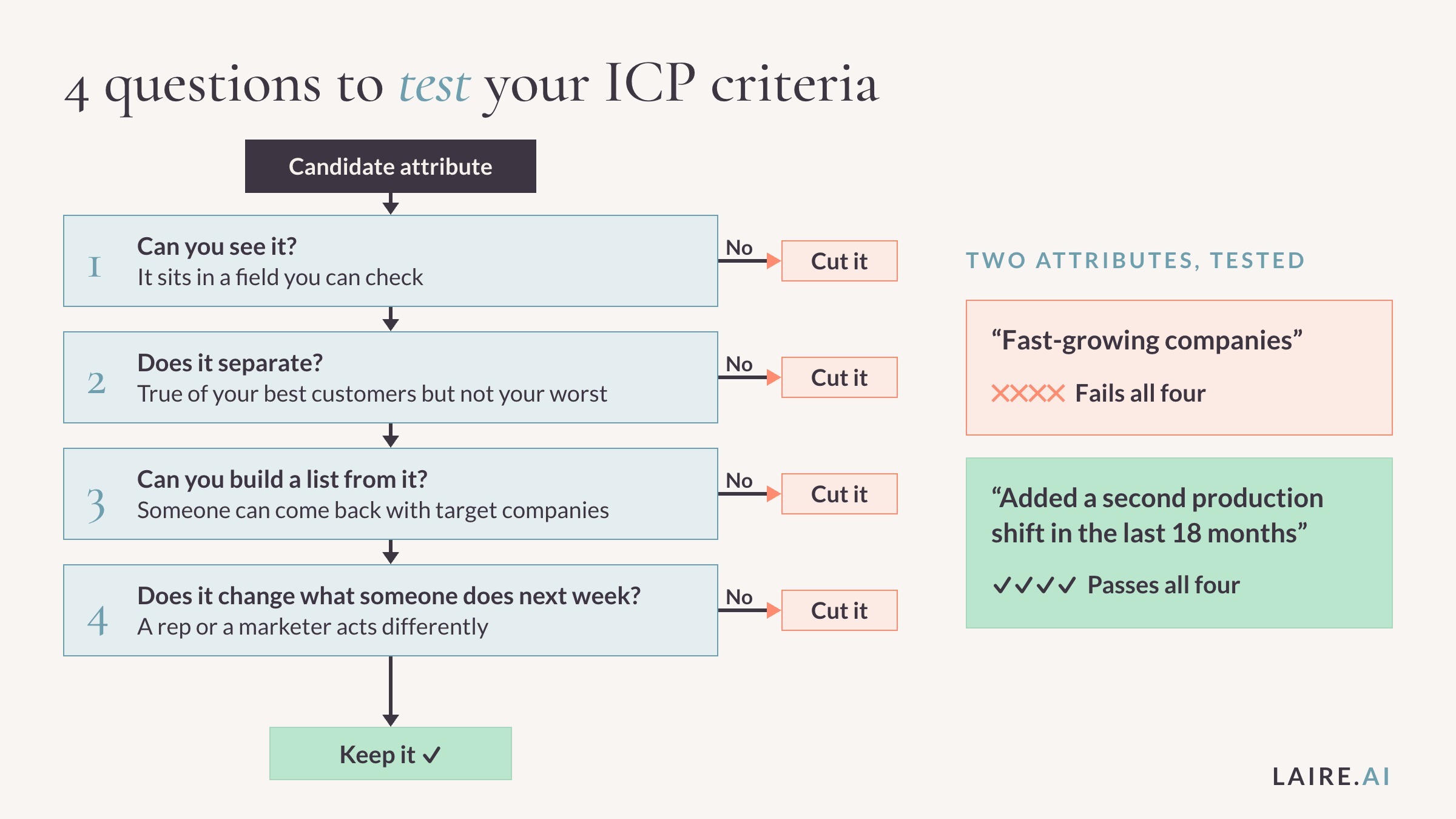
1. Can you see it?
The attribute has to exist somewhere you can check. A field in your CRM, a filter in LinkedIn, a page on their website, or a public filing you can pull from the SEC's full-text search. If confirming it takes a judgment call from whoever happens to be looking, it'll be applied inconsistently and then quietly abandoned.
2. Does it separate?
Compare your best customers against your worst. An attribute that's true of both groups describes your market, not your ICP. Most candidate criteria fail right here. "Values good service" is true of everyone.
3. Can you build a list from it?
Hand the attribute to someone and ask them to come back with target companies. If they can't, it can inform a conversation but it can't steer a program. Industry shows the difference well: "manufacturing" is too broad to work with, while a specific NAICS code gives you something you can filter on.
4. Does it change what someone does next week?
If a rep or a marketer reads the attribute and nothing about their next action changes, it's background color.
Here's the contrast that makes the test concrete. "Fast-growing companies" fails all four. You can't verify it reliably, it describes most of your market, you can't filter a list on it, and no rep changes behavior because of it.
"Added a second production shift in the last 18 months" passes all four. It shows up in hiring posts and local press, it separates manufacturers under capacity pressure from everyone else, you can build a list from it, and it tells a rep exactly when to call.
Run your firmographics, technographics, operating model, trigger events, and buying structure through the same four questions. What survives is your ICP.
How to define your ICP in five steps
1. Pull your closed-won deals, and your losses
Export your last 20 to 50 closed-won customers. Then export the ones who churned, the deals you lost late, and the accounts that were painful to serve. Most teams study only the wins. The losses carry more signal, because they show where your value breaks down. This step inherits every flaw in your records. Confirm your CRM data is clean enough to trust before you draw conclusions from it.
2. Rank customers by value, not revenue
Revenue alone will mislead you. Your largest account can also be your least profitable. Score each customer on four things:
- Profitability once delivery cost is taken out
- Retention length or repeat purchase rate
- Speed and friction of the original sale
- Whether they refer, act as a reference, or renew without a fight
Add a fifth input if you track it: which customers would recommend you.
3. Compare the top group against the bottom
Take your top quartile and your bottom quartile. Look for attributes the top group shares that the bottom group doesn't. This comparison is the step most teams skip. Studying only your best customers produces a list of traits that describe your entire market.
Write down every pattern you notice, including the ones that feel too obvious or too odd to matter. You'll cut them in the next step.
4. Test every attribute, then cut
Run each pattern through the four-question test. Most will fail.
In the Marketing Action Plans we build at LAIRE, the profiles teams go on to use tend to come down to five to eight criteria. Anything longer stops working as a filter and turns back into a description.
Do this with sales in the room. An ICP that marketing writes alone becomes a document sales ignores. What you want is a shared rule, so get sales and marketing to agree on it while the evidence is still on the table.
5. Write it twice
Your ICP needs two formats, because they do different jobs.
First, write it as a sentence a salesperson can repeat on a call. Something like: "Specialty manufacturers in the Southeast with 100 to 500 employees, running an ERP but no CRM, selling through distributors." Second, write it as a scorecard your CRM can hold.
|
Criterion |
Weight |
Scores 3 |
Scores 1 |
Disqualifies |
|---|---|---|---|---|
|
Employee count |
20% |
100 to 500 |
50 to 99, or 501 to 1,000 |
Under 25 |
|
Industry |
25% |
Specialty or contract manufacturing |
Adjacent industrial |
Consumer goods |
|
Go-to-market model |
20% |
Sells through distributors or dealers |
Mixed direct and channel |
Direct to consumer only |
|
Systems in place |
15% |
ERP in place, no CRM |
ERP plus basic CRM |
No system of record |
|
Trigger event |
20% |
New plant, shift, or sales leader in 18 months |
Expansion planned |
None |
The weights are yours to set and they'll change once you see real scores. The disqualifier column matters most, because it's the only part of the scorecard that forces a decision.
What to do if you only have a handful of customers
Pattern analysis needs volume. With 15 customers and an 11-month sales cycle, the method above won't work yet. That's the normal situation for manufacturers, builders, and advisory firms with high deal values and low deal counts.
The real threshold is whether you can split your customers into a top group and a bottom group and still see a difference between them that reads as a pattern rather than a coincidence. Until you can, you have three substitutes.
Invert it first. Build the negative profile before the positive one. Disqualification needs far less data, because everyone on your team can already name the accounts that went badly and say why. Five bad experiences will usually give you three solid disqualifiers.
Interview your salespeople, not your spreadsheet. Ask which deals felt easy and which fought them at every stage. Then ask what the easy ones had in common. Reps carry pattern recognition that never reaches the CRM.
Look outward. Study the segment your competitors serve well and the one they underserve. Look at who your competitors serve well and the neglected segment usually becomes obvious.
One caveat is worth writing into the document itself. A profile built on 15 customers is a hypothesis. Date it, note what evidence would change your mind, and revisit it after the next ten deals close.
Ideal customer profile examples for three B2B industries
The three profiles below are illustrative composites. They show the level of specificity to aim for. They aren't real companies or client data.
Notice what each one includes that a generic profile leaves out: a trigger event and a set of disqualifiers.
Specialty manufacturer:
|
Who they are |
Contract or specialty manufacturers serving industrial OEMs |
|
Size signal |
100 to 500 employees, $20M to $150M revenue |
|
Operating signal |
Sells through distributors or manufacturer reps; ERP in place, no CRM |
|
Trigger event |
New plant or second shift, or a first sales leader hired in the last 18 months |
|
Disqualifiers |
Consumer goods, single-customer dependency, no internal marketing owner |
Custom home builder:
|
Who they are |
Semi-custom and custom builders operating in a defined metro |
|
Size signal |
25 to 150 homes a year, with an in-house sales team |
|
Operating signal |
Owns the land acquisition decision; runs design selections in-house |
|
Trigger event |
Opening a new community, or expanding into a second market |
|
Disqualifiers |
Spec-only builders with no sales process, remodelers under $2M, no appetite for a CRM |
Registered investment advisory firm:
|
Who they are |
Fee-only RIAs serving business owners or pre-retirees |
|
Size signal |
$200M to $1.5B in assets under management, 5 to 25 employees |
|
Operating signal |
Growth has been referral-led; a marketing hire or agency is a new idea |
|
Trigger event |
Advisor succession, a merger, or a new service line such as tax planning |
|
Disqualifiers |
Commission-only practices, no compliance review process, solo advisors |
Each of these would let a rep look at an inbound lead and reach a decision in under a minute. That's the standard to aim for.
Putting your ICP into your CRM so it gets used
If you're still working out whether you need an ICP at all, this section will keep. Come back to it once the profile exists, because it's the step that decides whether any of the earlier work matters.
The failure here is rarely analytical. The ICP gets built, presented, approved, and then lives in a slide deck nobody opens again.
Store it at the company or account level rather than on the contact record. Create one property per surviving criterion, so your system can calculate fit on its own.
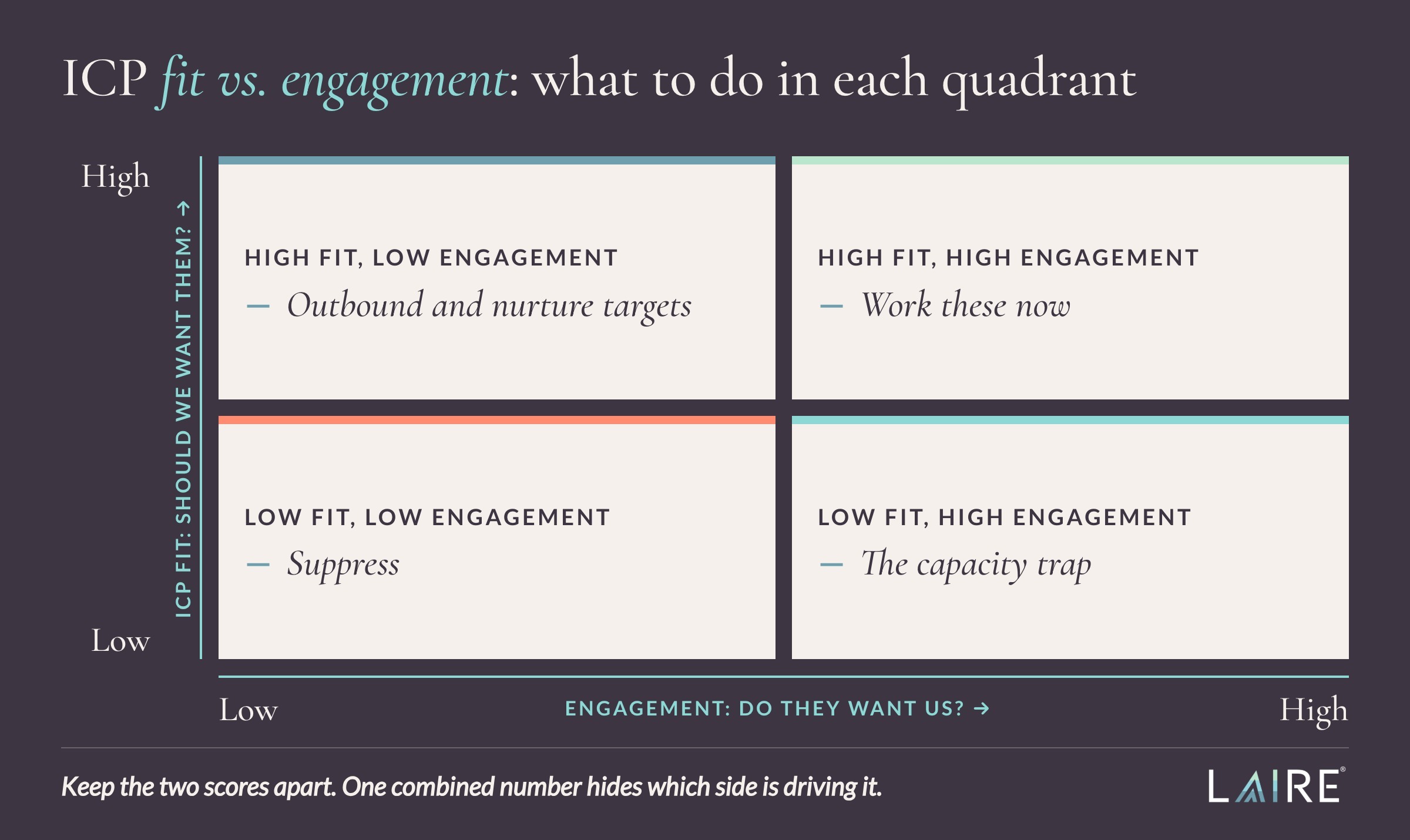
Then keep two scores apart. Fit asks whether we should want them. Engagement asks whether they want us. Combining them into one number hides which is driving the total, and the two situations call for different responses.
That gives you a grid your team can act on:
- High fit, high engagement. Work these now.
- High fit, low engagement. Your outbound and nurture targets.
- Low fit, high engagement. The trap that quietly eats sales capacity.
- Low fit, low engagement. Suppress.
Connect fit to how you define a qualified lead and to your lifecycle stages, so the score moves records instead of labeling them. In HubSpot, that usually means company properties feeding a calculated fit score, with lists and workflows reading from it.
Then make it binding. A threshold that governs routing changes behavior. A threshold that only appears in reporting doesn't. Get it written into a service level agreement between sales and marketing, and enforce the disqualifiers as strictly as the qualifiers.
How often should you update your ICP?
Review it once a year at minimum, then let specific triggers drive the real revisions. Cadence alone tends to produce a review nobody acts on.
Revise your ICP when:
- You launch a new product or service line
- You enter a new market or geography
- Your pricing changes materially
- One segment starts churning faster than the rest
- The title that signs the contract changes
- Your best new customers stop matching the profile
One signal matters more than the rest. When sales routinely overrides the fit score and turns out to be right, your profile is out of date. The same discipline applies to updating your personas.
Frequently asked questions about ideal customer profiles
What is the difference between an ICP and a buyer persona?
An ICP describes a company. A buyer persona describes a person inside that company. Your ICP tells you which organizations are worth pursuing, and your personas tell you how to speak to the people who evaluate and approve the purchase. Most B2B companies need one ICP and several personas.
How many customers do you need to build an ICP?
Enough to split into a top group and a bottom group and still see a real difference between them. If you can't get there yet, document the accounts that went badly to build a negative profile first, and interview your sales team about which deals felt easy. Treat the result as a hypothesis and revisit it after the next ten deals close.
How often should you update your ideal customer profile?
Review it annually, and revise it whenever something structural changes: a new product line, a new market, a pricing change, concentrated churn in one segment, or a shift in who signs the contract. A profile that hasn't changed in three years is usually being ignored.
Can a company have more than one ICP?
Yes, though each one needs its own evidence and its own scorecard. Separate profiles make sense when you sell distinct products to distinct markets. They work badly as a way to avoid excluding anyone, which is the most common reason companies end up maintaining four.
What is a negative ICP?
A negative ICP is a written description of the companies you won't sell to, regardless of their budget or interest. It usually lists disqualifying attributes such as company size, operating model, or a missing internal capability. It's often faster to build than a positive profile, because teams remember bad-fit accounts vividly.
If you'd rather not run this alone, a Marketing Action Plan (MAP) by LAIRE® builds it with you. The process starts by interviewing a cross-section of your current and past clients, then works out what your strongest accounts have in common and turns that into something your team can act on.
Book a free 20-minute consultation and we'll walk you through how it works: