When a prospective client needs a lawyer today, many open ChatGPT or their LLM of choice before they ever pull up a list of blue links. They type the situation they’re in, ask which kind of attorney handles it, and read the answer the AI hands back. Somewhere in that answer, a firm gets named. Answer engine optimization for law firms, or AEO, is how you make that firm yours.
AEO is the work of becoming the source AI tools cite when they answer legal questions. It doesn’t replace search engine optimization (SEO); it builds a second floor on top of it. Your rankings still matter, but a new layer of visibility now sits above them, and it rewards firms that structure their expertise so a machine can read, trust, and repeat it.
We mapped this approach for financial firms in our guide to becoming the featured answer, and the same seven moves translate cleanly to legal, with one important difference: the stakes are higher. Here’s how to earn the cited spot.
The Short Answer: How Law Firms Get Cited by AI
A law firm earns citations in ChatGPT and AI search by combining seven moves: answer-first content that responds to real client questions, structured data that labels the firm for machines, deep authority in a specific practice area and location, consistent citations across trusted legal directories, clear information that AI agents can compare, credentialed video, and rigorous proof of experience and trust. Because AI treats legal guidance as high-stakes content, authority and accuracy decide who gets named.
Key takeaways:
- AEO is a second floor on your SEO foundation, not a replacement for it.
- Legal is Your-Money-Your-Life (YMYL) content, so search engines and AI hold it to a higher bar for authority and accuracy.
- Specificity wins: practice area plus jurisdiction beats “full-service firm.”
- Your credentials must be consistent everywhere AI looks, not just on your site.
- Attorney-advertising rules still apply to content written for AI.
Why AI Search Raises the Stakes for Law Firms
Legal guidance falls into what Google and AI models call YMYL, short for “Your Money or Your Life.” It’s content that can meaningfully affect someone’s finances, freedom, or well-being, so AI systems weigh accuracy, authority, and trust far more heavily before they cite it. A generic answer won’t clear that bar. A well-credentialed, clearly sourced one will.
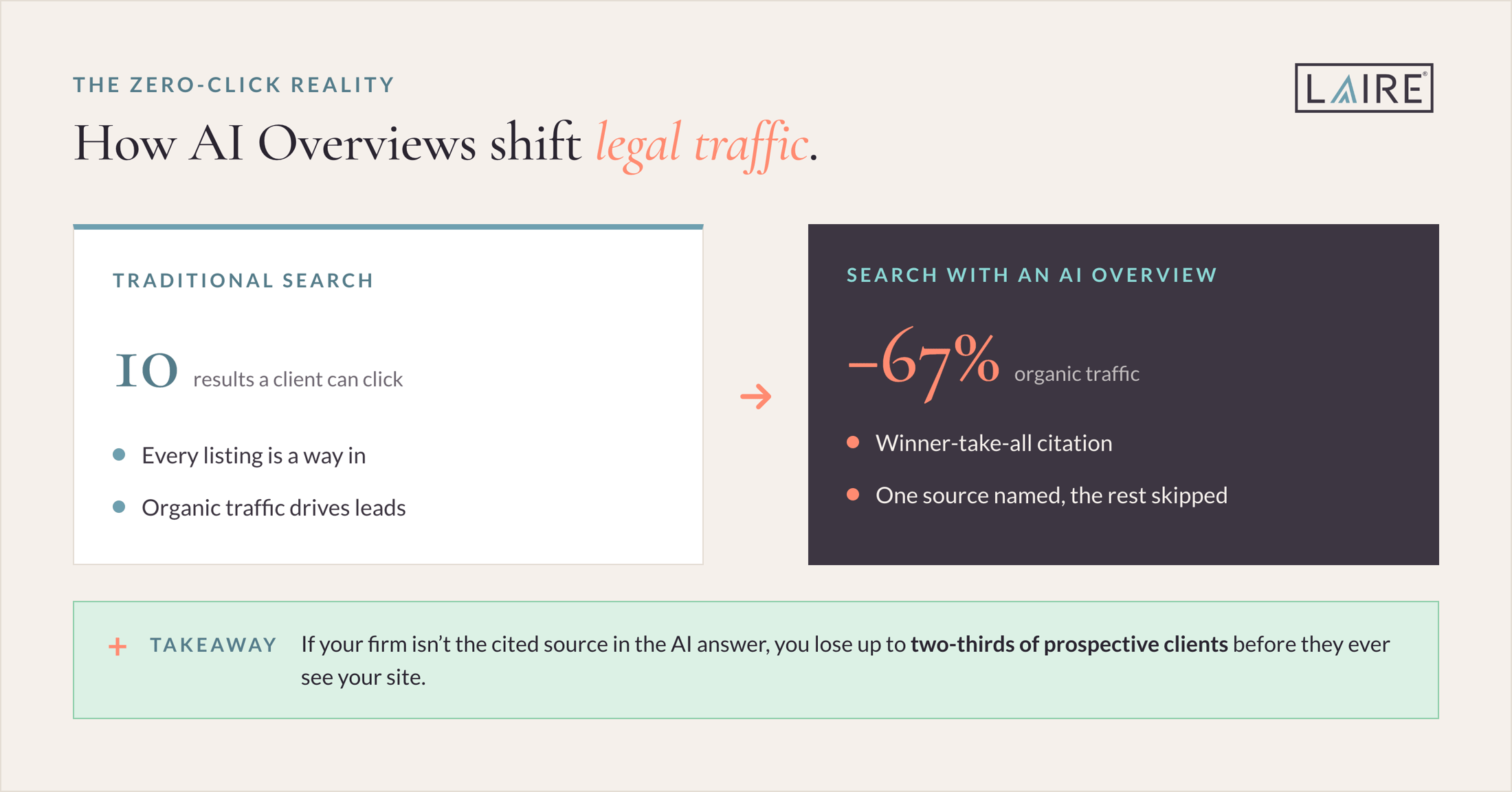
The urgency comes from how people now behave. A first-of-its-kind UX study of Google’s AI Overviews found that desktop click-through rates can fall by roughly two-thirds when an AI Overview appears. We break down what that zero-click reality means in our nine AI visibility best practices, and the takeaway for legal is direct: prospective clients are getting their first answer inside the AI response, and often deciding who to call from it. Being the cited firm is the new front door.
Law Firm SEO vs. Legal AEO: What’s the Difference?
Strong law firm SEO and legal AEO share a foundation, but they aim at different targets. Lawyer SEO works to rank your pages in a list of results. AEO works to get your firm quoted inside the answer AI generates above that list. You need both, and AEO depends on the SEO fundamentals being in place first.
|
|
Law firm SEO |
Legal AEO |
|
Goal |
Rank in the list of search results |
Get cited inside the AI-generated answer |
|
Success looks like |
A top position for “estate planning attorney” |
Your firm named when someone asks AI for one |
|
Core levers |
Keywords, technical health, backlinks |
Answer-first structure, schema, authority signals |
|
Primary metric |
Rankings and organic clicks |
Citations and share of AI answers |
Answer the Legal Question First, the Way a Client Asks It
AI pulls short, self-contained answers from the top of a page, so lead with one. Under your headline, place a direct 40- to 60-word answer to the exact question a client would ask, then expand into the nuance below it.
The trick for legal content is to use the client’s language, not the statute’s. Write the question the way a worried person would type it, and answer it plainly and accurately before you add the caveats:
|
A client actually searches: |
Not: |
|
Do I need a lawyer for an uncontested divorce? |
Dissolution of marriage procedural requirements |
|
How long do I have to file an injury claim? |
Statute of limitations for tort actions |
|
What happens to my house in bankruptcy? |
Homestead exemption thresholds by chapter |
Answer those, keep it educational rather than case-specific advice, and you give the AI something clean to quote and the reader a reason to keep going.
Use Schema to Label Your Firm’s Expertise for AI
Schema markup is structured data that labels your content so an AI doesn’t have to guess what it’s looking at. Think of it as tagging every part of your site with a name the machine already understands. For a law firm, these are the types that carry the most weight:
- LegalService and Organization — what the firm is and does
- Person — each attorney, tied to their credentials and bio
- FAQPage — your question-and-answer content (note that FAQ markup is optional since May 2026)
- VideoObject — attorney videos and their transcripts
- BreadcrumbList — how your site is organized
Applied across practice-area pages and attorney bios, this markup helps AI connect the right lawyer to the right specialty and location, which is exactly what it needs to cite you with confidence.
Win on Practice Area and Jurisdiction, Not “Full-Service”
AI favors specialists over generalists, because specificity is what makes an answer useful. Watch how much more a model can do with the specific version:
|
Vague Description: |
Specific enough for AI to cite: |
|
Full-service law firm |
Estate planning attorney for business owners in Charlotte |
|
Experienced attorneys |
Board-certified family law attorney serving Mecklenburg County |
|
We handle injury cases |
Motorcycle accident lawyer for riders across the Carolinas |
Legal search is unusually local and practice-driven, which works in your favor here. Publishing genuine depth in one practice area and one region, rather than thin pages across a dozen, strengthens your presence in the knowledge graph AI draws from. Pick the areas you actually want more matters in, and go deep enough that no generalist page can compete.
Earn Citations Across the Sources AI Trusts for Law
AI doesn’t just read your website; it looks for consensus across the web. For legal, that means the sources it already associates with credible attorneys. Get these aligned so they all tell the same story:
- Google Business Profile, complete and current
- Justia and Avvo listings that match your site
- Martindale-Hubbell profile and rating
- FindLaw and other legal directories
- State-bar records and admissions
- Bylined commentary in legal or local press
When those agree on who you are and what you practice, your credibility compounds. Every credible reference is a vote the model counts, so keep any comparative or superlative language within your jurisdiction’s advertising rules as you build them.
Make Your Firm Easy for Agentic AI to Shortlist
A new class of AI agents now acts on a user’s behalf, comparing options before presenting a shortlist. Ask one to “find a good estate attorney near me,” and it weighs practice areas, location, process, and how easy the firm is to engage.
Give those agents clean material to work with. Present your practice areas, service areas, intake process, and contact details in clear, current, well-structured copy, and keep it up to date. Outdated or buried information is a quiet reason to get skipped. Treat these pages as an AI-readable version of your intake brochure, written so a machine can parse it as easily as a client can.
Use Video to Get Your Attorneys Cited More Often
AI now watches and listens as well as it reads. Short videos in which an attorney answers a common question, paired with an accurate transcript and VideoObject schema, open another pathway for your firm to be surfaced and cited.
Video also does something legal buyers value: it puts a credentialed, recognizable face to the expertise. A consistent series answering the questions clients actually ask builds trust with human viewers and hands AI models more signals that a real, qualified attorney stands behind the content.
Prove E-E-A-T and Clear the YMYL Bar
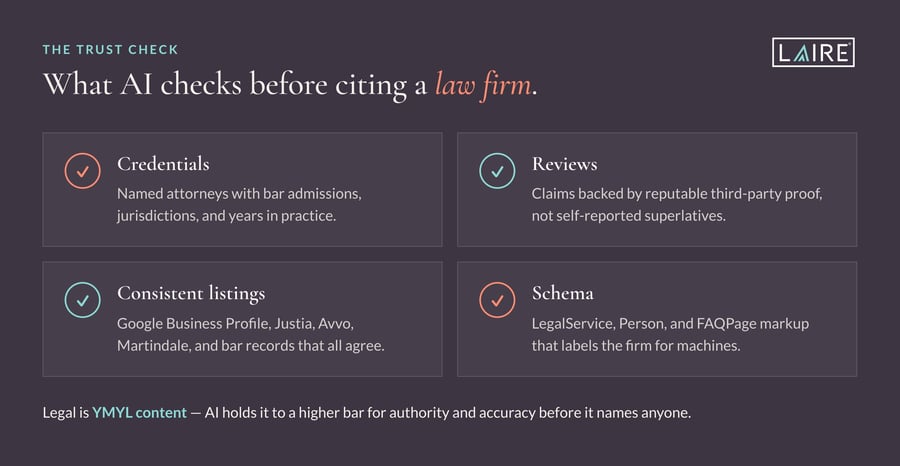
This is where legal firms win or lose the citation. E-E-A-T, which stands for Experience, Expertise, Authoritativeness, and Trustworthiness, is the framework AI uses to judge who is credible, and it applies most strictly to YMYL topics like law. We cover the fundamentals in our guide to supercharging your SEO with E-E-A-T; the legal application is where it gets specific. Here’s what AI looks for before it trusts your firm:
- Named attorneys with bar admissions, jurisdictions, and years in practice
- Bios linked to real credentials and authoritative profiles
- Claims backed by reputable third-party sources
- Content that’s kept current, with a visible update date
- Accurate, non-misleading language in line with ABA Model Rule 7.1 and your state bar
- The disclaimers your jurisdiction expects, such as noting that prior results don’t guarantee a similar outcome
Handled well, compliance and credibility reinforce each other, and both signal trust to AI.
Answer Engine Optimization for Law Firms: Your Action Plan
Pulling the seven moves together, here’s the at-a-glance version to work from:
|
Move |
What AI rewards |
Your next step |
|
Answer-first content |
A clean, liftable answer up top |
Add a 40–60 word answer under each key question |
|
Schema markup |
Machine-readable labels |
Add LegalService, Person, and FAQPage schema |
|
Practice-area depth |
Specificity and focus |
Go deep on the areas and regions you want |
|
Trusted citations |
Consensus across the web |
Align GBP, Justia, Avvo, Martindale, and bar listings |
|
Agent-ready info |
Clear, current details |
Keep practice areas, intake, and contact up to date |
|
Credentialed video |
Multimodal trust signals |
Publish attorney Q&A videos with transcripts |
|
E-E-A-T and YMYL |
Proven, compliant authority |
Show credentials, cite sources, honor bar rules |
How LAIRE Helps Law Firms Become the Cited Answer
Earning AI citations in a regulated, trust-sensitive field takes a foundation, not a quick fix. As a HubSpot Diamond Solutions Partner, we build AEO on top of solid law firm SEO: answer-first content, clean schema, author and authority signals, local and practice-area strategy, and AI-visibility tracking so you can see where you’re being cited and where you’re missing out. We bring this level of discipline to firms that need to show up as the trusted answer.
Frequently Asked Questions About Legal AEO
Will AI actually recommend my law firm?
It can, if your firm gives AI clear reasons to trust it. Models cite sources that demonstrate relevant expertise, consistent credentials across the web, and well-structured content. A firm that publishes deep practice-area content, maintains accurate directory listings, and proves attorney authority is far likelier to be named than one that doesn’t.
What is answer engine optimization for law firms?
Answer engine optimization for law firms is the practice of structuring a firm’s content and online presence so AI tools like ChatGPT, Perplexity, and Google AI Overviews cite it when answering legal questions. It focuses on being the trusted, quoted source rather than simply ranking in a list of links.
Is AEO different from law firm SEO?
They overlap, but they aren’t the same. Law firm SEO works to rank your pages in search results. AEO works to get your firm cited inside AI-generated answers. AEO builds on SEO fundamentals like quality content and technical health, then adds answer-first structure, schema, and stronger authority signals.
Can AI cite my firm if I’m a solo practitioner?
Yes. Size matters less than clarity and credibility. A solo attorney with a focused practice area, a complete Google Business Profile, consistent directory listings, and a well-credentialed bio can be easier for AI to cite than a large, generalized firm, because the specialty and location are unmistakable.
How long does it take to show up in AI search?
There’s no fixed timeline, and it depends on your starting authority, how consistent your listings are, and how quickly AI systems recrawl your content. Firms usually see the fastest gains by fixing directory consistency and adding answer-first content and schema, then compounding authority over the following months.
How do I show attorney credentials so AI trusts my firm?
Publish detailed attorney bios that list bar admissions, jurisdictions, years of experience, and areas of focus, and link them to authoritative profiles. Add Person and Organization schema, keep credentials consistent across directories, and cite reputable sources. These signals help AI verify that a qualified attorney stands behind your content.
Do bar advertising rules apply to AI search content?
Yes. Content created to influence AI answers is still legal advertising, so it must follow your jurisdiction’s rules on accurate, non-misleading communications and required disclaimers. Rules vary by state, so confirm specifics with your bar before publishing comparative claims or case results.
Become the Answer AI Recommends
The firms that show up when clients ask AI for a lawyer won’t be the loudest; they’ll be the clearest, the most credentialed, and the easiest to trust. That position is earnable, and it compounds into visibility at every stage of a client’s search.
Want to see where your firm is being cited today, and where it’s being missed? Schedule a free 20-minute consult with LAIRE.