B2B content marketing is the practice of creating and publishing useful content to attract, educate, and convert business buyers into qualified leads and customers. Most companies already do it. Far fewer can point to the pipeline it created.
That gap is the real problem. Your team can publish every week, rank for a few terms, and still hear the same question from leadership: what did any of this bring in? Content that was never built to move a buyer toward a decision, and never connected to the system that turns interest into pipeline, won't generate leads no matter how often you publish.
This guide gives you a five-part framework for B2B content marketing that generates leads, with examples across fintech, manufacturing, professional services, and home services. Use it to diagnose where your content is losing leads and decide what to fix first.
B2B content marketing generates leads when each asset is tied to a specific buyer, a specific decision, and a specific next step. Without all three, content produces readers, not pipeline.
Why Most B2B Content Doesn’t Generate Leads
Most B2B content fails to generate leads because it was planned around topics and traffic, not around buyers and decisions.
A common pattern looks like this: a team picks keywords with decent volume, writes helpful articles, and watches sessions climb. The content is accurate. It just answers questions that sit far from any buying decision, so visitors read one post and leave. Nothing captures them, and nothing tells sales they were there.
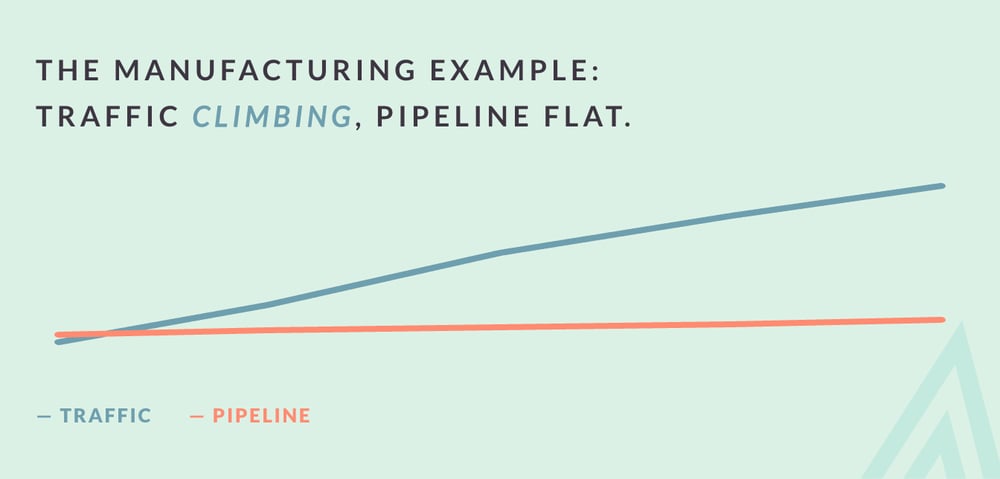
Think of a manufacturing company that ranks well for broad how-to searches. The traffic looks healthy in the report. Almost none of it comes from the plant managers and procurement leads who actually buy. The few who do visit find no reason to raise their hand. Traffic went up. Pipeline didn't move.
Content marketing for B2B carries extra weight that consumer content does not. Purchases are considered, cycles run for months, and a buying committee has to agree. According to Gartner, a typical B2B buying committee consists of six to ten decision-makers, each armed with four or five independently gathered pieces of information. When content ignores that reality, it produces readers instead of leads. The fix isn't more posts. It's a system that connects each asset to a buyer, a decision, and a next step.
The Lead-Generating B2B Content Framework
Content that generates leads follows a repeatable path. Each stage depends on the one before it, and skipping any stage is usually where leads leak out.
|
Stage |
The job |
The question it answers |
|---|---|---|
|
STRATEGY |
Build content around buyer decisions and your ICP |
Who is this for, and what are they trying to decide? |
|
JOURNEY |
Map content to each stage of the buying journey |
Does content exist for the awareness, consideration, and decision moments? |
|
TRUST |
Back claims with first-hand expertise |
Why should this buyer, and an AI engine, trust us? |
|
CONVERSION |
Give every asset a clear path to a next step |
What do we want the reader to do, and where does that go? |
|
MEASUREMENT |
Judge content by pipeline, not traffic |
Is this content contributing to revenue? |
The rest of this guide works through each stage with what to look for and what to change.
Stage 1: Start With the Buyer Decision, Not the Keyword
Effective B2B content strategy starts with a decision your buyer is trying to make, then finds the search terms and formats that support it. Keywords still matter. They just come second.
Begin with your ideal customer profile and the questions buyers ask on the way to a purchase. What are they comparing? What do they need to justify internally? What makes them hesitate? Those questions point to content that sits close to a decision, where a reader is far more likely to become a lead.
Take a professional services firm that sells compliance consulting. Ranking for "what is compliance" brings in students and curious readers. Writing for "how to choose a compliance consultant" or "in-house compliance vs. outsourced" reaches a buyer who is weighing an actual purchase. Same effort, very different pipeline.
Map your priority content to the decisions your best customers make, and to the people who make them. A useful test for any planned piece: name the buyer, name the decision, and name what you want them to do next. If you can't answer all three, the content is more likely to generate traffic than leads.
Stage 2: Map Content to the B2B Buying Journey
Lead-generating content covers the full buying journey, from early awareness to the final decision. Most B2B libraries are heavy at the top and thin exactly where buyers get serious.
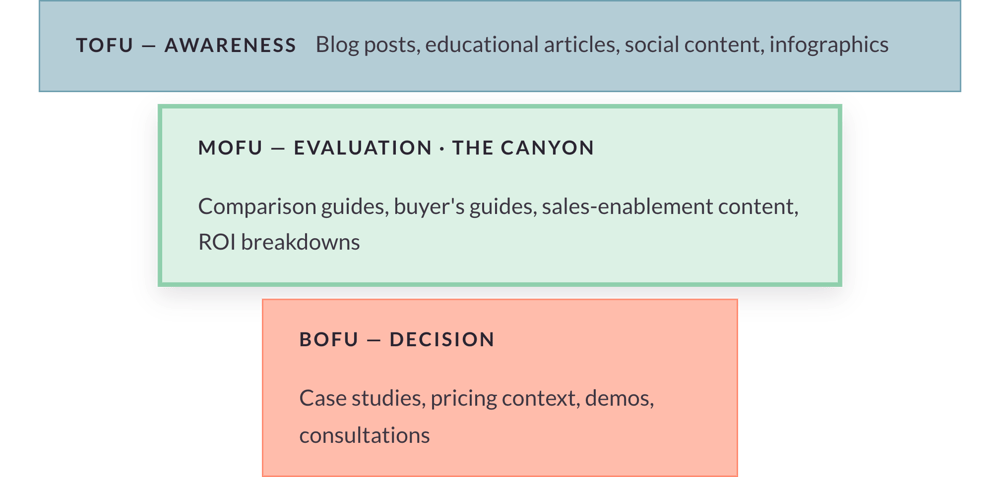
Think in three stages. Top of funnel builds awareness and answers broad problem questions. Middle of funnel helps a buyer evaluate approaches, compare options, and build a case internally. Bottom of funnel supports the final decision with proof, pricing context, and specifics. Each stage needs content, and the middle is where lead generation is usually won or lost.
Where MOFU Content Usually Breaks
Middle-of-funnel content is where most teams have a gap. They publish plenty of awareness posts and a few product pages, then leave a canyon in between. A fintech SaaS buyer who understands the problem and is now comparing platforms finds nothing that helps them evaluate. So they leave to research a competitor, or they go quiet.
Fill that middle with comparison guides, buyer's guides, and sales-enablement content, ROI explanations, and honest breakdowns of approaches. This is the content a buyer forwards to the rest of the committee. It is also the content most likely to earn an email address, because the reader is close enough to a decision to trade one.
Strong MOFU coverage is often the single biggest lever on lead volume for B2B content marketing teams. If your library has a gap, it's almost always here.
Stage 3: Earn Trust With First-Hand Expertise
Content generates leads when a buyer trusts it, and trust now comes from expertise a competitor cannot copy. First-hand experience, real examples, and named authors do more for lead generation than another well-optimized summary of what everyone already publishes.
Two forces make this matter more than it used to. Buyers are skeptical of generic, AI-produced content and can spot it quickly. At the same time, search engines and AI answer engines increasingly favor material that shows genuine expertise, clear authorship, and original insight. Content that only restates common knowledge struggles to rank, struggles to get cited, and rarely earns a lead.
A home services company selling to builders makes the point well. An article listing generic "tips for choosing a contractor" competes with thousands of identical posts. An article walking through what went wrong on three real projects, and how the team fixed it, reads differently. It gives a buyer a reason to trust the company. It gives an AI engine something specific to cite.
Put your first-hand knowledge on the page: your process, your data, your named experts, your mistakes and lessons. That is the material a language model cannot generate without you, and it is what makes a reader believe you can help.
What Real First-Hand Proof Looks Like
One example worth sharing: a Center of Influence (COI) LinkedIn campaign LAIRE runs for a financial services client. A COI campaign targets professionals who already have relationships with your ideal clients, in this case, Real Estate Agents, and nurtures them to refer business.
The approach uses LinkedIn Document Ads and a dedicated "Refer a Client" landing page. Agents who download the asset enter a HubSpot nurture workflow that guides them toward a referral. The budget runs $2,000 to $5,000 per month. Since September 2025, the campaign has produced 970 leads at an average cost per lead of roughly $15.
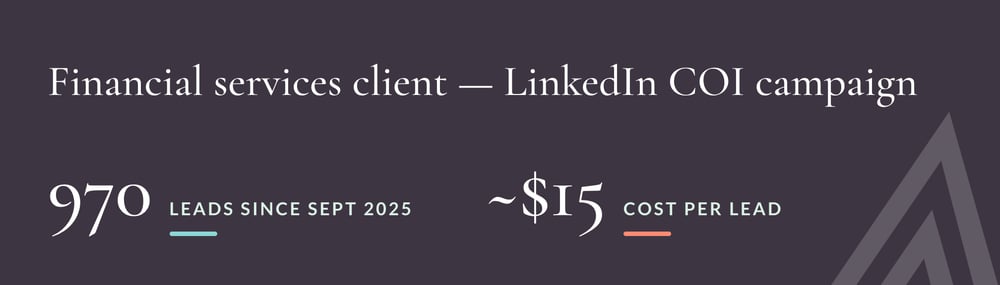
That kind of result doesn't come from generic awareness content. It comes from a strategy built around a specific buyer, a specific decision, and a clear next step, tracked in real time in HubSpot. The framework works the same way regardless of industry.
Stage 4: Build a Clear Path From Content to Conversion
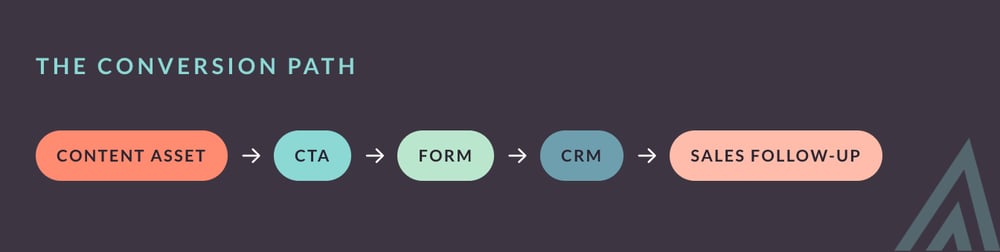
Every content asset should offer the reader a clear, relevant next step, and that step should connect to your CRM and sales process. Content without a path is a nice read that no one in sales ever hears about.
Match the offer to the reader's stage. An awareness post might invite a deeper guide. A comparison article might offer a checklist, a template, or a short consult. A decision-stage page should make it easy to talk to someone. The call to action should continue the reader's task instead of interrupting it. A well-placed offer converts far better than a generic "contact us."
The path cannot stop at a form. When a reader converts, that submission should flow into your CRM, tie back to the content they engaged with, and give sales the context to follow up well. A prospect who downloads a buyer's guide, returns to a comparison page, and matches your target profile is a different conversation than a cold lead. One LAIRE fintech SaaS client saw a 220% increase in leads after LAIRE built a clearer strategy and connected the company's content and systems. Set up your lead lifecycle stages and routing so sales gets that context automatically. Skip that step, and the leads your content earns quietly disappear.
A content asset without a conversion path, CRM connection, and sales handoff generates awareness, not pipeline. All three have to be in place.
Stage 5: Measure Content by Pipeline, Not Traffic
Judge B2B content by the pipeline it influences, not the traffic it collects. Sessions, rankings, and time on page are vanity metrics that describe activity. They do not tell leadership whether content is helping the business grow.
Set the measurement question before you publish: which content contributes to leads, opportunities, and closed revenue? Then track the metrics that answer it, such as leads generated per asset, influenced pipeline, and conversion rate by content type.
Attribution in B2B is rarely perfect, since committees touch many assets over a long cycle. You do not need perfect attribution to see patterns. You need enough to tell which content pulls its weight.
Return to that manufacturing company from earlier. Once it measured content by influenced pipeline rather than sessions, the picture changed. The ranking articles that produced no buyers stopped looking like wins. A handful of unglamorous MOFU pages turned out to be doing the real work. That shift changes what you produce next. When you measure content against pipeline, you stop rewarding volume and start investing in the pieces that actually generate leads.
How to Apply the Framework This Quarter
You do not need to rebuild your content program to see results. Start by finding the biggest leak.
Work through the framework as a quick diagnostic:
- Strategy: Name the buyer, decision, and next step. Pull your top ten pieces and try to answer all three for each. If you can't, that's your starting point.
- Journey: Find where your library is thin. For most B2B teams, the gap is in the middle of the funnel.
- Trust: Check whether your best content shows first-hand expertise. Content that summarizes what everyone else says won't rank, won't get cited, and won't earn a lead.
- Conversion: Confirm every key asset has a relevant next step that reaches your CRM. If it doesn't, fix that before you publish anything new.
- Measurement: Pull last quarter's pipeline and trace which content touched it. If you can't do that, measurement is the stage to fix first.
Pick the one stage where the answer is weakest and fix that first. For many B2B teams, the fastest gain comes from adding real MOFU content and giving it a clear path to conversion. Improve one stage, measure the change, then move to the next.
Build a Content Program That Generates Real Pipeline
B2B content generates leads when it works as a connected system, not a publishing habit. Build content around buyer decisions, cover the full journey, back it with first-hand expertise, give it a clear path to conversion, and measure it against pipeline.
Content marketing generates three times as many leads as traditional marketing at lower cost, but only when the program is built to convert, not just to publish. Most teams are already doing the work. The framework is what turns that work into leads your sales team can actually use.
If you want to see where your content is leaking pipeline, the LAIRE Marketing Action Plan connects your content, systems, and measurement so you can see what's working and prioritize what to fix first.
Frequently Asked Questions About B2B Content Marketing
What is B2B content marketing?
B2B content marketing is the practice of creating and distributing useful content to attract, educate, and convert business buyers. Unlike advertising, it earns attention by helping buyers make better decisions, which builds trust and generates qualified leads over time.
How is B2B content marketing different from B2C?
B2B purchases are considered decisions made by a buying committee over a cycle that often runs months. Content has to reach multiple stakeholders and serve several roles. It leans more on education, proof, and helping a buyer build an internal case than on quick emotional appeals.
Why is my B2B content not generating leads?
The most common reason is that content was planned around keywords and traffic instead of buyer decisions, with little middle-of-funnel content and no clear path to conversion. Content that sits far from a buying decision attracts readers who leave without ever becoming leads.
How long does B2B content marketing take to generate leads?
It varies by industry, competition, and how close your content sits to a buying decision. Decision-stage and comparison content can produce leads within weeks, while broad awareness content usually compounds over several months. Consistency and conversion paths matter more than volume.
How do you measure B2B content marketing ROI?
Measure content against pipeline rather than traffic. Track leads generated per asset, influenced pipeline, and conversion rate by content type, and connect content engagement to your CRM. B2B attribution is rarely exact, but it can still show which content contributes to revenue.
Ready to find where your content is losing leads? Book a 20-minute marketing consult. The LAIRE Marketing Action Plan connects your content, systems, and measurement so you can see what is working and prioritize what to fix first.