Fintech marketing is how financial technology companies attract, earn the trust of, and convert customers for products like payments, lending, banking, and wealth tools. It is B2B and B2B2C marketing under harder rules: buyers are skeptical, the category is regulated, and money is involved. That combination makes trust the real bottleneck, not awareness. The seven strategies below focus on winning that trust, and the one most fintech teams underuse is building advocates instead of shouting at the buyer. Each strategy includes a fintech example and a practical note.
What makes fintech marketing different
Fintech marketing carries constraints that ordinary B2B marketing does not. You're asking someone to trust you with their money, or their customers' money, so the bar for credibility is high. According to the 2026 Edelman Trust Barometer: Insights for Financial Services, financial services sits at 63% global trust and "one of the least trusted" industries surveyed, which means skepticism is your starting condition, not the exception.
Three forces shape the work. Trust is scarce, because buyers have been burned and the stakes are personal. Regulation limits what you can claim and how, so compliance sits inside the marketing process rather than beside it. And the buying cycle is long and crowded, with a committee that often includes product, security, legal, and finance. Financial technology marketing that ignores any of these tends to generate interest that never converts.
The upside: these constraints reward the disciplined. When most competitors lead with hype, a fintech that leads with proof and clarity stands out fast.
Fintech marketing's defining constraint is trust. Because buyers are skeptical, regulated, and handling money, credibility isn't a differentiator but the price of entry.
7 fintech marketing strategies that work
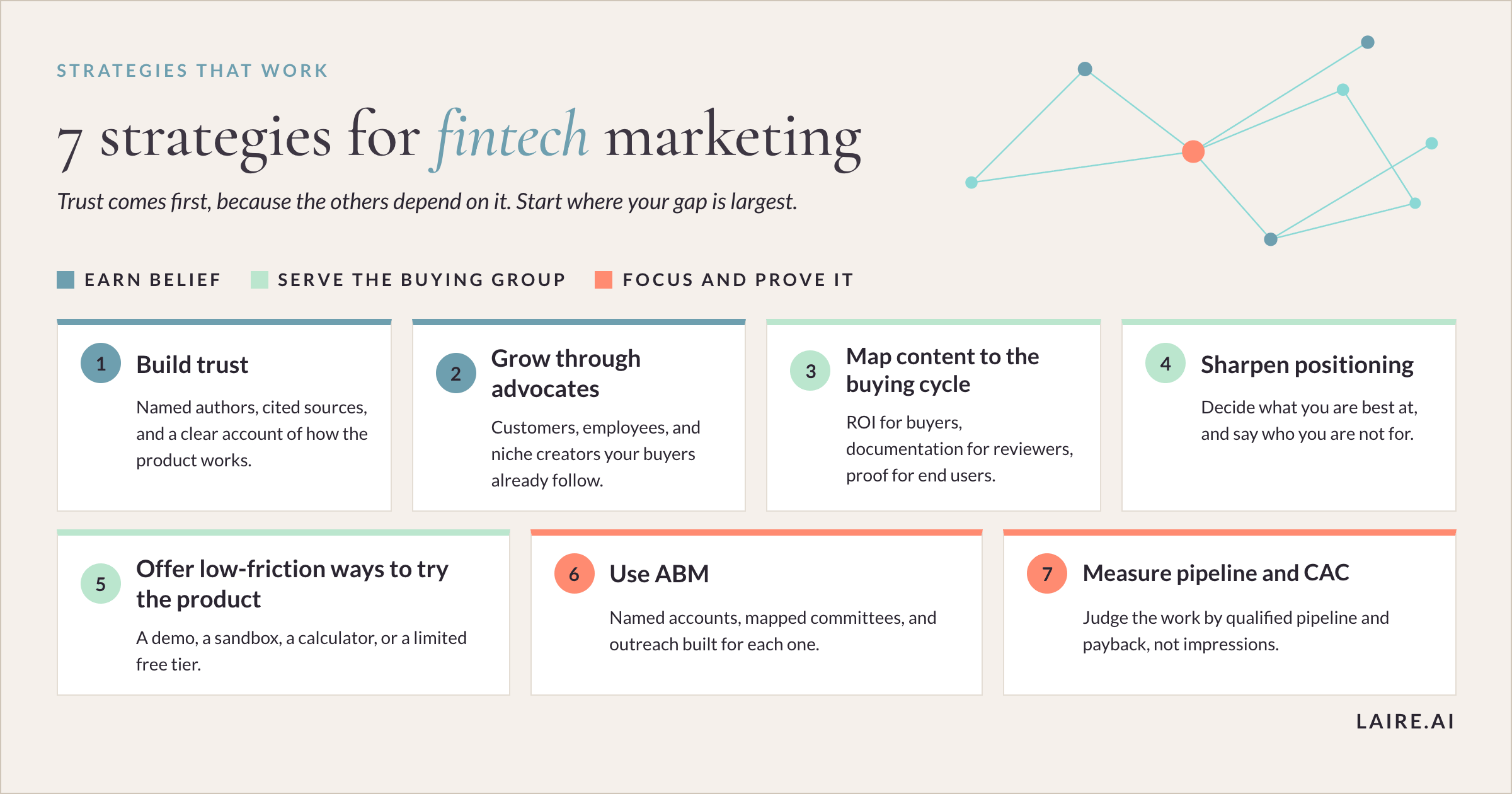
These strategies are ordered roughly by foundation. Trust comes first, because the others depend on it. Start where your gap is largest. Here's the full set at a glance.
|
Strategy |
What it does |
Prioritize when |
|
1. Win trust first |
Builds credibility into the content with E-E-A-T and YMYL-grade proof |
Buyers hesitate or do not believe you |
|
2. Grow through advocates |
Borrows trust from customers, employees, creators, and communities |
Paid media is not converting skeptics |
|
3. Map the buying cycle |
Serves every stakeholder across a long, multi-person decision |
Deals stall in committee review |
|
4. Sharpen positioning |
Makes a crowded category understand what you do and who you serve |
Buyers cannot tell you apart |
|
5. Product-led offers |
Lets prospects try value before a sales call |
Your product is easy to demo or sample |
|
6. Account-based marketing |
Focuses effort on named enterprise and partnership accounts |
Your best deals are large and few |
|
7. Measure pipeline and CAC |
Judges marketing by pipeline, acquisition cost, and payback |
You cannot tell what produces pipeline |
1. Win trust before you chase attention
In fintech, trust is the conversion engine. A prospect who doesn't trust you won't convert, no matter how good the ad is.
Build trust into the content itself. Show real expertise, name your authors, cite your sources, and be specific about how the product works and where it doesn't fit. Financial topics fall under what Google calls YMYL, short for Your Money or Your Life, the category its Search Quality Rater Guidelines hold to the strictest standard because a wrong answer can cost someone real money. Those pages are judged on first-hand expertise and E-E-A-T, which stands for experience, expertise, authoritativeness, and trustworthiness. Those are the same signals that decide whether the AI engines now summarizing your category will cite you.
A payments startup that publishes a clear security overview, reviewed by a named expert, earns more credibility than one running louder ads. Make transparency a habit, not a disclaimer. It's the cheapest advantage you have.
YMYL content in fintech must show first-hand expertise on the page. Named authors, cited sources, and honest product limitations earn the trust that drives organic rankings and LLM citations.
2. Grow through advocates and influencers, not just ads
The fastest way to earn trust in fintech is to borrow it from voices your buyer already believes. That means building advocates rather than going straight to the buyer with paid media.
Advocates come in four forms: happy customers who will vouch for you, employees who share real expertise publicly, niche fintech creators and analysts your audience already follows, and communities where your buyers actually talk. A lending platform that turns ten operators into public advocates will move more pipeline than the same budget spent on cold ads. Start by activating the people closest to you, since it's easier to turn employees into brand advocates than to buy a stranger's trust. Then invest in relationship marketing with customers and creators so the endorsements are genuine.
The pull is measurable. The 2026 Edelman Trust Barometer found that 57% of people who trust a financial influencer would trust or consider trusting a company they currently distrust if that influencer vouched for it. Partner with credible niche voices over celebrity reach, because relevance and trust beat raw audience size in a regulated category. The goal is simple: let other people say the things you cannot credibly say about yourself.
In fintech, influencer vouching transfers trust directly. Per the 2026 Edelman Trust Barometer, 57% of financial influencer followers would consider a company they currently distrust if that influencer endorsed it.
3. Map content to a long, multi-stakeholder cycle
Fintech deals involve several people over months, so your content has to serve each of them. Gartner puts a typical B2B buying group at roughly six to ten people, and in fintech that group usually spans economic buyers, security and compliance reviewers, and the end users who will live with the product. One great blog post rarely closes a committee that size.
Think about who needs what. Economic buyers want ROI and risk framing. Security and compliance reviewers want documentation and proof. End users want to see how the product works. Map your content to those roles and to each stage, from early education to final validation, so it can move financial buyers toward a decision. It also helps to keep your buyer personas current, since fintech roles and priorities shift quickly. When a champion can hand the right asset to each stakeholder, deals move. When they can't, deals stall in review.
4. Sharpen your positioning in a crowded category
Most fintech categories are noisy, and buyers struggle to tell products apart. Clear positioning is a marketing strategy, not a branding afterthought.
Decide what you are the best in the world at, and who you are not for. A vertical fintech that says "built for construction subcontractors" will beat a generic "financial platform for businesses" every time. Your brand personality and archetype then give that position a consistent voice across every touchpoint. Sharp positioning makes every other strategy cheaper, because the market finally understands what you do.
5. Use product-led and low-friction offers
Fintech buyers want to see the product before they commit, so give them a low-risk way in. Product-led motions fit the category well.
Offer a demo, a sandbox, an interactive calculator, or a limited free tier so a prospect can experience value before a sales call. A budgeting app can let users try the core feature immediately, while a B2B payments tool can offer a guided sandbox for evaluators. Pair the offer with a clear next step so interest turns into a conversation. The point is to reduce the leap of faith your product otherwise asks for.
6. Run ABM (Account-Based Marketing) for enterprise and partnerships
When your best deals are large enterprises, banks, or platform partnerships, broad demand generation is the wrong tool. ABM fits fintech’s high-value, low-volume deals.
Pick the accounts that matter, learn who sits on each buying committee, and tailor content and outreach to their specific situation. A fintech company selling into regional banks can build named-account plans that speak to each bank's compliance and integration concerns. Connect it to your CRM so marketing and sales work the same accounts, and lean on the right stack for financial firms to keep it coordinated. For smaller, high-intent segments, borrow from proven lead generation tactics for financial firms. ABM rewards focus, not volume.
7. Measure by pipeline and CAC, not vanity metrics
Fintech marketing should be judged by pipeline, customer acquisition cost, and payback, not by traffic or impressions. Investors and boards care about efficient growth, so your metrics should too.
According to First Page Sage's fintech CAC benchmarks, the average cost to acquire an SMB fintech customer runs about $1,450 and an enterprise customer about $14,772. Broader SaaS acquisition costs are up 40 to 60% since 2023, driven by ad inflation, longer sales cycles, and tighter targeting across paid channels. Track which strategies produce qualified pipeline and at what cost, then shift budget toward what pays back fastest. Advocacy and content often look modest in a click report but strong in an influenced-pipeline view, so measure them properly. LAIRE has helped financial firms grow through this kind of discipline, including a financial services firm that grew site traffic 260% and a financial firm that grew organic traffic 2,338% with inbound and HubSpot. Attribution in a long cycle will never be perfect. It only needs to be good enough to show what's working.
How to prioritize these marketing strategies for fintech
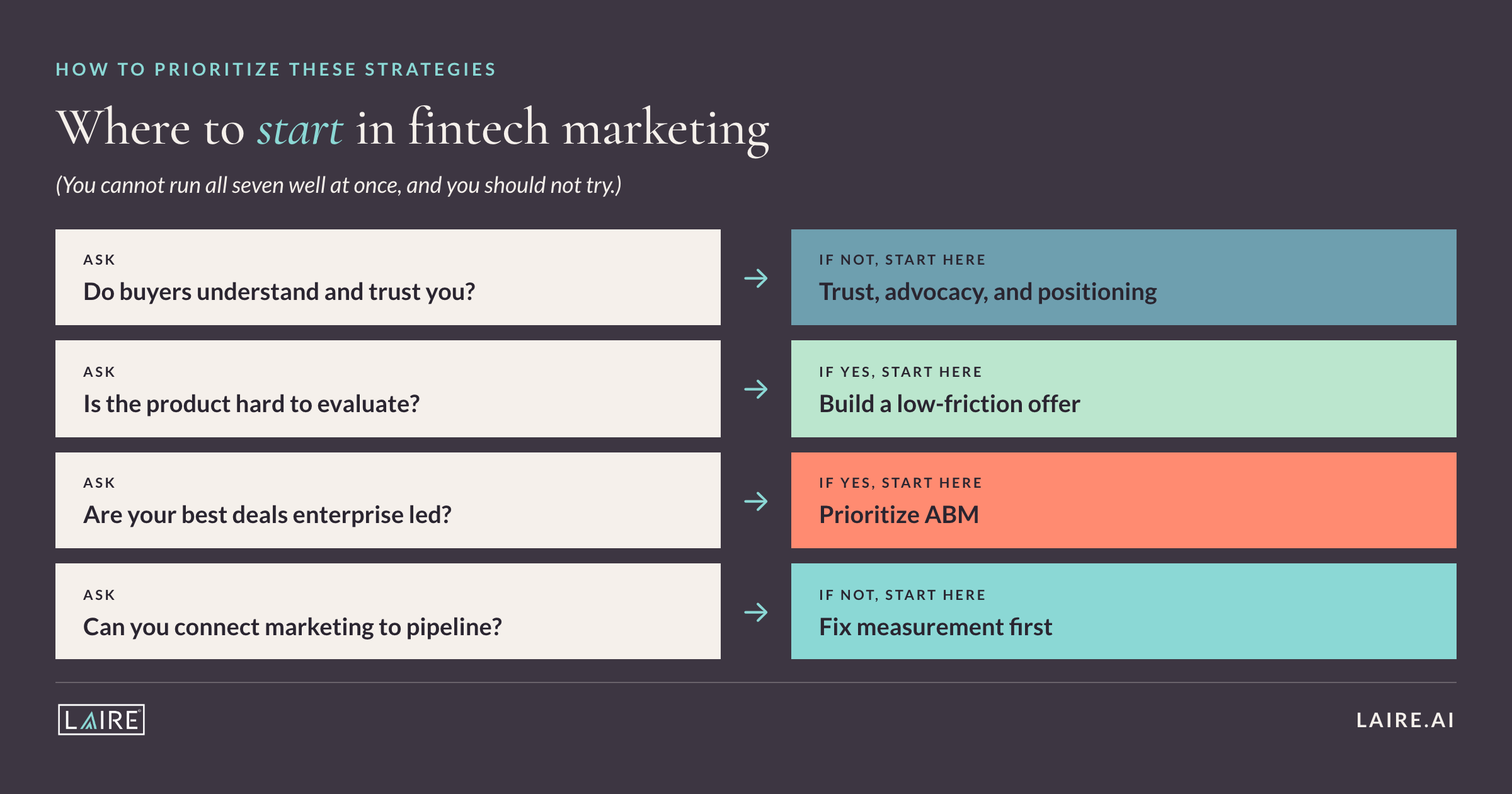
Start with trust and positioning, then add the channel that fits your motion. You cannot run all seven well at once, and you should not try.
Use a short diagnostic. Do buyers understand and believe you, or is trust the bottleneck? If so, fix strategies one, two, and four first. Is your product easy to try? If not, build a low-friction offer. Are your best deals enterprise or partnership shaped? Then ABM earns its place. Can you tell which marketing produces a pipeline? If not, fix measurement before you spend more. For most fintechs, the fastest gain comes from strategy two, because advocates and credible voices compound trust faster than paid media in a skeptical market. Pick one gap, fix it, measure the change, then move to the next.
Conclusion
Fintech marketing rewards trust, focus, and patience more than volume. Earn credibility in the content, grow through advocates and influencers, serve the whole buying committee, position sharply, let buyers try the product, use ABM where the deals are big, and measure against pipeline and CAC. Financial technology marketing is harder than average B2B marketing, and that is the opportunity. Do the disciplined work most competitors skip, and the trust you build becomes the moat.
Frequently asked questions
What is fintech marketing?
Fintech marketing is the practice of attracting, building trust with, and converting customers for financial technology products such as payments, lending, banking, and wealth tools. It blends B2B and B2B2C tactics with the trust and compliance demands of financial services. The defining challenge is credibility, since buyers are cautious about who handles their money.
How is fintech marketing different from traditional financial services marketing?
Fintech companies usually sell newer products, move faster, and often serve both businesses and consumers, so they must build trust without the long history of an established bank. Traditional financial services marketing leans on legacy reputation, while fintech marketing has to earn credibility quickly through proof, advocates, and clear positioning, all within the same regulatory limits.
What are the best marketing strategies for fintech companies?
The most effective strategies are building trust through credible content, growing through advocates and influencers, mapping content to a long multi-stakeholder buying cycle, sharpening positioning, offering low-friction product trials, running account-based marketing for enterprise deals, and measuring by pipeline and CAC. Trust and positioning come first, because the other strategies depend on them.
How do fintech companies build trust with skeptical buyers?
They build trust by being specific and transparent, showing real expertise with named authors and sources, and letting third parties vouch for them. Because financial topics are YMYL content, that expertise also has to be visible on the page. Customer stories, employee experts, niche creators, and active communities carry more weight than self-promotion. Clear security and compliance information, plus a low-risk way to try the product, also reduce the perceived risk of adopting a newer provider.
How do you measure fintech marketing success?
Measure fintech marketing by qualified pipeline, customer acquisition cost, and payback period rather than traffic or impressions. Track which strategies influence real pipeline, connect marketing engagement to your CRM, and judge advocacy and content by influenced pipeline instead of clicks. Attribution across a long cycle will not be perfect, but it should be good enough to show what drives efficient growth.
Want a fintech marketing plan built around trust and pipeline? LAIRE’s financial services marketing team helps fintech and financial companies turn credibility into growth. Book a 20-minute marketing assessment and we will show you where to focus first.