HubSpot announced sixteen products at Unbound 2026 in Boston, and almost every one of them depends on the same thing: how well your CRM already describes your business. The agents got the applause, but context is what makes them work.
LAIRE spent three days in the keynotes and the breakouts, and the most useful thing we brought home wasn't a product at all. Two of the strongest sessions argued positions that sit uncomfortably next to each other, and working out which one fits your business matters more than anything on the feature list.
Four things worth acting on before the quarter closes
- Context quality sets the limit on what HubSpot's AI can do for you, so clean up the record before you spend anything on credits.
- Agent Builder has the longest tail of anything announced, because the packaged agents hand every HubSpot customer the same capability and only your own processes are hard to copy.
- Buyer research is moving to AI assistants faster than most B2B sites can handle, which means your pricing, specs and policies need to be readable without a sales call.
- The two strongest sessions disagreed about where humans belong in a sale, and that disagreement is the most useful thing to come out of the week.
What HubSpot announced at Unbound 2026
Sixteen products and updates landed across three days, which is more than any team can absorb in one sitting. Grouped by the part of the business they touch, the list gets easier to think about.
|
Area |
Products |
Notes |
|
Context foundation |
Context Home, self-updating Smart CRM |
Generally available and free of credits. Context Home scores how complete your business context is and points at the gaps. |
|
Assistants and agents |
Breeze Assistant, Agent Hub, Agent Builder, Mobile Notetaker |
Breeze Assistant is free on every plan including Free, and Agent Hub and Agent Builder reach Starter, Professional and Enterprise alike. |
|
Marketing execution |
Marketing Studio, Campaign Agent, Content Agent, Nurture Agent |
Marketing Studio comes with Marketing Hub Professional and above, though the agents you run inside it are metered. |
|
Sales and revenue |
Prospecting Agent, Deal Progression, Revenue Agent, Customer Agent |
Prospecting Agent now watches more than 40 buying signals and assembles whole buying groups rather than drafting one email at a time. |
|
Advertising |
ChatGPT Ads and Microsoft Advertising integrations |
Both are native connections rather than workarounds through a third party. |
If you're on Professional, read that table from the bottom up. The sales and revenue row is where you'll see value in the first week, because those agents work on records you already have. The marketing row needs a credit budget and a working context foundation before it earns anything back.
One distinction is worth holding onto, because HubSpot's naming gets confusing fast. Growth Context is what HubSpot understands about your business. Context Home is where you manage it. The self-updating CRM keeps the underlying customer record current without anyone typing anything in.
Growth Context sets the ceiling on everything else
The main stage kept circling back to the same point. HubSpot's AI is only as good as the business context sitting behind it, and that context covers your positioning, your products and services, your differentiators, your ICP and personas, your brand voice and your qualification criteria.
HubSpot is claiming a lot for that context. In its Fall '26 Spotlight, the company reports that businesses create 3.6x more MQLs, win 3.2x more deals and close over twice as many tickets. Read the methodology next to the number, though, because the comparison runs Professional and Enterprise customers using AI with high-quality context against customers who aren't using AI at all. That's two different populations of companies rather than a controlled test of what context quality does, and the firms with tidy context were probably running a tighter operation to begin with. The direction is credible; the multiple is marketing.
The mechanism underneath is real, and it's where the work sits. The self-updating HubSpot Smart CRM captures connected calls, emails and meetings on its own, and enriches contact and company records as it goes. Smart properties pull structured information out of transcripts and notes. Every one of those features writes into a data model you already own, so if that model is inconsistent, all you've really done is automate the inconsistency and scale it.
Three things decide whether your portal is ready for any of this.
How to choose the right HubSpot alternative
Record quality
Duplicate companies, half-filled properties and free-text fields where a picklist belongs will produce agent output that is confident and wrong, which is considerably worse than no output at all. Start with data hygiene.
Lifecycle definitions
If marketing and sales still disagree about what qualifies a lead, no agent is going to settle that argument for you. Our read on customizing HubSpot lifecycle stages covers where teams usually go wrong.
Attribution plumbing
Record source remains the most underused property in the system, and it's the one that tells you where anything came from once agents start creating records on their own.
If you haven't run a HubSpot portal audit in the past year, that's the honest first step. Context Home will give you a completeness score, but it won't tell you which of your 340 properties should have been retired back in 2023.
The trust sessions made the harder argument
Marcus Sheridan, who wrote They Ask, You Answer and is the force behind Endless Customers, ran one of the strongest breakouts of the week. His frame was three words, faster, friction-free and fear-free, and the specifics got uncomfortable for most of the B2B marketers in the room.
Radical self-service
Pricing calculators, configurators, comparison tools, self-scheduling, availability and financing information all belong on the site, in public, where anyone can get at them. Sheridan's line was that human assistance should always be available and never required.
The agent-ready website
Adobe's analytics cover more than a trillion visits to US retail sites. Over the 2025 holiday season, Adobe found traffic from AI assistants to retail up 693% year over year, converting 31% better than any other source. Financial services rose 266% over the same period.
Those are consumer retail figures from a holiday shopping window, so hold them loosely, but the behavior they capture is what your buyers are learning to do: ask an assistant, then act on whatever it hands back. Anything that assistant can't read doesn't exist to it. That covers your PDFs, anything sitting behind a form, and every useful thing a salesperson only ever says out loud.
Self-disqualification
Publishing who you're not a good fit for makes you considerably more attractive to the people you are right for, and it trims the unqualified pipeline your team is already paying to process.
The reviews hub
BrightLocal's 2026 Local Consumer Review Survey found that 45% of consumers now use AI tools to find local businesses, up from 6% a year earlier. Half of all consumers trust those platforms to summarize reviews accurately. Machines are reading your reviews on a buyer's behalf, which raises the value of consolidating them somewhere a model can find them. Our guide to online business reviews covers the platform side.
Become the primary source
The Princeton-led Generative Engine Optimization paper presented at ACM KDD 2024 tested what raises a page's visibility in AI answers. Adding statistics, quotations and cited sources lifted it by as much as 40% within the paper's benchmark. Keyword stuffing produced no gain at all, and in some conditions made things worse.
Pages that get cited carry evidence a model can't source from anywhere else, meaning your numbers, your examples and a named author who genuinely knows the subject. It's the same argument behind E-E-A-T, and the reason your sales-call patterns, real project costs and objection data are worth publishing rather than guarding.
The part that did not come up on stage
Gartner is forecasting the opposite trend. In an August 2025 prediction, the firm said that by 2030, 75% of B2B buyers will prefer sales experiences that put human interaction ahead of AI. Gartner's Colleen Giblin and Elizabeth Jones call it a reversal, after several years of rising enthusiasm for self-serve and AI-driven selling.
Both readings can hold at once, and we think they do. Buyers want the research phase to be instant, anonymous and entirely self-directed, and they want a person the moment the decision starts carrying real risk. The teams that struggle have it backwards. They make someone fill in a form to learn a price, then drop them into an automated sequence at the point they wanted to talk to a human being.
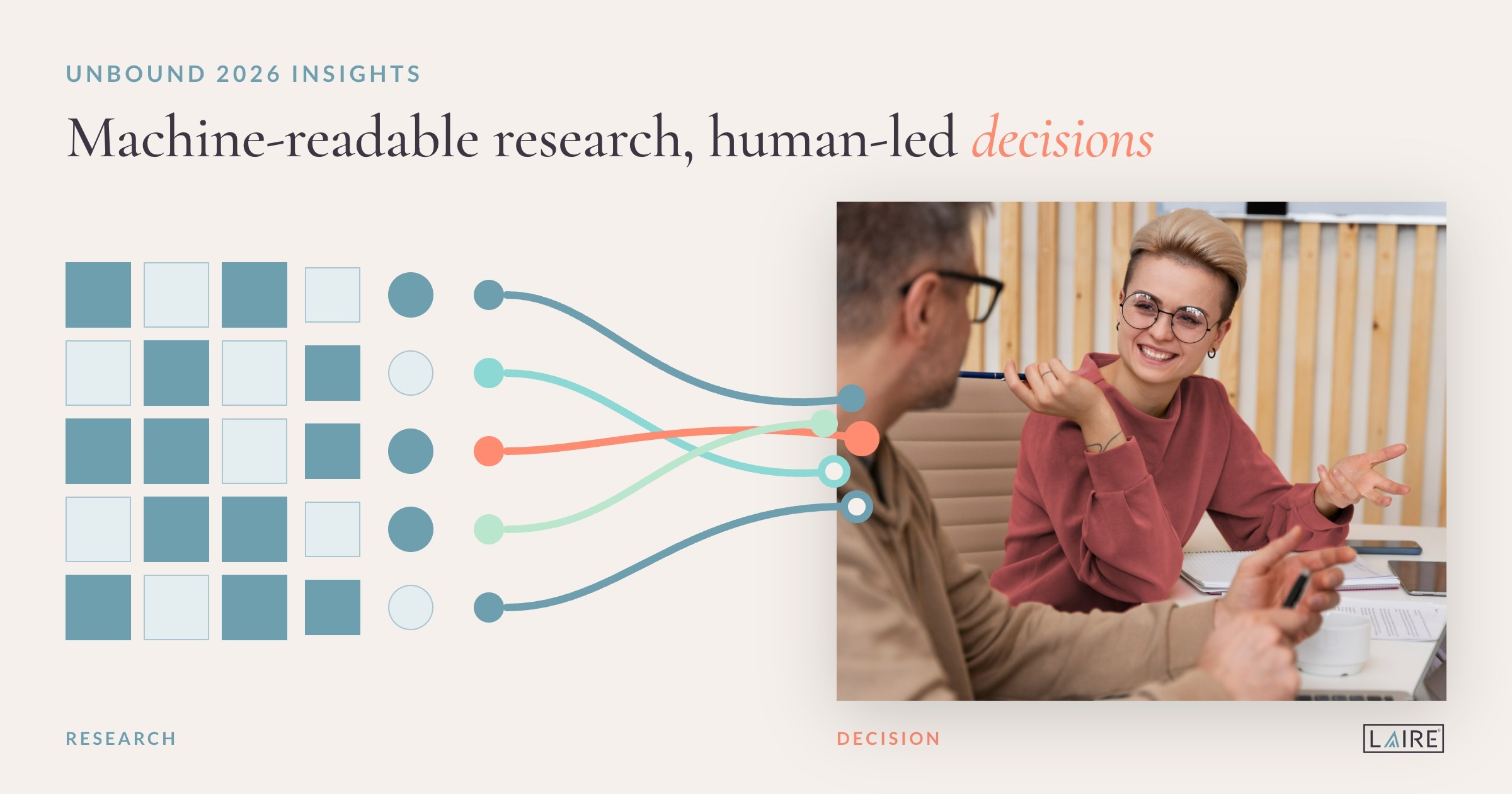
That's our read at LAIRE rather than a finding: build for machine-readable research and human-led decisions. Take the friction out of everything a buyer does before they contact you, and put your best people on everything that happens afterward.
Your email is summarized before anyone opens it
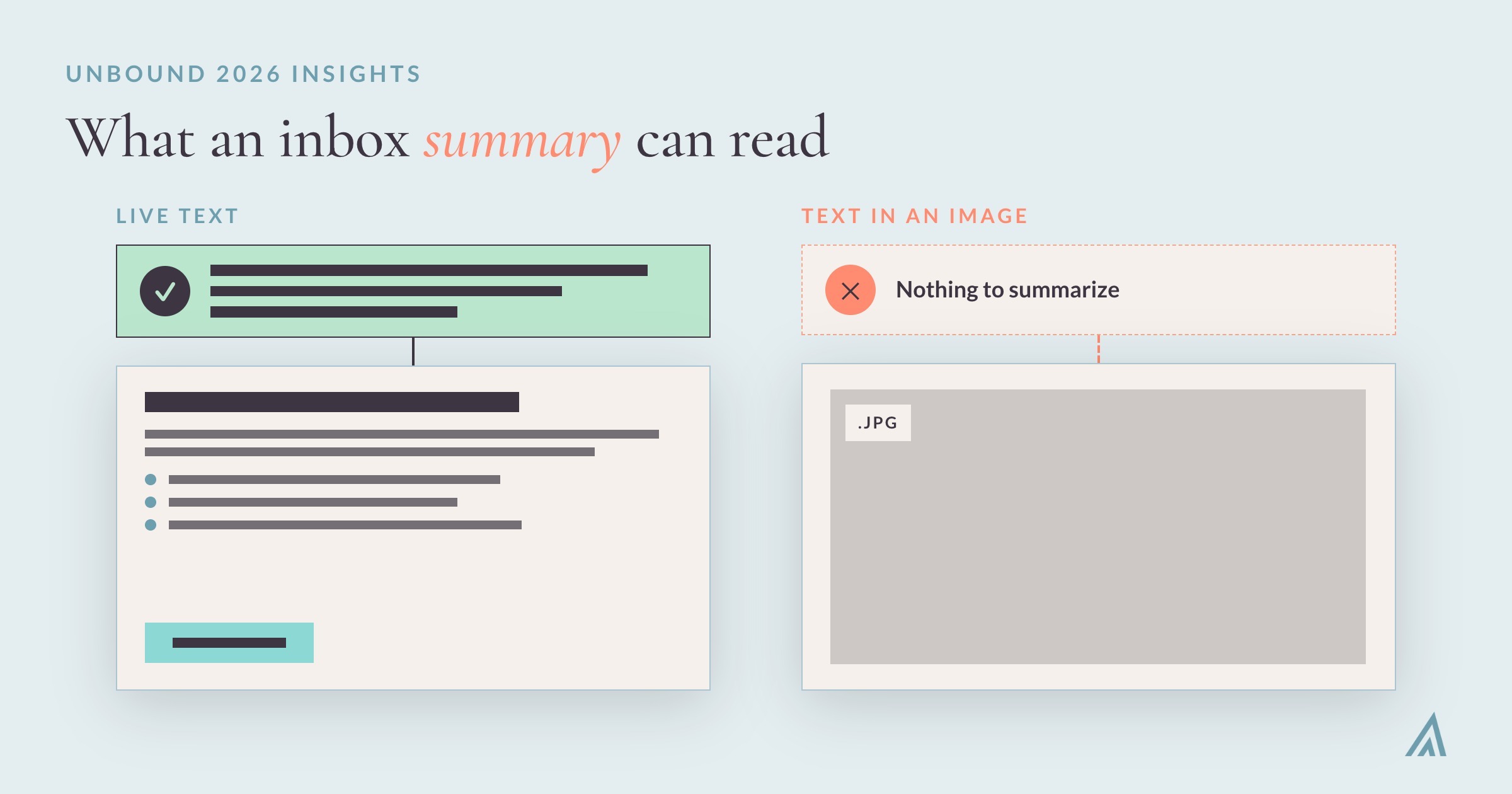
One of the email breakouts made a narrower point that should change how your team builds a send.
The AI summaries in Gmail, Apple Mail and Outlook Copilot read live text, meaning a headline, a paragraph or a button label someone typed into the email. Words baked into a JPG or a PNG don't count, and neither does a logo or your alt text, which means a beautifully designed email can summarize as very nearly nothing.
None of the fixes cost anything. Put the offer, the audience, the benefit, the deadline and the call to action inside the first 200 characters of live text. Use real bullets rather than a graphic that looks like bullets, and keep your button copy as text rather than an image. Assume a model is writing your preview line, because increasingly it is.
The same session flagged the words that depress engagement when they open a subject line or a title, with unlock, discover, revolutionary, game-changing and next generation leading the list. That reads like a transcript of every AI-drafted subject line we see, which is rather the point.
What to do in the next 90 days
The order matters more than the speed here. Running an agent pilot on a portal full of unreliable data produces confident output that nobody trusts, and that kind of failure is expensive to walk back.
|
Timing |
Do this |
Owner |
|
Weeks 1–4 |
Audit the portal: data quality, properties, lifecycle stages, associations, permissions. Fix the top issues before touching agents. |
Marketing ops |
|
Weeks 1–4 |
Open Context Home, complete the business context, and review the completeness score. |
Marketing leadership |
|
Weeks 5–8 |
List every manual, repetitive process across marketing, sales, and service. Rank by hours saved, feasibility, risk, and credit cost. |
Revenue leadership |
|
Weeks 5–8 |
Set AI governance: permissions, human review points, sensitive-data rules, approved use cases, quality checks. |
Ops and legal |
|
Weeks 9–12 |
Build one custom agent against the highest-ranked process. Keep a human approval step in version one. |
Marketing ops |
|
Weeks 9–12 |
Audit your site the way an AI assistant reads it: pricing, specs, availability, service area, policies, warranty, and financing, all in structured text. |
Marketing and web |
|
Ongoing |
Add AEO visibility to the monthly report alongside rankings and traffic. |
Marketing leadership |
Questions we got asked after the Unbound keynote
Do we need to buy credits to use any of this?
No. Context Home, Breeze Assistant, Agent Hub, the Agent Builder interface, core Deal Progression and Smart CRM enrichment all carry no credit cost. Marketing Studio comes with Marketing Hub Professional and above, though the agents you run inside it are metered. The packaged agents meter at published per-outcome rates that vary by agent, while custom agents meter per action unit. Those rates move often enough that you should check them in your own portal before building a budget around them.
Is Agent Builder worth it if we only have a handful of repeatable processes?
Weigh the build against the hours that process eats today. If routing and qualification are costing you a few hours a week, the math usually works out. The trap is building six agents before you've properly validated one.
Should we delay our AEO work now that Marketing Studio reports on it?
No. The score tells you where you stand. It doesn't produce the evidence, the original data or the clear authorship that gets a page cited in the first place, and that editorial work has a far longer lead time than any reporting change.
Our data is a mess. Do we wait on all of this?
Start the cleanup now and run a pilot alongside it on something narrow and low-risk where the data is already reliable. Waiting for a perfect portal means waiting indefinitely, and the context work gets considerably easier once the team has seen one agent working properly.
Where LAIRE fits in your marketing strategy
LAIRE is a HubSpot Diamond Solutions Partner, and the work sitting in front of most portals right now is unglamorous. It means cleaning up the data model, settling the lifecycle definitions, documenting the business context HubSpot's AI reads from, and working out which processes are genuinely worth turning into agents. Getting that order right is what separates an AI budget that compounds from one that funds a pilot nobody ends up using.
Our AI consulting and HubSpot integration services start with exactly that assessment. Book a 20-minute consult and we'll walk through what your portal is ready for and what to fix first.