A website redesign is a substantial rebuild of your site's structure, design, content, and technology. It is not a coat of fresh paint. The best reason to take one on is rarely that the site looks dated. It is that the site has stopped helping you grow.
Plenty of companies redesign for the wrong reason. A new executive dislikes the look. A competitor launches something shiny. The brand starts to feel stale. Those projects often cost real money and change very little, because the real problem was never visual.
This guide covers the signs it is time to redesign your website and a six-step process for doing it right. The goal is a site that generates leads and supports sales, whether you run the project in-house or with an agency.
What a website redesign actually is
A website redesign changes how the site works and how it guides visitors. It may include a new information architecture, revised messaging, new page templates, updated conversion paths, a different content management system, and new integrations with your CRM or marketing platform.
A refresh leaves that foundation in place and updates a smaller set of surface elements, such as colors, typography, imagery, navigation labels, or priority pages. That distinction matters. The decision between a refresh or a full redesign should depend on the problem you need to solve and the parts of the current site that are still doing their job.
When should you redesign your website?
Redesign your website when several performance or operational problems point to a weak foundation. If you are wondering when to redesign a website, look beyond appearance and examine how well the site attracts the right visitors, converts them, supports sales, and fits your internal workflow. These signs of poor website design are stronger evidence than a subjective dislike of the homepage.
Traffic arrives, but qualified leads do not
Traffic without conversion usually means visitors cannot see a relevant next step, do not understand the offer, or cannot find the proof they need. Start by reviewing conversion rates by page and traffic source. A sitewide redesign may be justified when design and content repeatedly weaken conversion across your highest-value pages.
Your sales team avoids the site
Ask sales representatives which links they send during active deals. If they rely on one-off decks because the website lacks clear answers, useful proof, or current positioning, the site is failing as a sales tool. This problem is common on manufacturing websites that do not support sales conversations, but it can affect any complex B2B purchase.
Marketing cannot update it without a developer
Your team should be able to publish a landing page, revise service copy, and add a case study without creating a development ticket for every change. If routine updates are slow or risky, content ages and campaigns wait on the platform. A redesign may need to address the CMS, reusable modules, permissions, and governance as much as the visual system.
The mobile experience is slow or unstable
A site that is difficult to read, navigate, or use on a phone loses buyers before the message has a chance to work. Measure the experience instead of guessing. Google's current Core Web Vitals define a good experience as Largest Contentful Paint within 2.5 seconds, Interaction to Next Paint of 200 milliseconds or less, and Cumulative Layout Shift of 0.1 or less at the 75th percentile.
The site describes an older version of the business
Your services, ideal customers, positioning, or sales process have changed, but the site still tells the old story. Patchwork edits can make the problem worse when pages use different language or send visitors toward outdated offers. A redesign creates room to rebuild the message around the company you are now.
The website and CRM do not work together
Forms, attribution, lead routing, and lifecycle reporting should connect. If lead data lands in disconnected inboxes or the sales team cannot see what a prospect viewed before submitting a form, the website is limiting follow-up and measurement. A redesign can address the forms, integrations, tracking plan, and data structure together.
The details vary by industry. A financial services firm may lose qualified leads to an unclear contact path. Construction websites that do not convert often bury the service area, proof, or action a visitor came to find. The shared issue is a site built around internal preferences instead of buyer decisions.
Should you refresh or fully redesign your website?
Choose the smallest project that can solve the underlying problem. A refresh is usually enough when the site structure works, the platform is manageable, conversion paths are clear, and the main gap is visual consistency or a limited set of outdated pages.
Choose a full redesign when the problems are structural. That includes confusing navigation, outdated positioning across most pages, poor mobile performance, an inflexible CMS, weak conversion paths, or missing connections to sales and marketing systems. A redesign costs more and takes longer, so it should remove a constraint that smaller changes cannot fix.
If the answer is unclear, run a short discovery phase before approving the full budget. Review analytics and search data, interview sales, test the highest-value user journeys, and estimate how much of the current content and technology can stay. That evidence will show whether you need targeted repairs or a new foundation.
The website redesign process: 6 steps to do it right
A successful website redesign process follows a clear order: define the goal, audit the current site, plan the journey, design and build, protect SEO, then launch and improve. Starting with visuals invites subjective debate before the team has agreed on what the website must accomplish.
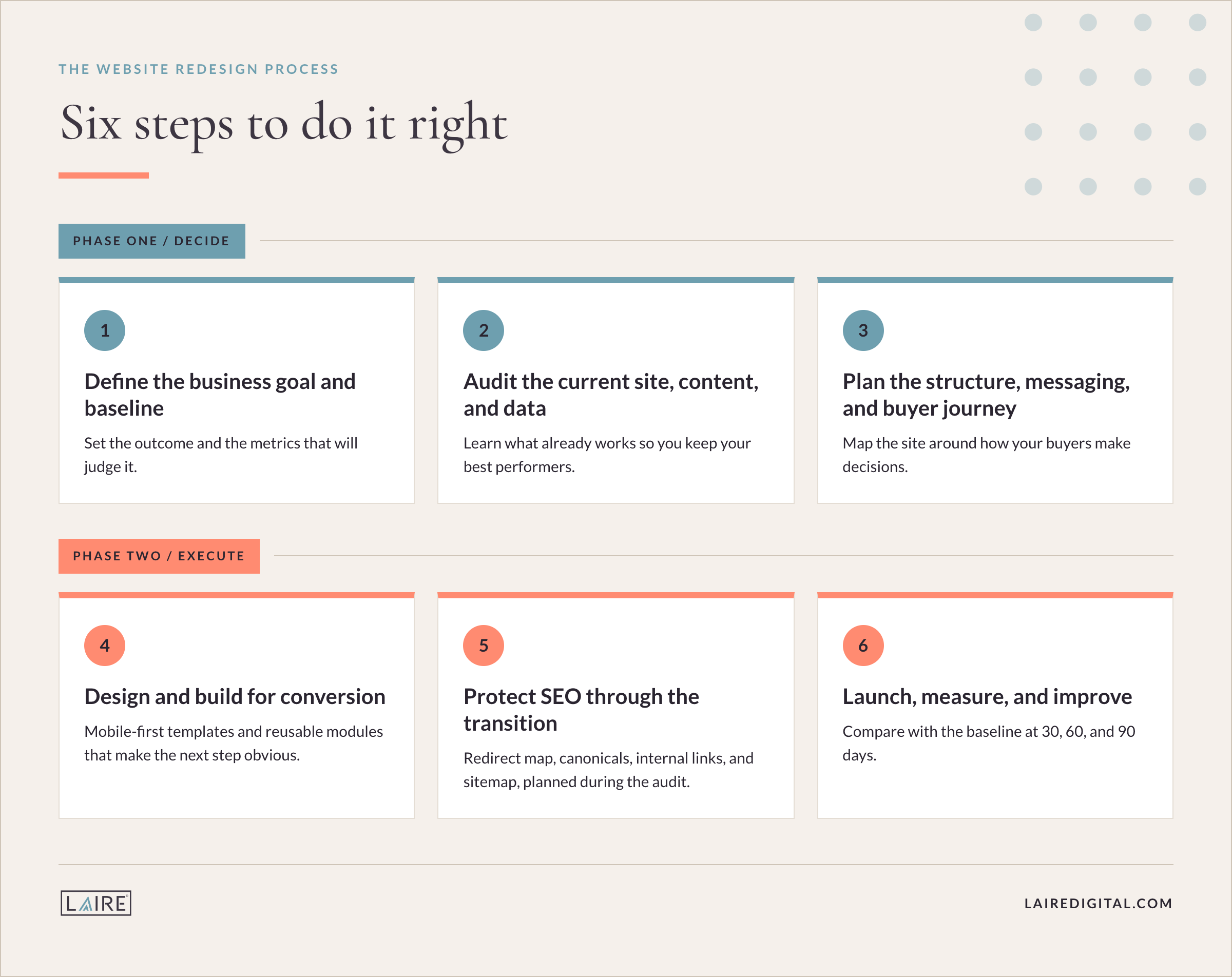
Step 1: Define the business goal and baseline
Start with the outcome you need. Decide what the redesigned site must do better, such as generate more qualified leads, support sales conversations, or lift conversion on your key pages. Then set specific metrics so you can judge the result later. A goal like "more demo requests from the pricing page" gives the whole project a target. A redesign without one becomes a matter of taste, and taste is almost impossible to measure.
Deliverable: a short measurement plan with the primary goal, supporting metrics, data source, owner, and review dates. Include business metrics such as qualified leads and pipeline alongside website metrics such as sessions, conversion rate, form completion, and engagement on priority pages.
Step 2: Audit the current site, content, and data
Before you rebuild, learn what you already have. Review which pages drive traffic, which convert, and which sit untouched. Check your analytics, your search rankings, and the content buyers actually engage with. The audit tells you what to keep, what to improve, and what to retire. Just as important, it protects the pages that already earn results, so a redesign does not accidentally delete your best performers.
Deliverable: a content and URL inventory, a list of technical requirements, and a baseline report for the metrics defined in Step 1.
Step 3: Plan the structure, messaging, and buyer journey
Map the site around how your buyers make decisions. Decide the page structure, the primary paths you want visitors to follow, and the message each page needs to land. A logical structure and clear messaging do more for lead generation than any design trend. This is also where you plan the next step you want each type of visitor to take, so no page becomes a dead end.
Deliverable: an approved sitemap, navigation model, page-level messaging brief, and conversion path for each core audience.
Step 4: Design and build for conversion
Good design makes the right action obvious. Design mobile-first page templates that make the message and next step easy to understand. Build reusable modules so the marketing team can create new pages without breaking consistency. Test forms, accessibility, page speed, CRM routing, and analytics events during development, while changes are still easier to make.
LAIRE applies growth-driven design by launching a strong core experience and improving it with real behavior and conversion data. That gives the team a practical backlog for post-launch testing instead of treating every assumption as final.
Step 5: Protect SEO through the transition
SEO migration work should begin during the audit. Create a one-to-one map from every important old URL to the most relevant new URL, then use server-side permanent redirects such as 301 or 308. Update internal links, self-referencing canonicals, metadata, structured data, and the XML sitemap. Keep the staging site out of the index, and confirm that any temporary noindex rules or crawl blocks are removed at launch.
Google's official site move guidance also recommends testing the new site, monitoring traffic and crawl errors, and avoiding redirect chains. LAIRE's guide to redesigning without losing SEO provides a practical checklist for the transition.
Deliverable: an approved redirect map and SEO launch checklist, with an owner assigned to validate both immediately after release.
Step 6: Launch, measure, and improve
Before release, run a website launch checklist that covers forms, CRM routing, analytics, consent settings, broken links, redirects, canonicals, sitemaps, mobile behavior, and page speed. Test the highest-value journeys with real devices and real form submissions.
After launch, compare performance with the baseline at 30, 60, and 90 days. Watch qualified leads, conversion rates, organic landing pages, ranking and index coverage, form errors, and sales feedback. Search visibility may fluctuate while search engines re-crawl the site, so use the trend across several weeks and the quality of resulting leads, rather than judging the project from its first few days.
Common website redesign mistakes to avoid
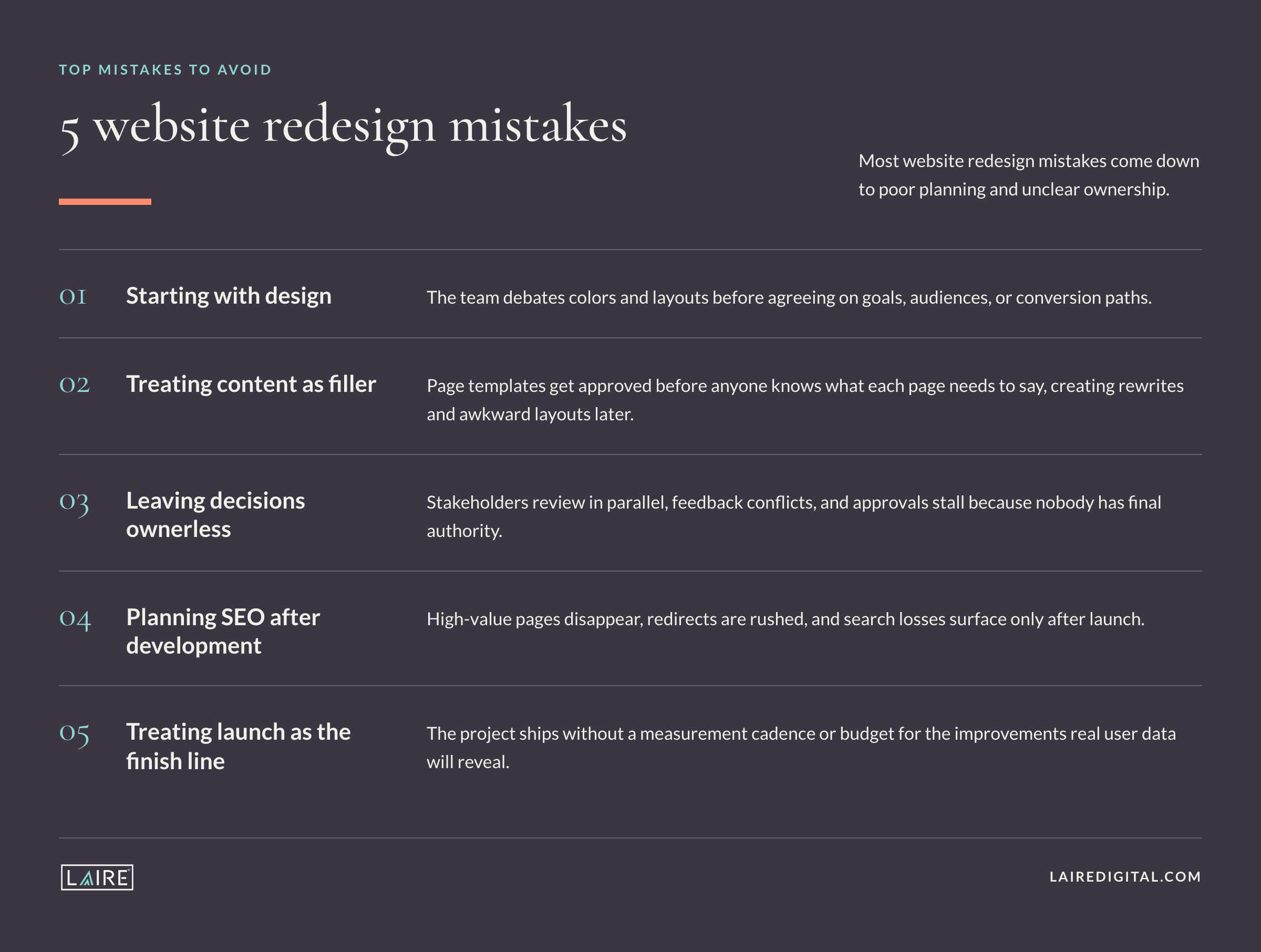
Most redesign failures come from the order of operations or weak ownership, not a lack of creative talent. Watch for these predictable problems:
- Starting with design. The team debates colors and layouts before agreeing on goals, audiences, or conversion paths.
- Treating content as filler. Page templates get approved before anyone knows what each page needs to say, creating rewrites and awkward layouts later.
- Leaving decisions ownerless. Stakeholders review in parallel, feedback conflicts, and approvals stall because nobody has final authority.
- Planning SEO after development. High-value pages disappear, redirects are rushed, and search losses surface only after launch.
- Treating launch as the finish line. The project ships without a measurement cadence or budget for the improvements real user data will reveal.
How long does a website redesign take, and what does it cost?
Most B2B website redesigns take roughly three to six months. The timeline depends on page count, content creation, custom functionality, integrations, migration complexity, and how quickly stakeholders can review and approve the work. A smaller site with a clear decision-maker can move faster. A large site with several audiences, systems, and compliance reviews will take longer.
Cost varies for the same reason. For useful context, LAIRE's current website redesign pricing starts at $10,000 for a website migration to HubSpot and $25,000 for custom website design and development. Those are starting points, not quotes. Content, SEO, custom features, integrations, photography or video, platform fees, and post-launch support can all change the scope.
Set expectations for results as carefully as you set the launch date. A redesigned site may take days or weeks to be recrawled and settle in search results, and results depend on the wider strategy. In one LAIRE engagement that combined a new website with fresh content and improved tracking, InsideOut Development saw organic search traffic increase by nearly 150%. The case supports the value of a coordinated redesign and marketing program; it does not mean a new design alone will produce the same outcome.
Make the redesign earn its keep
Redesign your website when the site blocks growth, and treat the project as a business decision rather than a visual one. Watch for the performance signs, match the fix to the problem, and run the process in order. Start with goals, and protect the SEO you have already earned. A site built around how your buyers decide will keep generating leads long after the launch excitement fades.
Frequently asked questions
What is a website redesign?
A website redesign is a substantial rebuild of a site's structure, content, design, and technology. It changes how the site works and guides visitors. A website refresh keeps the underlying structure and platform largely intact while updating a smaller set of visual or content elements.
How do you know when it is time to redesign your website?
It is time to consider a redesign when the site repeatedly fails to convert qualified traffic, support sales, perform well on mobile, reflect current positioning, connect with your CRM, or let marketing make routine updates. Use analytics, search data, sales feedback, and user testing to confirm that the problem is structural before committing to a full rebuild.
How long does a website redesign take?
A typical B2B website redesign takes about three to six months. Page count, content needs, custom development, integrations, migration risk, accessibility or compliance requirements, and stakeholder review time all affect the schedule.
How much does a website redesign cost?
Website redesign cost depends on the site's size, complexity, platform, content needs, SEO work, and custom functionality. At LAIRE, a website migration to HubSpot currently starts at $10,000, while custom website design and development starts at $25,000. A discovery process is the best way to turn those starting points into a project-specific scope.
How do you redesign a website without losing SEO?
Inventory the current URLs and identify the pages that earn traffic, links, rankings, or conversions. Map important old URLs to relevant new URLs, use permanent server-side redirects, update internal links and canonicals, submit the new sitemap, and monitor Search Console and crawl errors after launch. Plan this work before development is finished.
Thinking through a website redesign? See how LAIRE approaches custom website design and development, then book a free 20-minute website and marketing assessment to identify priorities and pressure-test your plan.