You have some marketing budget left and a deadline to commit it. One question should decide what you do with it. Will this still have value on March 31? Year-end money tends to buy whatever a vendor can start on Monday. Availability beats fit, and the bill gets explained in February.
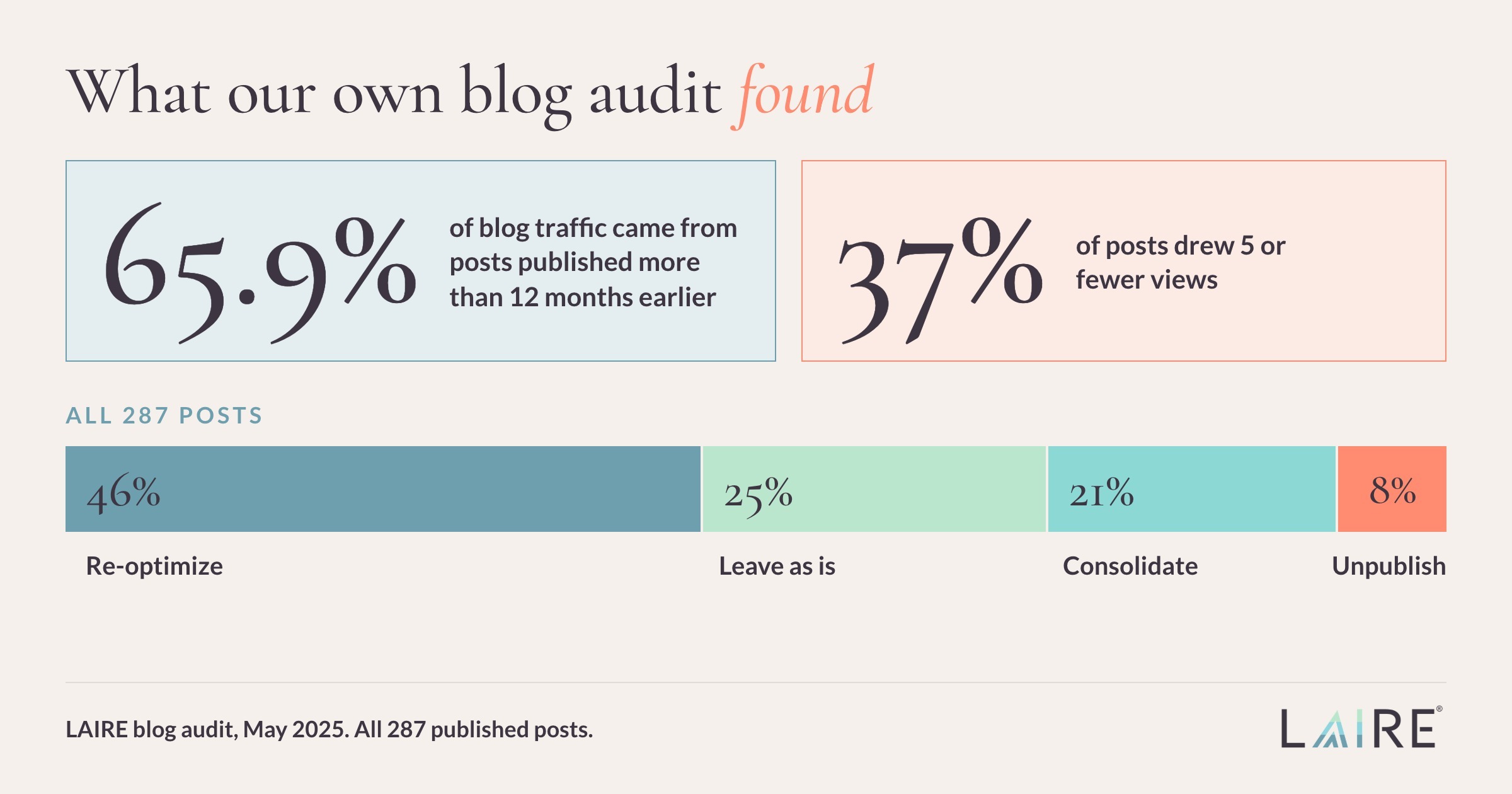
We checked how this plays out in our own content. In a May 2025 audit of all 287 posts on this blog, pieces published more than twelve months earlier drew 65.9% of our traffic. What you buy in Q4 pays out in Q2, when it pays out at all. Plan the spend around that lag instead of against it.
Put leftover marketing budget into what still works in March
Leftover Q4 marketing budget belongs in assets, data, and conversion infrastructure, since those keep producing after the quarter closes. Fund content that keeps ranking, CRM and reporting cleanup, conversion path repairs, and buyer research. Skip anything you can't brief, staff, and measure by the end of January. Where you need a result inside Q1, buy conversion and data work rather than new content.
Key takeaways
- Apply a durability test to every candidate. Will this still have value on March 31?
- Your real cutoff is a finance question. The answer usually buys more room than you expect.
- Sort candidates by lead time, then by whether your budget clears on invoice or on delivery.
- Content compounds, but not automatically. In our own blog audit, 37% of posts drew five or fewer views.
- Write down what each dollar bought. This year's actuals set next year's baseline.
Why the year-end marketing budget gets spent badly
Expiring budget authority changes how decisions get made, however disciplined the team is.
The clearest evidence comes from government procurement. Jeffrey Liebman and Neale Mahoney studied federal contract spending for a 2017 American Economic Review paper. They found that 8.7% of spending falls in the final week of the fiscal year. Quality collapses in that week. Projects started in those last days drew the lowest quality scores 25.79% of the time. Across the rest of the year, the figure was 3.04%. Their proposed fix is the interesting part. Where one agency had authority to roll budget forward, the year-end quality drop didn't appear.
Federal IT contracts aren't marketing campaigns. The mechanism still transfers. When a date forces the decision, the shortlist narrows to whoever can invoice in time.
Two numbers show why that trade is expensive right now. Gartner's 2026 CMO Spend Survey polled 401 marketing leaders, most at billion-dollar companies. Of those, 56% say they lack the budget to deliver their 2026 strategy. The CMO Survey, fielded in January 2026, found overall marketing spending up 1.74% year over year. Digital was up 8.20%. Budgets are tight, and the growth sits in digital. A December purchase that produces nothing in Q1 costs you twice. You lose the cash, and you lose the digital work it displaced.
Ask finance what expires before you shortlist anything
Most marketing budget planning advice skips the step that decides everything else. Marketing teams treat December 31 as the wall. Depending on how your company keeps its books, it frequently isn't. Five questions for finance, ideally this week:
- Does the fiscal year end with the calendar year, or somewhere else?
- What's the last date a purchase order can be raised against this year's budget?
- Does budget clear on invoice date, payment date, or delivery date?
- Can any portion carry forward, and who approves that?
- Can we prepay for work delivered in Q1, and on what terms?
Question three reshapes the menu more than any other. If your budget clears on invoice date, you can commission work in December and take delivery in February. If it clears on delivery, your options narrow to work that finishes inside the window, and the tables below mark which those are.
Question five is the one most teams never ask, and the timing rewards asking it. HockeyStack analyzed $28 million in LinkedIn ad spend across more than 70 B2B SaaS companies. Q1 carried the lowest average cost per click of any quarter, at $10.48. It was also the second-heaviest spending quarter. The report doesn't explain the gap, so treat the read narrowly. If LinkedIn is already in your Q1 plan, prepaying it from expiring budget buys those clicks at the year's lowest average rate.
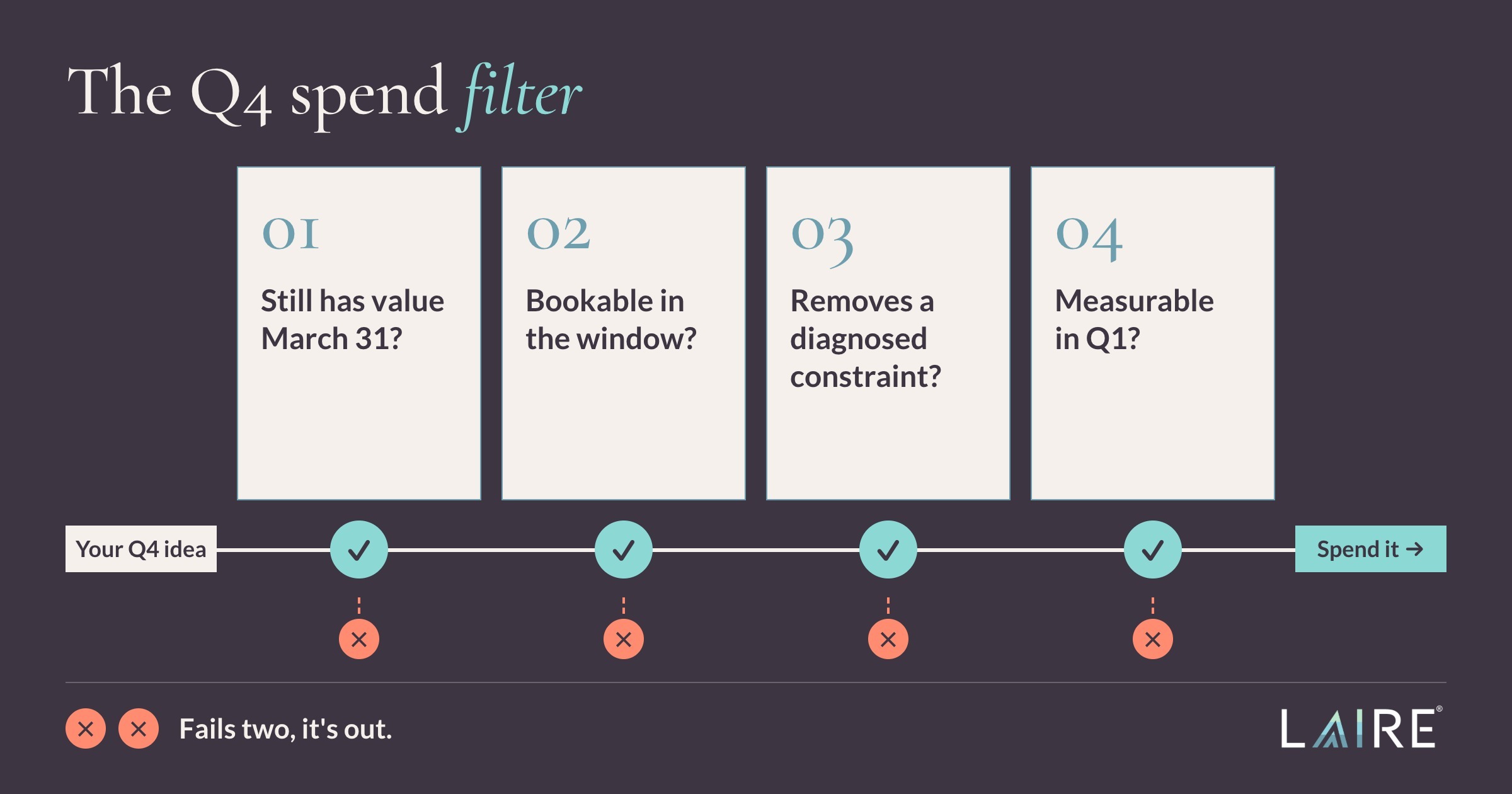
The Q4 spend filter: 4 questions before you approve
Run every candidate through these four. Anything that fails two is a poor use of year-end budget, however easy the approval. The filter is also the fastest way to optimize a marketing budget you didn't plan to still be holding.
|
Question |
What it tests |
It fails when |
|---|---|---|
|
Does it still have value on March 31? |
Durability. Whether the purchase leaves behind an asset, a capability, or clean data. |
The value ends when the quarter does. |
|
Can it be scoped, contracted, and recognized inside the window? |
Bookability. Whether finance counts it this year. |
Approval alone eats the remaining time. |
|
Does it remove a constraint you've already diagnosed? |
Fit. Whether it addresses a known bottleneck. |
You're funding a category instead of a problem. |
|
Can you measure it in Q1? |
Accountability. Whether you can report a result. |
The only available metric is activity. |
The filter earns its keep on a close call. A manufacturer has budget left. Two options remain at the same price. One is a December LinkedIn push. The other is a buyer's guide with the landing page and nurture sequence behind it.
The campaign clears bookability easily. It fails durability because on March 31 it's a closed report. The guide clears durability, and it clears fit if lead quality is the diagnosed constraint. It also clears measurability, since you can read form fills and sales-qualified leads against it through Q1. The guide fails nothing twice; the campaign fails one badly. That reasoning fits in a sentence your CFO will accept.
Question four earns the most attention, because year-end purchases are the ones finance asks about in February. Decide now which number this should move and where you'll read it. If the honest answer is impressions or publishing volume, you're buying vanity metrics.
Size the purchase to the budget that's left
Match the kind of purchase to the size of what's left. Each band below supports a different sort of buy.
A small remainder buys one fix
A remainder that's a rounding error against the annual number buys one fix. Point it at a single constraint and finish it. That might be a conversion path repair, a data cleanup, or a round of customer interviews.
A larger remainder buys an asset
That covers a buyer's guide, a comparison page, or a re-optimized set of pages that already rank on page two. These need weeks rather than days, and they keep earning long after the invoice clears.
A large uncommitted share is a planning signal
When a meaningful share of the full year's budget is still uncommitted in Q4, read that as information. The constraint was capacity, approvals, or plan clarity, and a large December purchase won't repair any of them. Naming the real cause now makes the January planning conversation considerably easier.
What our own blog audit says about which spending lasts
"Content compounds" is the standard argument for buying assets with year-end budget. We wanted to know whether our own library behaves that way, so in May 2025 we audited all 287 published posts on this blog against their traffic. Three findings changed how we spend at year-end.
Older posts carried the traffic
Posts published more than twelve months before the audit accounted for 65.9% of blog views. The twenty best-performing posts produced 65% of all views between them, and only two of those twenty had been published in the previous six months. Nothing published in the audit quarter reached the top of the list. An asset bought in December is unlikely to prove itself in Q1. Expect that lag and plan around it.
Compounding isn't automatic
In the same window, 37% of posts drew five or fewer views. We marked 29% of the library for consolidation or removal. Volume published in prior years did not become an asset on its own, and a good deal of it became maintenance. Buying content in December only works when each piece answers a question buyers are asking.
Re-optimizing beat replacing
We flagged 46% of posts for re-optimization and only 25% as fine to leave alone. Our own highest-traffic pages, including posts drawing over a thousand views each, sat in the re-optimization tiers rather than the leave-alone tier. The pages with the most to gain were already published.
Treat these as one agency's numbers from one reporting window. They are not an industry benchmark. They changed our own behavior. We stopped treating December as a month to add volume and started treating it as a month to improve what already earns.
Marketing budget allocation, sorted by lead time
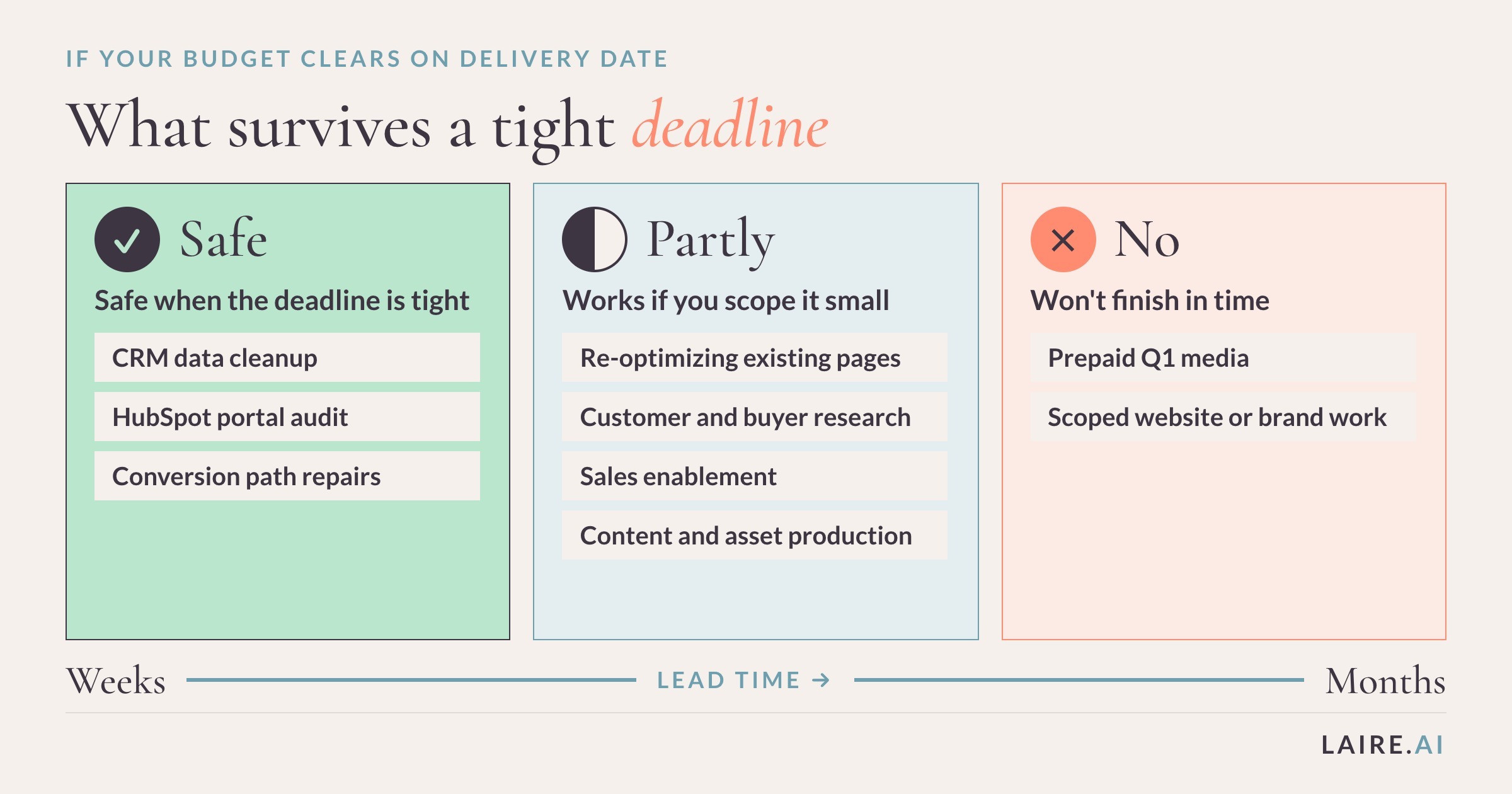
Lead time decides what's realistic, so sort candidates by it before anything else. Marketing budget allocation in December is mostly a scheduling problem. The question is less what you want and more what can be scoped, approved, and recognized in the days you have. The two tables below group candidates by how long they take to scope and start. Treat those groupings as planning estimates, since scope and approval speed move them, and confirm them against real quotes. The final column flags what survives if your budget clears on delivery date.
Work you can scope and start quickly:
|
Investment |
Why it holds value |
Clears on delivery? |
|
CRM data cleanup |
Deduplication and lifecycle hygiene raise the accuracy of every Q1 campaign running on that data. Data hygiene is dull, and it compounds. |
Yes |
|
HubSpot portal audit |
Configuration debt caps what your reporting and automation can do all year. Auditing the portal produces a January fix list. |
Yes |
|
Conversion path repairs |
Forms, thank-you pages, routing rules, and follow-up sequences change the yield of traffic you're already paying for. |
Yes |
|
Re-optimizing existing pages |
The highest-upside pages are usually ones you already own. In our audit, 46% of posts were worth re-optimizing. |
Usually |
Work that needs a longer runway:
|
Investment |
Why it holds value |
Clears on delivery? |
|
Content and asset production |
A buyer's guide, comparison page, or middle-funnel set keeps earning for years. Map it to the buyer's journey and not to a keyword list. |
Only if scoped small |
|
Customer and buyer research |
Recorded interviews sharpen a year of messaging. Campaigns can't tell you why you lost. |
Partial |
|
Sales enablement |
Battlecards and a rebuilt proposal template close the distance between marketing claims and sales conversations. |
Partial |
|
Prepaid Q1 media |
Converts expiring budget into working spend in the quarter where B2B LinkedIn costs per click run lowest. |
No, prepayment only |
|
Scoped website or brand work |
A redesign you've deferred is a legitimate year-end commitment when the brief already exists. |
No |
Strategy sits above all of it, though rarely on its own. One fintech SaaS client started with a Marketing Action Plan covering personas, lead scoring, and measurement. They then acted on it, rebuilding the homepage and demo pages and reworking HubSpot workflows. Lead form submissions reached 99 in Q1 2025, up 220% year over year from a small base. Plan and execution ran together. The plan can't be separated from the result, and it's where they began.
Year-end spending that rarely survives January
These four purchases look responsible in December and read badly in March.
Net-new campaigns launched after mid-December meet low attention and high competition. They end before the data means anything. All you have at the end of it is a line item.
Software bought without an owner turns into a renewal conversation you can't win. Ask who logs in first on January 5.
Unbriefed media top-ups move money faster than anything else available. That speed is why they get chosen under time pressure. An account already running at efficient scale converts extra budget into worse impressions. LAIRE's case for diversifying rather than overspending on paid ads holds hardest in December.
Retainers for capacity you won't staff turn budget into unused credits. Agency hours need someone to brief them. Buy capacity only where a person already has work waiting for it.
Write the record that protects next year's budget
Spending well in Q4 is also a budget-season argument. If finance builds next year's plan from this year's actuals, an underspend sets a lower baseline. Careless spending lands in the same place once the Q1 results come in.
One page defends against both. For each item, record the purchase, the constraint it addresses, the owner, the Q1 metric, and the review date. Five columns, one row per purchase.
That page works in January because every row names a business constraint instead of a channel, so the conversation runs on outcomes your CFO already tracks. Our guide to justifying your marketing budget to your boss goes further on the argument. Tying each row to a lifecycle stage makes the pipeline connection easier to show than a channel breakdown does.
A two-week plan to commit Q4 marketing budget
Starting from a number and a deadline, work in this order.
|
Days |
Action |
Output |
|
1 |
Confirm cutoff dates and recognition rules with finance. |
A firm deadline and a prepayment answer. |
|
2 to 3 |
Name your top three growth constraints for Q1. Start where volume drops most between two pipeline stages, then ask whether the cause is traffic, offer, conversion, or follow-up. |
A ranked diagnosis you can fund against. |
|
4 to 5 |
List every candidate and run the four-question filter. |
A shortlist that fails nothing twice. |
|
6 to 7 |
Request scopes and quotes with delivery dates. |
Confirmation of what's bookable. |
|
8 to 9 |
Assign an owner and a Q1 metric to each survivor. |
Accountability before approval. |
|
10 |
Approve, raise purchase orders, record the one-page rationale. |
Committed budget and a defensible record. |
|
11 to 14 |
Brief the work and book the January review. |
Momentum going into Q1. |
Write down the constraint, buy the thing that removes it, confirm you can measure it, and write down why you chose it. Run in that order and a spend-down becomes a head start.
Frequently asked questions
Can I use this year's marketing budget for work delivered next year?
Often, yes. It depends on two things: whether your budget clears on invoice, payment, or delivery date, and whether your company permits prepayment. Confirm both with finance before you shortlist anything. The answer decides which options are open to you. Teams that ask early can fund a Q1 content program or media flight from expiring budget.
What if finance won't approve anything new this late in the year?
Look for work that fits inside an existing agreement rather than a new one. Adding scope to a current retainer, extending a signed statement of work, or redirecting hours already contracted avoids a fresh procurement cycle. Where a new vendor is unavoidable, prioritize whoever is already set up in your systems.
Is it bad to return unspent marketing budget?
It depends on how your company sets budgets. Where next year's plan is built from this year's actuals, an underspend can lower your baseline. Returning money still beats funding work you can't brief, staff, or measure. The strongest position is a documented spend tied to a named constraint, with a Q1 metric against each item.
Will content bought in Q4 produce leads in Q1?
Usually not that fast, and you should plan for it. When we audited our own 287 blog posts in May 2025, posts older than twelve months accounted for 65.9% of traffic, and only two of our top twenty posts had been published in the previous six months. Buy content in Q4 for the compounding, and fund conversion path and data work if you need a Q1 number.
How do you allocate a marketing budget across channels?
No single split works across B2B. Marketing budget allocation should follow where your pipeline stalls. Industry averages describe other companies' constraints. Where demand is strong and conversion is weak, fund the website and sales enablement before adding media. Our guide to marketing spend for revenue growth covers benchmarking in detail.
When should Q4 spending stop and Q1 planning start?
They overlap. Set Q1 priorities first, then commit the remaining budget against them. Committing money before the plan exists produces the deadline-driven pattern Liebman and Mahoney documented. In their data, last-week decisions scored worst on quality.
Pressure-test your shortlist before you commit
Most year-end spending problems are diagnosis problems. The filter above helps. A second opinion on the diagnosis helps more, particularly when the shortlist is already circulating and the deadline is real.
Book a 20-minute marketing consult to pressure-test your Q4 shortlist and find where your pipeline is losing leads. For the fuller picture, a Marketing Action Plan by LAIRE connects strategy, systems, execution, and measurement around your growth goals. You get a prioritized roadmap for the year ahead.