Most B2B companies know what they want to say about themselves. The trouble starts when they read their competitors' websites and find the same sentences waiting there.
A Unique Selling Proposition is a specific claim about what a buyer gets from choosing you. It has to be stated so your competitors can't honestly say the same thing. The second half of that is where the work lives, and almost every guide skips it.
Below is a method for getting to a claim that survives your competitors, your buying committee, and the request for proof. We run it inside every Marketing Action Plan, alongside the work on what makes a brand remarkable.
What counts as a Unique Selling Proposition
A Unique Selling Proposition, or USP, is the one claim your competitors can't honestly make too. Your buyer has to care about it, and you have to prove it. It answers the only question that matters once three vendors are on a shortlist, which is why you rather than them.
The term's older than most advice written about it. Rosser Reeves of the Ted Bates agency set out three tenets of a Unique Selling Proposition in Reality in Advertising, published in 1961. The second is the one worth sitting with:
The proposition must be one that the competition either cannot, or does not, offer. It must be unique – either a uniqueness of the brand or a claim not otherwise made in that particular field of advertising.
Reeves wrote for mass-market consumer advertising, and his third tenet about moving the mass millions belongs to that world. The second has survived perfectly, and it's striking how often it gets left out. The competitor test was in the definition from the start. Sixty-five years later, most guides mention competitors once, under a step called "analyze the competition." Then they move on without saying what to do.
Key takeaways
- A Unique Selling Proposition is a claim your buyer cares about, your competitor can't honestly make, and you can prove.
- Most B2B propositions fail the second test, not the first. The claim's true. It isn't yours alone.
- Generate candidates by subtracting from what you already say, not from a blank page.
- A claim survives only if you can put evidence next to it that a buyer accepts.
- Write it in one sentence, then test it on sales calls and your homepage.
Why most B2B selling propositions aren't unique
Here's a pattern we see almost every time we run this exercise, across manufacturing, fintech, home construction, and professional services.
The company has a list of things it believes make it different. It usually includes a consultative approach, senior people rather than juniors, deep industry knowledge, and responsiveness. Every item is genuinely true of them.
Then we open four competitor websites and read the list back.
These claims aren't lies. They're accurate and shared, which is a different problem needing a different fix. Better copy won't solve it, because the sentence was never the issue. You solve it by finding the claim underneath that the others can't make.
Brand differentiation in a mature market is mostly subtraction. Start with everything true about you, then remove everything also true about them. What's left is small, and that's the point. If your list reads like everyone else's, that's one of the clearer signs of a weak brand.
USP, value proposition, and positioning aren't the same
These three get used interchangeably, which causes real confusion in workshops. They answer different questions, for different moments.
|
What it answers |
Who it's for |
Where it shows up |
|
|
Unique Selling Proposition |
Why you instead of the alternatives |
A buyer comparing options |
Sales conversations, homepage, proposals |
|
Value proposition |
What you do and what the buyer gets |
A buyer deciding whether to engage at all |
Homepage hero, ads, outbound |
|
Positioning |
What category you're in and who you're for |
Your own team, and the market |
Strategy documents, messaging frameworks |
A value proposition can be true and still leave a buyer undecided between you and two competitors. The Unique Selling Proposition breaks the tie. Positioning sits underneath both and decides which comparison you're in at all. It's the same relationship a marketing plan has to a marketing strategy.
Start with the buyers you want to win
A USP gets written for the specific people who'll sit in a room and decide, not for a market.
In B2B that room is crowded. Gartner surveyed 632 B2B buyers in 2024. It found that buying groups now range from five to 16 people across as many as four functions, and that 74% of buyer teams show what Gartner calls unhealthy conflict during the decision. That means conflicting objectives, disagreement on the right course of action, or being overruled from outside.
That changes what a good USP has to do. A claim that delights the practitioner and means nothing to the CFO won't survive the conversation after your call ends. You're giving one person something they can repeat to colleagues with different priorities.
So be specific about who sits in that group and what each of them is accountable for. Personas more than a year old describe a buying process that's since changed, so keeping them current comes first. Sales call recordings and recent win and loss notes beat a persona document nobody's opened since the last rebrand. If you're starting thin, you can build personas from LinkedIn data.
List every claim you make, then find what makes your business unique
Don't start from a blank page. Pull your existing claims from your homepage, service pages, sales deck, last three proposals, and most recent RFP response. Write each on its own line, in the words you use rather than a tidied-up version. Twenty to forty lines is normal.
Two rules. Write the claim rather than the category, so "we assign a senior strategist to every account" instead of "service quality." Include what you say on sales calls but have never written down, because those are often the honest ones.
The list gives you something to subtract from. Finding what makes your business unique is far easier as an editing job than an invention job.
Run the competitor test on every claim
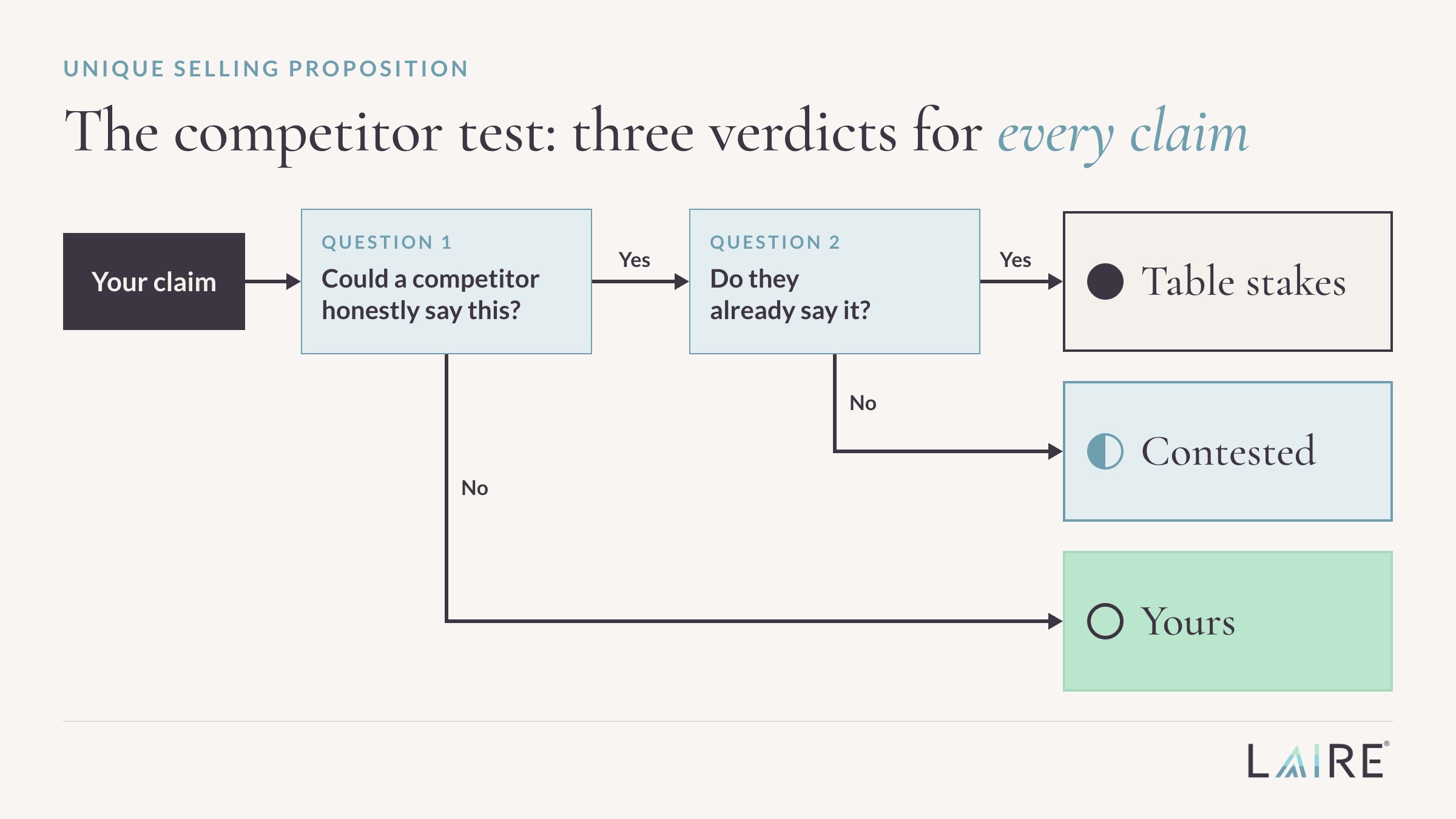
This is the step everyone names and nobody explains. Open the websites of the three or four competitors you genuinely lose deals to. That's rarely the aspirational list, and never every firm in your category. Then score each line of your claim list against two questions.
|
Your claim |
Could a competitor honestly say this? |
Do they already say it? |
Verdict |
|
We take a consultative approach |
Yes |
Yes, all four |
Table stakes |
|
Senior people on every account |
Yes |
Two of four |
Contested |
|
We publish our methodology publicly |
Yes |
No |
Contested, and available |
|
Our founders host the industry podcast |
No |
No |
Yours |
|
We're certified at the top partner tier |
Yes, two of them are |
Yes |
Table stakes |
Three verdicts come out of this.
- Table stakes claims are true, shared, and still worth saying somewhere, because their absence is noticed even though their presence persuades nobody. They belong on your service pages, not in your USP.
- Contested claims are the interesting middle. A competitor could make the claim but hasn't, or only some do. These are winnable by being more specific, by committing publicly, or by getting there first.
- Yours claims are the ones a competitor can't honestly make. There are usually fewer than you expect, often only one.
Two things make this work. Copy competitor claims verbatim, because paraphrasing is where you quietly make their version sound weaker than yours. Score yourself honestly too, since the exercise is worthless otherwise. If you want an outside read, our free branding assessment covers it.
Sort what survives by the proof you can show
A claim that clears the competitor test still has one gate left. When a buyer says "show me," what happens? Sort everything still standing into three tiers.
.jpg?width=2400&height=1350&name=How%20to%20Define%20Your%20USP_02_proof-tiers%20(2).jpg)
Provable on demand. You can point at something public right now. Named clients, published work, a verifiable certification, a number on a page. The strongest tier by a wide margin.
Provable on request. The evidence exists but lives behind a conversation. References, case studies under NDA, results you can walk someone through on a call. Usable, as long as you can produce it quickly.
Assertable only. You believe it, you may well be right, and there's nothing to show. "We care more." "We're more responsive."
A claim you can only assert isn't a Unique Selling Proposition yet. It's an ambition, and the honest move is to build the evidence or pick a different claim. When clients ask what proof looks like, we point at published results, like a fintech SaaS company or a financial services firm. A buyer reads those without taking a meeting.
What the LAIRE remarkables look like under that test
It'd be easy to run this on somebody else's brand. Here's ours instead, scored the same way, with the uncomfortable rows left in. We call these remarkables, and identifying them is one of the nine deliverables inside the MAP.
Marketing Action Plan by LAIRE. A named, productized engagement with a public page describing what it includes. Competitors do strategy work, but none has this named artifact a prospect can read before talking to anyone. Verdict: yours, provable on demand.
Married 2 Marketing. A podcast hosted by our two co-founders. No competitor can claim it, and none is going to. Verdict: yours, genuinely unique, but secondary. It builds trust. It isn't why a manufacturer signs a contract, and pretending otherwise would be the mistake this article's about.
P.A.C.E. Our commitment to supporting people, animals, the community and the environment. Values alignment rarely decides a B2B deal on its own, though it breaks ties and affects who wants to work here. Verdict: yours, secondary.
millionLAIRE. Our clients have seven-figure goals and we count alongside them on the way there. Strong hook, memorable name. The honest read is that it's an ambition rather than a proven outcome. That puts it in the assertable tier until the proof sits somewhere public. Verdict: needs evidence before it carries weight.
HubSpot Diamond Partner status. This one fails, and it's worth saying so. Several serious agencies hold Diamond or Elite tier. Its absence would count against us and its presence persuades nobody. Verdict: table stakes.
That last row is the most useful one. Most companies stop once they've found three things they like. The value sits in the rows that don't survive, because each is a sentence you can stop spending words on. We went through this when we rebranded from LAIRE Group to LAIRE. Our founders talked it through on Is Your Business Remarkable.
Write the statement in one plain sentence
Once you know which claim survives, writing it is the easy part. The failure here is decoration. A workable structure:
We help [specific buyer] achieve [specific outcome] through [the thing competitors can't claim], which you can see in [the evidence].
You won't publish it in that shape. It's a thinking tool, and the homepage version should sound like a person said it. Every element has to survive the rewrite. If you can't fill one of the four slots, you've found your next piece of work rather than your USP.
Keep it to one sentence a salesperson can say out loud without reading it. Write it in the same register as the rest of your brand voice, then record it in your brand guide.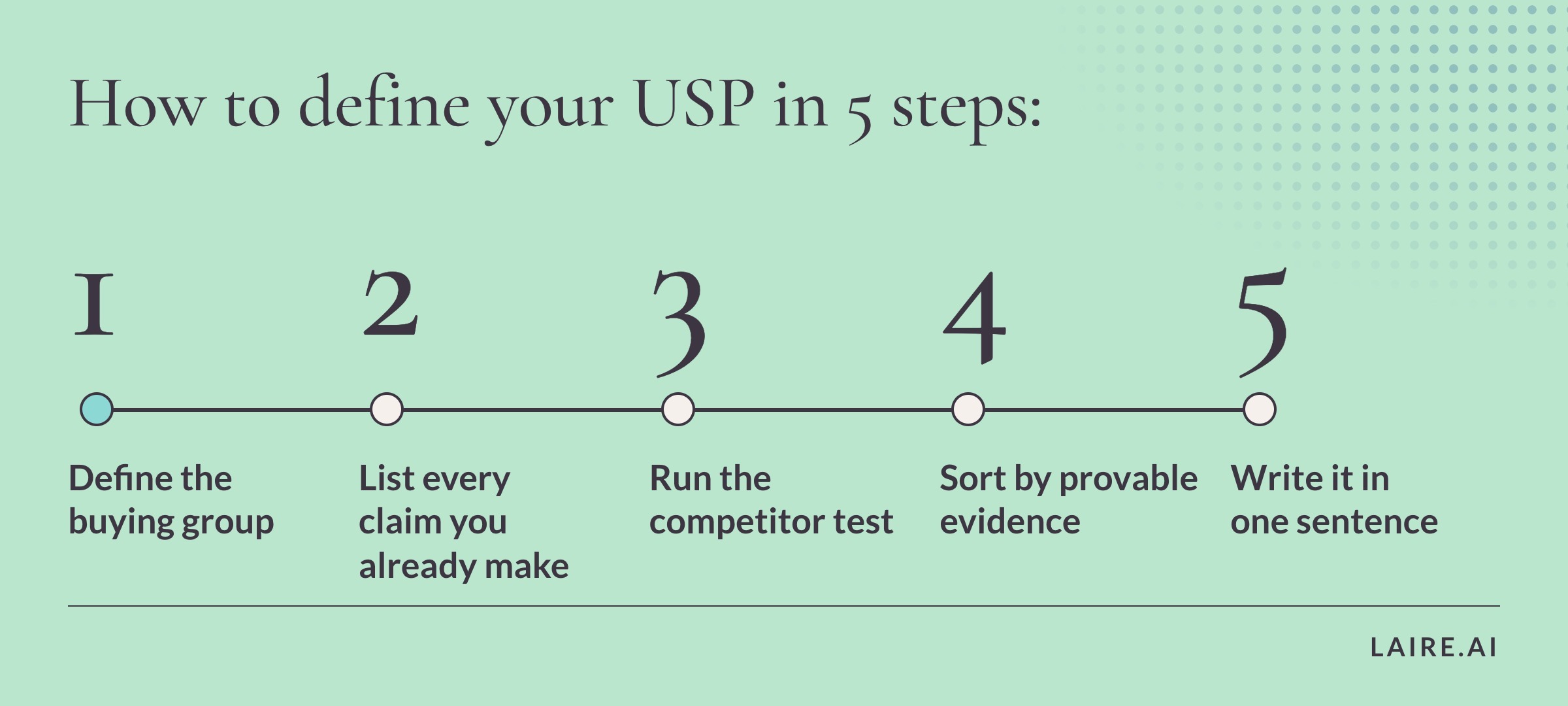
Unique Selling Proposition examples that hold up in B2B
Most USP example lists are built from consumer brands. Domino's delivery guarantee and Warby Parker's home try-on are good examples. Neither tells you much when your deal has a nine-month cycle and a procurement review.
Start with a real one. Wistia sells video hosting into a market where YouTube is free, and its homepage claim is "Your videos. Always on brand. Always ad-free," alongside video engagement written to every contact record in tools like HubSpot and Marketo. Run that through the competitor test and it holds, because advertising is central to how YouTube makes money. The claim isn't that Wistia tries harder. It's that the biggest competitor structurally can't say the same thing. That's the strongest version of a USP, and rarer than it sounds.
The patterns below come from the kinds of companies we work with, each shown weak then tested.
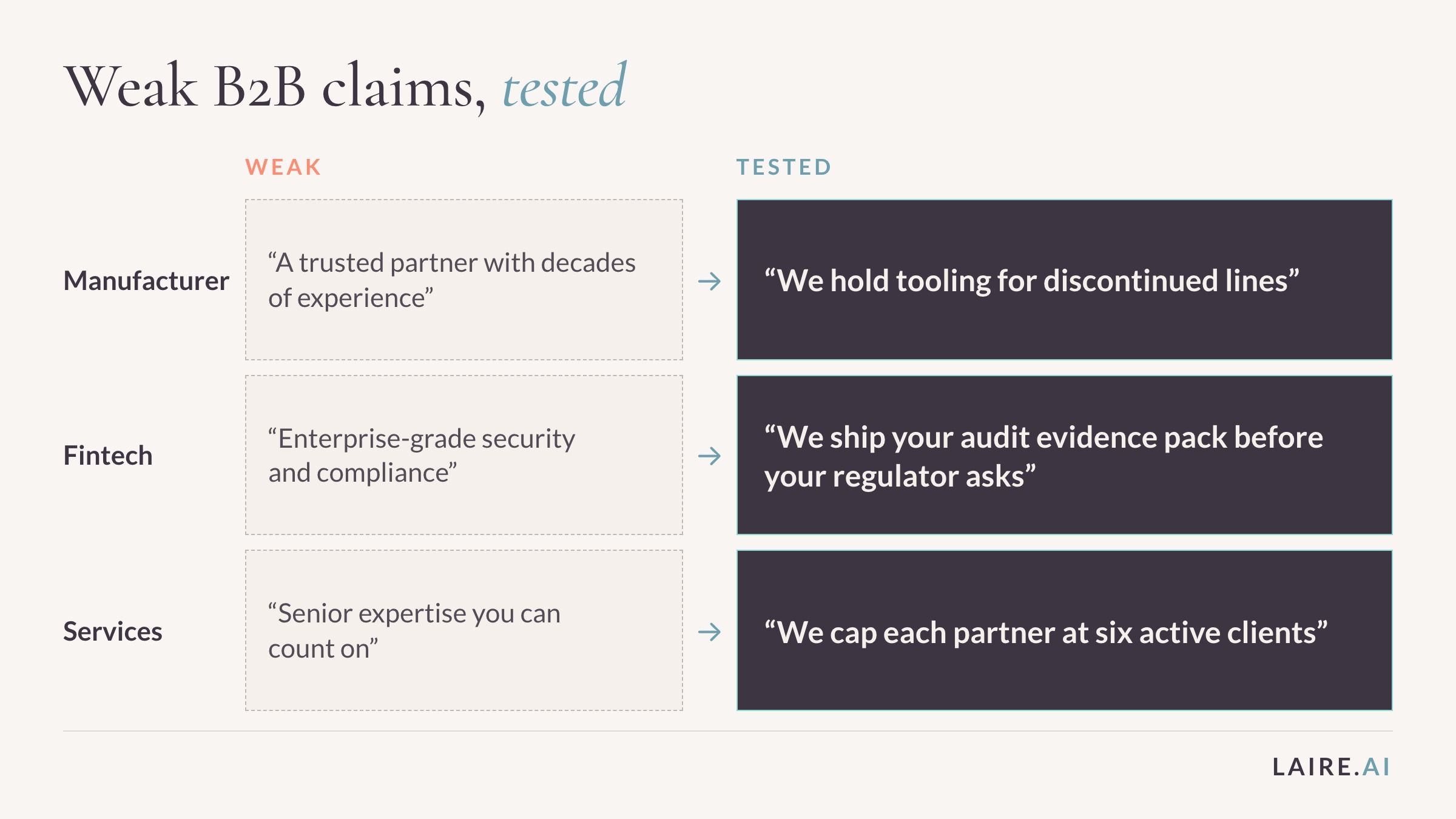
Industrial manufacturer. Weak: "a trusted partner with decades of experience." Tested: "We hold tooling for discontinued lines, so you can still get parts for equipment you bought in the nineties." A competitor who scrapped their old tooling can't copy that this quarter.
Fintech platform. Weak: "enterprise-grade security and compliance." Table stakes, though its absence would end the conversation. Tested: "Our compliance team ships your audit evidence pack before your regulator asks for it." The same strength, moved from a credential to an outcome a committee member owns.
Professional services firm. Weak: "senior expertise you can count on." Tested: "The partner who pitches you does the work, and we cap each partner at six active clients." The number makes it defensible.
Every tested version is narrower, more concrete, and slightly uncomfortable to commit to in public. That discomfort is a good sign. A claim nobody could object to is usually one nobody can distinguish either.
Four signs your Unique Selling Proposition needs work
These issues aren't always obvious. You might just notice that deals are taking longer to close than they should.
It's true, but your competitors can say the same thing
This is probably the most common mistake, and it's easy to miss. If your competitors can make the same claim about their business, it's not much of a differentiator. The best way to find out? Put your USP through the competitor test.
It only speaks to one person in the buying group
B2B buying decisions can involve up to 16 people across four different functions. If your USP only resonates with one of them, you risk losing their support when others get involved. Make sure your message addresses what matters to everyone influencing the decision.
You can't back it up with evidence
It's easy to claim you're faster, better, or more reliable. But what happens when a potential customer asks for proof? If you can't point to real results, customer stories, or specific examples, your claim loses credibility.
It focuses on your process instead of the buyer's results
Your internal processes might be different from your competitors', but that doesn't automatically make them valuable to buyers. Focus on what your approach actually helps customers achieve.
For example:
"We run a four-phase discovery process" tells buyers how you work.
"You'll know which three things to fix before you spend a dollar" tells them what they'll get.
Test it where buyers hear it
A USP that only exists in a brand document hasn't been tested. It has to work in three places.
Start with sales calls. Give it to your team for a month and listen. The signal you want isn't compliments; it's whether prospects ask a follow-up question. A claim that prompts "how does that work?" has landed, and a polite nod hasn't.
Then your homepage, above the fold, where it works without a person attached. Then your proposals, where it sits beside two competitors' documents and gets compared line by line.
Watch win and loss notes for the language buyers use back to you. When prospects repeat your claim in their own words, it's working. When your salespeople quietly stop saying it, that's a result too. From there, carry the claim across your brand archetype and the content mapped to the buyer's journey. That sequencing is why strategy comes before tactics.
What makes your business different?
Finding your USP takes more than a brainstorming session. You need to understand what your buyers value, what your competitors are claiming, and what you can genuinely prove. That's part of what we do in the LAIRE Marketing Action Plan (MAP). We work with you to identify your USP and brand remarkables, then use those insights to build a marketing strategy around what makes your business worth choosing. Find your competitive advantage
Frequently asked questions
What is a Unique Selling Proposition in simple terms?
It's the reason a buyer should choose you instead of the alternatives, stated as one specific claim. To qualify it has to pass three tests. Your buyer cares about it, a competitor can't honestly say it too, and you can prove it when asked. A claim missing any of the three is marketing copy rather than a USP.
What's the difference between a USP and a value proposition?
A value proposition explains what you do and what the buyer gets. A Unique Selling Proposition explains why they should pick you over two companies offering something similar. The value proposition gets you considered, and the USP breaks the tie. Most companies have a reasonable value proposition and a weak USP, because the second requires knowing your competitors well.
Can a business have more than one USP?
One per audience, at most. If you sell to genuinely different buyers, say a manufacturer selling to OEMs and to distributors, a different claim may matter to each. Within one buying group, more