Most B2B marketing teams have more blog post ideas than they can use. There’s always a question from sales, a webinar to recap, or a keyword with decent volume. The hard part is deciding which ones deserve a slot on the calendar. Pick badly and the post sits on your blog collecting single-digit views.
We learned how much topic clusters matter by auditing our own blog. In July 2024, we sorted 344 LAIRE posts into 80 topic groups and gave each post a recommendation. About a third of the posts were flagged to consolidate or unpublish. Meanwhile, 13 posts in a series on brand archetypes accounted for nearly a quarter of every view in the audit.
The archetype posts were written as a series around one overview post. Most of the underperformers were written one idea at a time over several years.
What topic clusters are and why they make ideas easier to pick
A topic cluster, sometimes called a content cluster, is a group of related pages built around one subject. A pillar page covers the subject broadly, and supporting posts each answer one specific question in depth. Every post links to the pillar and to its closest neighbors. Readers and search engines can then follow the whole topic from any page they land on.
That structure gives every new blog post idea a test to pass. An idea either answers a question your chosen cluster is missing, or it waits.
Content Marketing Institute traces the pillar-and-cluster model to HubSpot Research in 2017. The model has outlasted plenty of SEO fads.
Key takeaways on choosing blog post ideas with topic clusters
- A topic cluster is a pillar page plus supporting posts that each answer one distinct question, all linked together.
- Use clusters as a filter for blog post ideas. A strategic idea answers a question that’s missing from a cluster tied to something you sell.
- Related posts written over the years don’t add up to a cluster. In our audit, seven email posts written one at a time drew 127 views combined, while a 13-post series drew 12,522.
- Google asks whether your site has a primary purpose or focus, and its guidance warns against publishing lots of content on many topics or a page for every variation of a query.
- Before you write a new post, check whether an existing one should be updated or consolidated instead.
A 13-post series beat every one-off group in our blog audit
Our July 2024 audit grouped every post on the LAIRE blog by topic and compared performance. The series and the one-off groups performed very differently.
|
Topic group |
Posts |
How the posts came to exist |
Combined views |
Median views per post |
Audit recommendation |
|
Brand archetypes |
13 |
Written as a series: one overview and 12 deep dives |
12,522 |
829 |
All 13 kept as is |
|
Inbound marketing basics |
10 |
Written one at a time, 2016 to 2023 |
184 |
13 |
5 consolidate, 2 re-optimize, 3 keep |
|
Email marketing basics |
7 |
Written one at a time, 2021 to 2022 |
127 |
9 |
4 consolidate, 3 re-optimize |
|
Blogging |
5 |
Written one at a time, 2021 to 2022 |
107 |
9 |
2 consolidate, 2 re-optimize, 1 unpublish |
Views are the raw view counts in the HubSpot export behind our July 2024 audit of 344 posts, so they work best for comparing posts with each other
Demand probably explains part of the difference, and the audit didn’t measure search volume for these topics. We think structure explains much of the rest. Each archetype post had one job, which was to explain a single archetype and the brands that use it, and the whole series shared one overview post.
The email posts show the reverse. Four of them were broad tips articles covering much of the same ground, with titles like “4 Tips for Total Email Marketing Domination” and “What Not to Do with Email Marketing.” They overlapped, and none became the obvious answer to anything.
A competitor gap analysis in September 2026 showed the same pattern from the outside. On topics like HubSpot onboarding and sales enablement, we had between three and nine overlapping posts. The competitor pages earning traffic on those same topics were single, focused articles. More posts on a subject only help when each one has a separate job.
The archetype numbers measure reach, and reach says little about who is reading. A topic that draws students and other agencies can look healthy in analytics and contribute nothing to pipeline, so check the audience behind a winning cluster before you copy its playbook.
Google wants a focused site, not a page for every query
Google’s documentation doesn’t prescribe topic clusters by name, but several parts of its guidance point the same direction.
Google’s self-assessment for creating helpful, reliable, people-first content includes a simple question: “Does your site have a primary purpose or focus?” On the same page, Google lists a warning sign: publishing lots of content on many different topics in the hope that some of it performs. A cluster is a practical way to give your blog that focus.
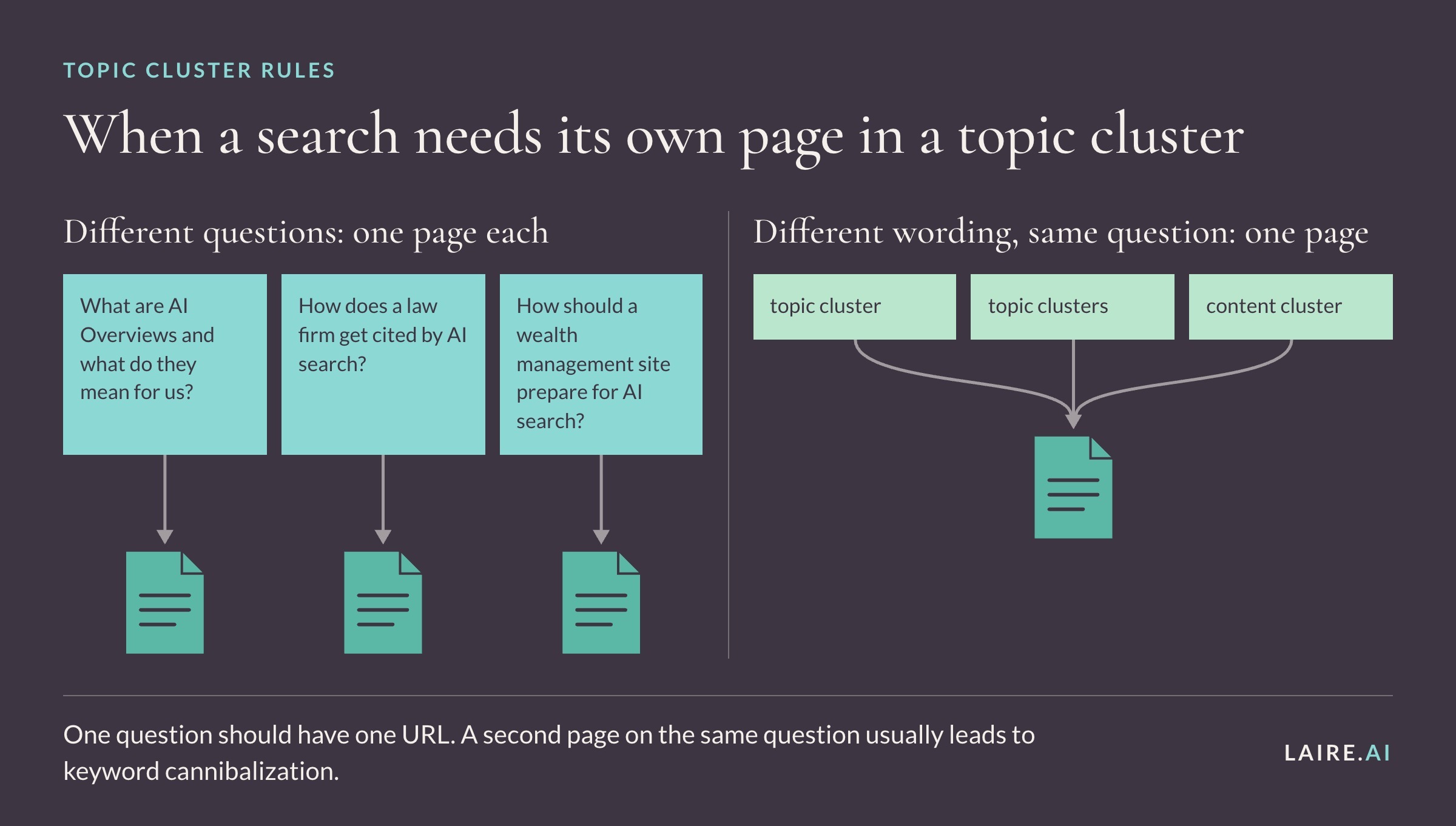
Google’s guide to optimizing for generative AI search adds a second guardrail. It says making separate pages for every variation of a query, mainly to manipulate rankings, falls under its scaled content abuse policy. In Google’s words, “a high quantity of pages doesn’t make a website higher quality or more relevant to users.” For clusters, that means one page per distinct question, however many keyword variants a tool can generate.
Two myths from older topic cluster advice are also worth retiring. You’ll still read that a pillar page should run 5,000 words or more. Older topic cluster advice also repeats two myths. Google’s helpful content page says it has no preferred word count. It also says adding or removing content mainly to make a site seem fresh won’t help rankings. Write the pillar as long as the topic needs, and publish when you have something worth adding.
How to choose the topic cluster you'll build first
Pick one cluster and finish it before you start another. A half-built cluster has many of the same problems as no cluster at all. If you’re still shaping the wider program, our B2B content marketing framework shows where clusters fit alongside conversion paths and measurement.
The strongest first clusters usually meet five conditions:
- It maps to something you sell, so every post has a natural next step for the reader.
- Your buyers already ask about it in sales calls, onboarding sessions, or RFPs.
- You have first-hand material to draw on, such as client results, your own process, or data nobody else has.
- There’s measurable demand, ideally from queries that already earn you impressions in Search Console.
- It’s narrow enough to cover well in a quarter or two with the team you have.
That fourth condition changed one of our own plans. When we planned new pages under our financial services marketing work, we wanted to start with wealth management, RIAs, and fintech. Search Console showed that banks, credit unions, and financial advisors were already generating far more impressions, so we changed the build order to follow that demand.
Impressions are a better early signal than clicks for this kind of decision. A page with near-zero click-through can still show you exactly which questions people associate with your site. If you’d like a refresher on choosing terms, our post on keyword research as the foundation of content marketing covers the basics.
Where to find blog post ideas for a topic cluster
Once you’ve picked a cluster, you need a list of candidate questions. The best lists combine what people search for with what buyers tell you directly.
|
Source |
What it tells you |
How to use it |
|
Search Console queries |
Questions people already connect with your site |
Look for queries earning impressions where no page is built to answer them |
|
Sales and customer calls |
The words buyers use and the objections that stall deals |
Keep a running list; a question you hear three times is a candidate post |
|
Keyword research tools |
Search volume, difficulty, and phrasing variations |
Validate demand and wording for ideas you already have |
|
People Also Ask and AI answers |
How Google and assistants break the topic into sub-questions |
Note the sub-questions that recur, and whether your site is cited for any of them |
|
Competitor gap analysis |
Topics competitors rank for that you don’t cover |
Keep gaps that fit your services and drop the ones that would only bring traffic |
|
Your own data and client work |
What only your team can say |
Turn findings into posts a competitor can’t copy |
AI search makes sub-questions matter more. Google describes a technique called query fan-out, where its AI features run several relaAI search makes sub-questions matter more. A well-built cluster looks a lot like that set of related searches, with one strong page per distinct question.
Be selective with competitor gaps. In that same September analysis, the single highest-traffic page for one competitor was a roundup of keyword rank tracking tools. We left that topic alone. It brings them traffic, but it doesn’t speak to the buyers we serve. Our guide to conducting a competitor audit walks through the rest of that process.
A 4-question filter for strategic blog post ideas
Run this filter on every candidate idea before it reaches the editorial calendar. It takes a few minutes per idea.
- Does it belong to a cluster we’ve chosen to build? If the honest answer is “sort of,” park it.
- Is there evidence someone wants it? Impressions, search volume, or a question sales keeps hearing all count. A hunch doesn’t.
- Is it a distinct question, or does one of our pages already answer it? One question should have one URL. A second page on the same question usually leads to keyword cannibalization.
- Can we add something nobody else can? That might be first-hand data, a client example, or an opinion we’ll defend. If not, the post will read like every other result on the page.
Google draws the same line in its AI search guide. It contrasts a summary that restates what’s already available with a first-hand account based on personal experience. The fourth question is where most generic blog post ideas fall out.
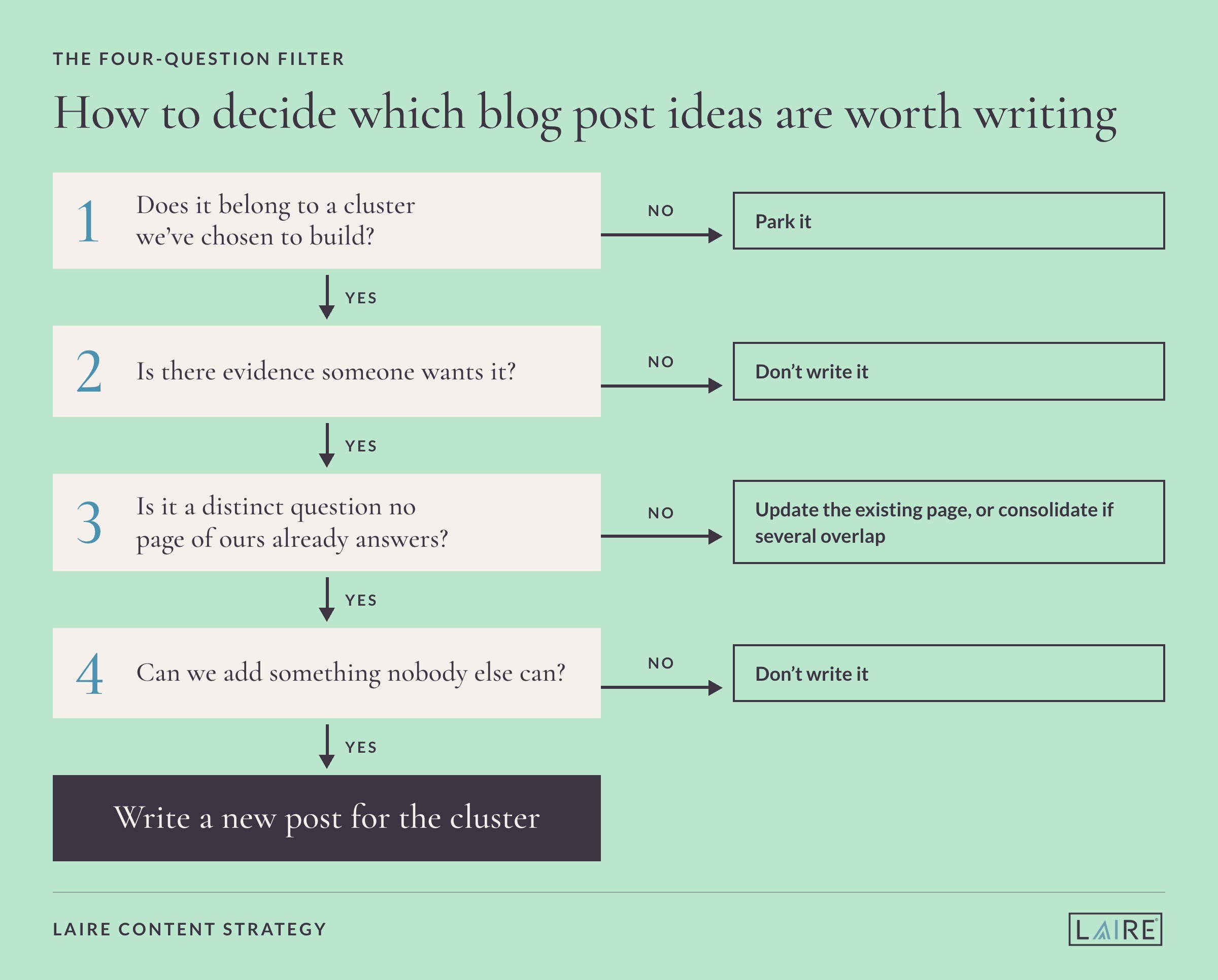
The answers point to one of four decisions:
|
What the filter shows |
Decision |
|
Yes to all four questions |
Write a new post for the cluster |
|
An existing page already answers the question |
Update and re-optimize that page instead |
|
Several pages answer the same question |
Consolidate them into one page and redirect the rest |
|
No cluster fit and no evidence of demand |
Don’t write it |
Our own audits sort existing posts into similar buckets, with keep and unpublish in place of write and skip. The May 2025 audit reviewed 287 posts. It recommended re-optimizing 132 of them and consolidating 59, compared with 73 to keep as they were.
The filter applied to four real ideas
Four topics from our September 2026 competitor gap analysis show how the filter works in practice. Search volumes and keyword difficulty are US Semrush figures from that analysis.
|
Idea |
Fits a cluster we’re building? |
Evidence of demand |
Distinct from our existing pages? |
Decision |
|
HubSpot vs Marketo comparison |
Yes, HubSpot platform |
880 searches a month, KD 32 |
Yes, we have no page on it |
Write a new post |
|
What is HubSpot |
Yes, HubSpot platform |
12,100 searches a month, KD 56 |
No, our post on what HubSpot is already answers it |
Re-optimize the existing post |
|
What is sales enablement |
Yes, sales enablement |
6,600 searches a month, KD 50 |
No, nine of our posts overlap on it |
Consolidate into one page |
|
Best keyword rank trackers |
No, our buyers don’t shop for SEO tools |
5,400 searches a month, KD 59 |
Not reached |
Don’t write it |
Only one of the four earned a new post. The rank tracker topic has six times the search volume of the idea that passed, and it still failed the first question.
Map each blog post idea to one question and one funnel stage
After the filter, each surviving idea gets a row in a cluster map. The map keeps two posts from drifting onto the same question months later, when nobody remembers the original plan.
For each post, record:
- The one question it answers, written the way a buyer would ask it
- The primary keyword, plus a few related phrases
- The funnel stage and the persona it’s written for
- The pillar page it links to and the neighboring posts it links to
- Its status: planned, drafted, published, or due for review
We’re building one of these maps now for AI search. In fall 2026, we noticed six posts on our blog that touched AI search, and none of them defined answer engine optimization. The cluster had plenty of supporting posts and no parent page. We wrote a guide to answer engine optimization to be the pillar, then gave every existing post a single job.
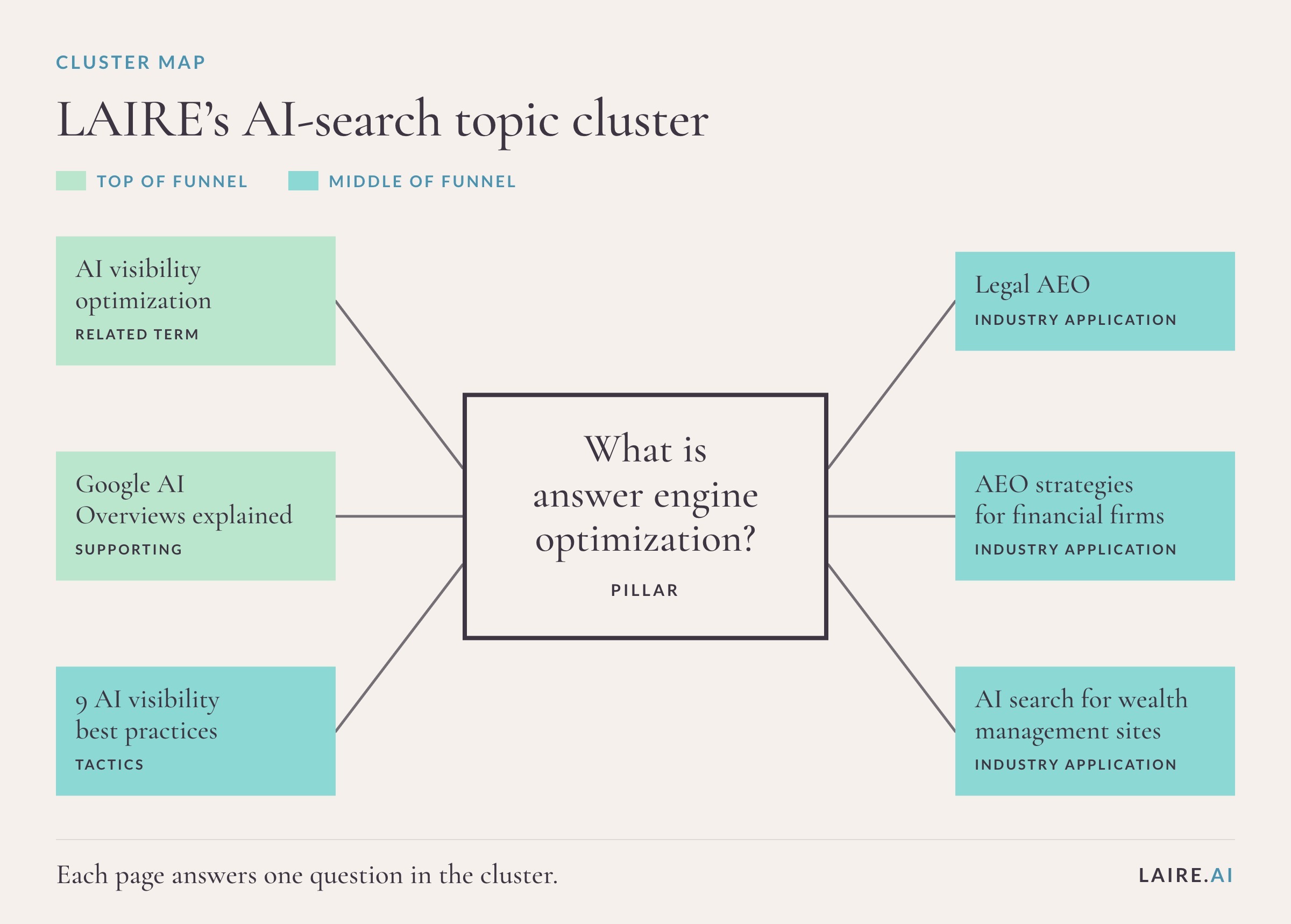
|
Page |
The one question it answers |
Funnel stage |
Role in the cluster |
|
What is AEO, and is it different from SEO? |
Top |
Pillar |
|
|
What is AI visibility optimization, and how does it relate to SEO? |
Top |
Related term (AIVO and GEO) |
|
|
How do we improve our brand’s visibility in AI search? |
Middle |
Tactics |
|
|
What are AI Overviews and what do they mean for us? |
Top |
Supporting |
|
|
How does a law firm get cited by AI search? |
Middle |
Industry application |
|
|
How does a financial firm become the featured answer? |
Middle |
Industry application |
|
|
How should a wealth management site prepare for AI search? |
Middle |
Industry application |
The cluster covers more than one stage of the buyer’s journey. Top-of-funnel posts attract the reader, and the industry posts give a specific buyer a reason to keep going.
How to link a topic cluster so it holds together
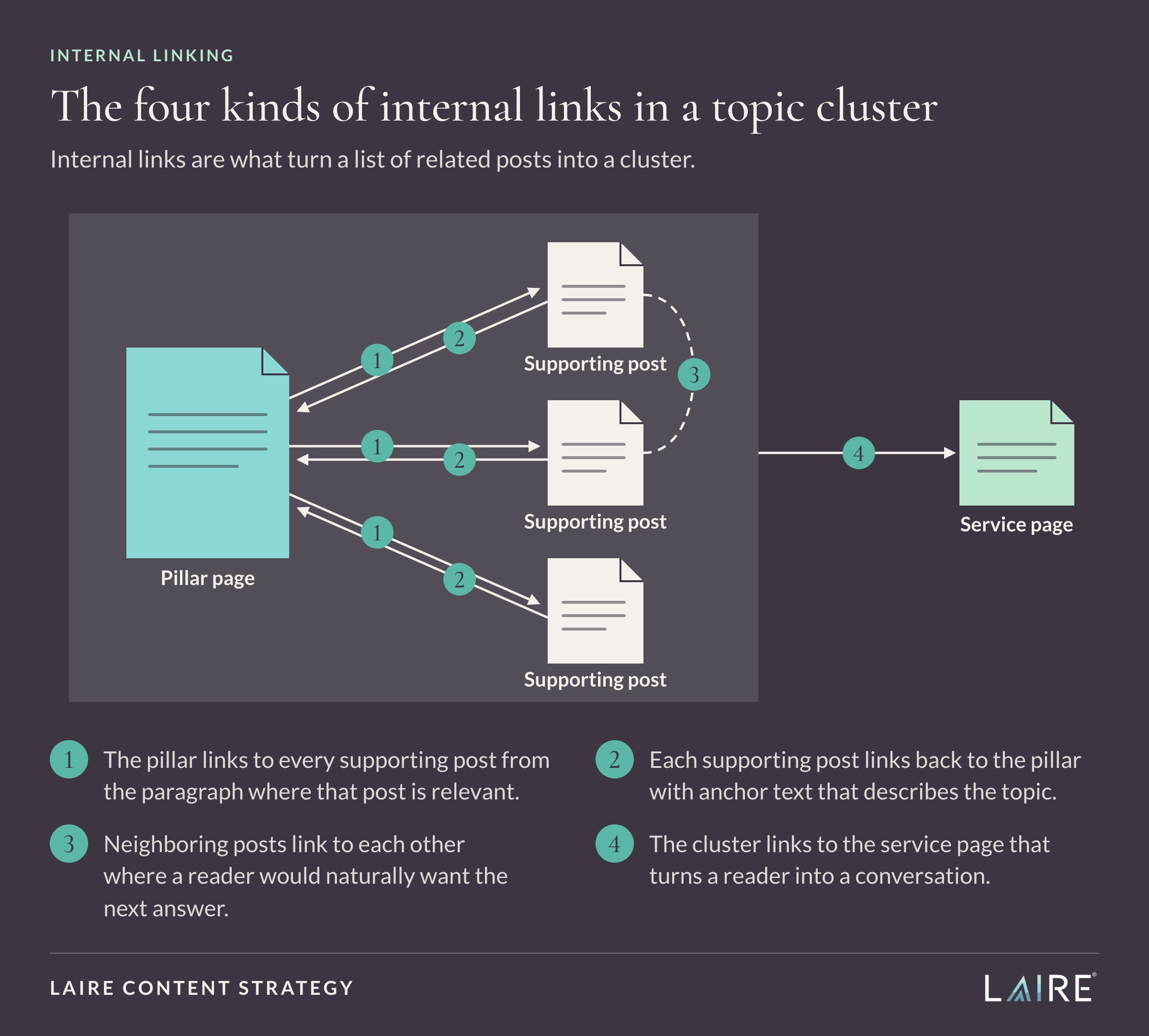
Internal links are what turn a list of related posts into a cluster. Google’s link best practices recommend that every page you care about be linked from at least one other page on your site. The same guidance asks for descriptive anchor text and says there’s no ideal number of links per page.
In practice, a cluster needs four kinds of links:
- The pillar links to every supporting post from the paragraph where that post is relevant.
- Each supporting post links back to the pillar with anchor text that describes the topic.
- Neighboring posts link to each other where a reader would naturally want the next answer.
- The cluster links to the service page that turns a reader into a conversation.
Under-linked posts are easy to miss. In our latest crawl of lairedigital.com, the median blog post had ten internal links pointing to it, and six posts had two or fewer. One of those six was our own post on planning six months of blog content, with exactly two internal links.
Site structure matters here too. If you’re rethinking how your blog and service pages relate, our guide to content hierarchy is a good companion to this one.
Keep your clusters current with regular re-optimization
A cluster needs upkeep after the last post goes live. Facts change, rankings shift, and new questions show up in your Search Console data.
We audit our blog regularly, and every page gets one of four decisions: keep it, re-optimize it, consolidate it, or unpublish and redirect it. Re-optimizing follows our ROPS process, which updates an existing post against current search data. When a page no longer serves anyone, our guide to when to no-index content covers the cleanup.
The review is also where new blog post ideas come from. Queries that start earning impressions against a cluster are often the next question your audience wants answered.
How to build your first topic cluster in 7 steps
Use this sequence to build a working cluster, starting with a blank calendar. For the writing side of each post, our blogging playbook picks up where this leaves off.
|
Step |
What to do |
What you’ll have at the end |
|
1. Pick one cluster |
Choose a topic tied to a service, with real buyer questions and existing impressions |
One pillar topic |
|
2. Inventory what you have |
List every existing post on the topic with its views and the question it answers |
A cluster inventory |
|
3. Gather questions |
Pull from Search Console, sales calls, People Also Ask, AI answers, and competitor gaps |
A candidate idea list |
|
4. Filter each idea |
Run the four questions on every candidate |
A write, update, consolidate, or skip decision per idea |
|
5. Map the cluster |
Assign one question, keyword, funnel stage, and persona to each post |
A cluster map |
|
6. Build and link |
Publish the pillar and supporting posts, and link them in both directions |
A connected cluster |
|
7. Review on a schedule |
Keep, re-optimize, consolidate, or unpublish each page |
A cluster that stays current |
Start your next topic cluster with an audit of your existing posts
The most strategic blog post ideas usually come from what you’ve already published and what your buyers already ask. An audit shows you which clusters are working, which posts are competing with each other, and which questions your content hasn’t answered yet.
If you’d like a second set of eyes, our content marketing team can review your existing library and Search Console data with you, then help plan, write, and maintain the topic clusters most likely to bring in the buyers you want. lp plan, write, and maintain clusters built around your buyers' questions.
If you’d rather work through the planning yourself first, our free Content Marketing Workbook helps you build around your buyers' questions.
Frequently asked questions about topic clusters
How many blog posts should a topic cluster have?
There’s no fixed number. Let the count of distinct buyer questions decide. Our brand archetype cluster has 13 posts because the subject has an overview and 12 archetypes. A narrow service topic might need five, and a broad one might need twenty.
What is an example of a topic cluster?
Our brand archetypes content is one. A single overview post, “What’s Your Brand Personality? 12 Brand Archetypes Explained,” covers the subject broadly. Twelve supporting posts each explain one archetype, such as the Sage or the Magician. Together they drew nearly a quarter of all views in our July 2024 blog audit.
Does a pillar page need to be 5,000 words?
No. Size the pillar to the breadth of the topic. It needs enough depth to answer the main question and enough structure to point readers to each supporting post.
What’s the difference between a topic cluster, a content hub, and a content silo?
The terms overlap heavily. Content hub usually describes the pillar page acting as a directory for the cluster. Content silo is an older term that often implied keeping links strictly inside one topic, while topic clusters encourage linking to closely related topics where it helps the reader.
Do topic clusters still matter for AI search?
Yes. Google says its AI features are built on its core ranking systems and break a question into related searches. A cluster that answers those related questions with distinct, well-linked pages gives those systems more to work with. Creating a page for every phrasing variant works against you.
How often should you publish new posts in a topic cluster?
Publish when you have a distinct question worth answering. Steady, useful additions beat a fixed quota. Update existing posts when their facts or rankings change.
Should you write the pillar page or the supporting posts first?
Either can work. If you already have several posts on a topic, write the pillar to connect them, which is what we did with our AI search content. If you’re starting from nothing, a pillar first gives every later post a clear place to link.
Blog audit figures come from a LAIRE July 2024 audit (344 posts) and May 2025 audit (287 posts), both built on HubSpot blog exports. Search volumes come from our September 2026 Semrush competitor gap analysis. Internal link counts come from our most recent crawl of lairedigital.com.